guides
How to Evaluate AI 3D Asset Generation Tools Before You Pay
A documentation-based guide to buying a 3D generator only if the mesh can enter a pipeline. Tencent Hunyuan 3D is a generator (web platform plus a Cloud API with dated CNY credit billing). NVIDIA Omniverse is an OpenUSD platform, not a consumer text-to-3D peer. Web-app prices were not listed and are not verified.
A generated 3D file is useful only if it can enter a real pipeline: a format your tools can open, topology you can remesh or UV, rights you can use, and a place in the process after the first mesh appears. “Text to 3D” is not the same purchase as a simulation or OpenUSD platform, and it is not a replacement for a DCC such as Maya. Paying for a generator and then discovering you still need a full DCC or a USD review environment is a scope error, not a feature miss.
This documentation-based guide was reviewed on November 23, 2026 (Asia/Shanghai). We did not generate meshes, inspect topology, rig a character, or connect a USD stage. No mesh-quality score or production-readiness claim is made. Descriptions come from official product and documentation pages opened that day. Consumer-site pricing for the Hunyuan 3D web app was not listed on the official marketing page retrieved here, and is not verified.
Separate generation, platform, and DCC work
Tencent Hunyuan 3D is a 3D generation product. Tencent publishes both a web creation platform and a Tencent Cloud API service. Those two surfaces share a model family, but they are not automatically the same commercial contract.
NVIDIA Omniverse is a different job. NVIDIA’s official Omniverse page describes a platform to design, develop, and deploy AI-powered 3D apps, with OpenUSD as a core technology, libraries for industrial digital twins and simulation, and “3D Content Generation” listed as a use case: “Automate content with generative AI and digital twins.” That use-case label does not turn Omniverse into a consumer text-to-3D app you buy the way you would buy a web generator. Treat it as a platform and OpenUSD environment that may surround generated assets.
A DCC such as Maya remains the place where many teams remesh, UV, rig, shade, and approve a hero asset. Maya is not in the AINav related-tools list for this article and is not treated as an AI generator competitor. Flux and other 2D image models are also not 3D competitors, even when they appear near 3D tools in a directory.
If your bottleneck is “we need a first mesh from a prompt or a reference image,” start with a generator and write down the export formats and topology you must accept. If your bottleneck is “we need a USD-based review, simulation, or digital-twin environment,” start with a platform such as Omniverse. If your bottleneck is “we need production topology and a rigger’s sign-off,” budget for DCC work after generation, not instead of it.
Hunyuan 3D: a web creation platform and a Cloud API
The official web product at 3d.hunyuan.tencent.com describes itself, in site metadata retrieved on November 23, 2026, as a one-stop 3D content AI creation platform based on Tencent Hunyuan 3D Generate Large Model 2.5. The English Open Graph description states that it supports “text-based 3D, image-based 3D, 3D animation generation, and texture generation.” The Chinese meta description also mentions sketch-to-3D, 3D character generation, and a low-polygon advantage. The page is a JavaScript application; those statements come from official metadata on the live site, not from a logged-in session. Public plan prices were not listed on that marketing page, so consumer-web pricing is not verified. Service and privacy terms, and any “for reference only” language, should be re-read on the live site at sign-in rather than inferred from a directory page.
The API surface is documented separately on Tencent Cloud. The official product overview, last updated June 10, 2026, describes Tencent HY 3D as an API service that creates 3D models from text or 2D images, with uses including 3D printing, home furnishings, and product design. It distinguishes a Professional edition, which can use Hunyuan 3D 3.0 and 3.1 models and supports text, image, multi-view, untextured geometry, sketch, and smart topology generation (3.1 is described as adding quality improvements and eight-view input), from a Rapid edition that “can shorten model generation time to within 1 minute 30 seconds.” Additional APIs include smart topology, texture generation, component generation, UV unwrapping, 3D character generation, format conversion, and text-to-motion. That is a pipeline-shaped API list, not a promise that every mesh is production-ready.
Buyers should also read the migration notice on the same Cloud docs: Tencent states that related Hunyuan model functions will gradually move to TokenHub, after which the original platform will not add new model capabilities and will stop supporting new purchases of model services. Already purchased services can continue for now. If you are opening a new API subscription, confirm on the current Cloud or TokenHub page where new purchases are supposed to go. Do not assume the product-1804 console will remain the place to buy new capacity.
Cloud billing is documented; web-app pricing is not
Tencent Cloud’s billing overview, last updated July 24, 2026, describes credit-based billing for Professional and Rapid generation and for add-on APIs. First-time activation can include a one-time free credit pack of 100 credits per user, valid for one year, which must be claimed in the console. Prepaid credit packs are listed in CNY, including 1,000 credits for 100 yuan and larger packs at slightly lower per-credit prices, each valid for one year from purchase, with unused credits expiring. Postpaid billing is listed at 0.12 yuan per credit, settled daily. Official examples in that document include a Professional default of 20 credits for a normal textured text- or image-to-3D job, 25 credits for LowPoly, and 15 credits for untextured geometry, with optional add-on costs for multi-view and other parameters. Failed tasks, including failures caused by content-risk policies, are documented as not consuming credits. Default concurrency is 3 for the Professional interface and 1 for the Rapid and add-on interfaces, unless a concurrency pack is purchased.
Those figures are date-stamped official Cloud prices in CNY. They are not a quote for every region, reseller, or the consumer web app, and they may change as TokenHub migration proceeds. The official default is that free or prepaid packs do not automatically switch to postpaid when they expire or run out; you must enable postpaid in the console. The later example is a calculation after that setting is on, not an automatic switch. Confirm the console setting rather than guessing. Do not use these Cloud numbers as the price of 3d.hunyuan.tencent.com.
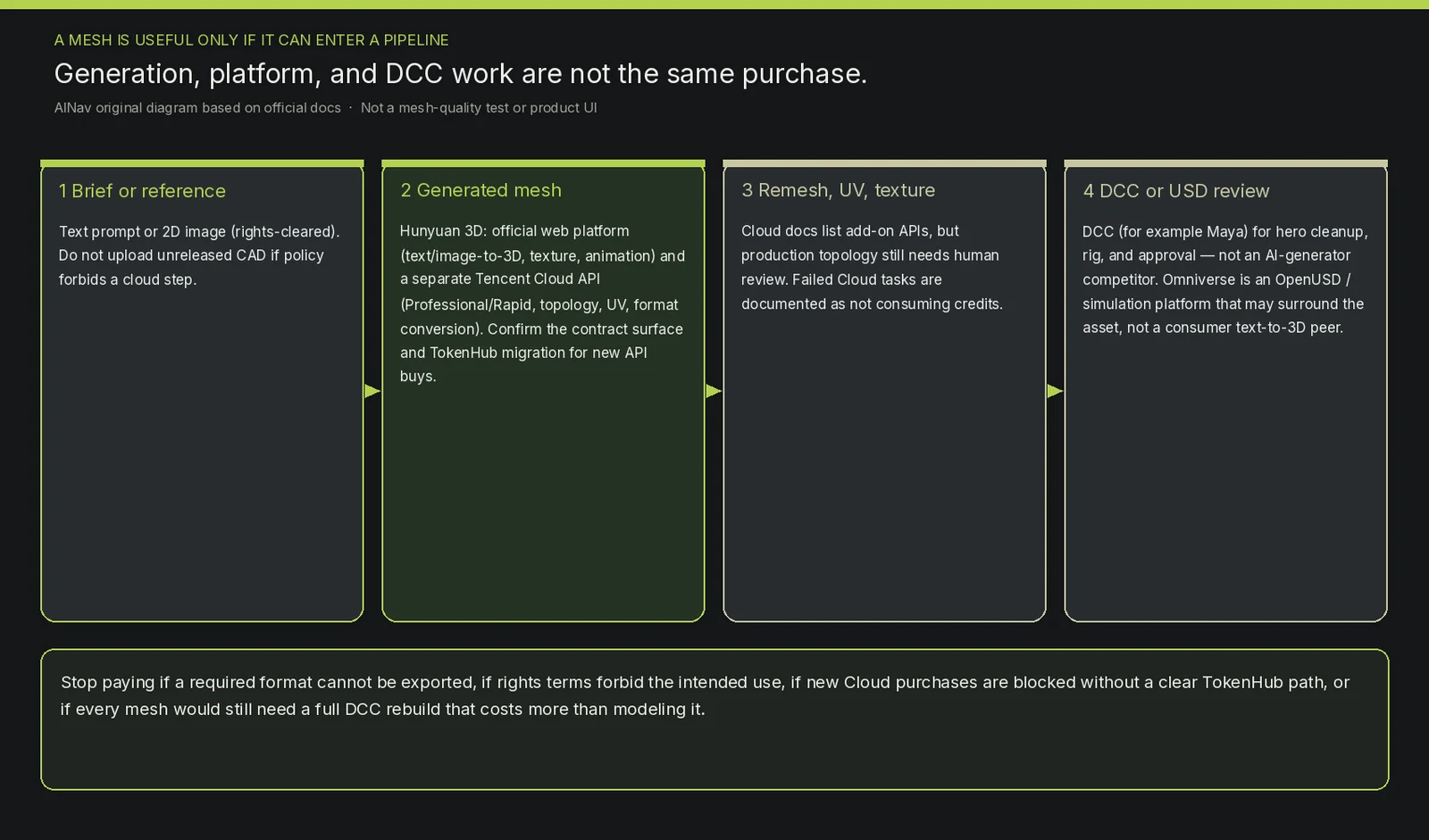
AINav original diagram based on official docs. Sources: Hunyuan 3D site, Tencent Cloud overview, Tencent Cloud billing, NVIDIA Omniverse. Not an official screenshot or a mesh-quality test.
Omniverse is the surrounding platform, not a second generator
NVIDIA documents Omniverse around Physical AI, OpenUSD, libraries, and simulation or digital-twin use cases. “3D Content Generation” appears as one official use case on the same product family, not as evidence that Omniverse is sold as a drop-in alternative to Hunyuan’s text- or image-to-3D API. If your team already works in USD, or needs a shared review and simulation environment, Omniverse may be the platform into which a generated asset is imported. That is an architecture decision. It does not answer whether a Hunyuan mesh has usable topology.
Omniverse pricing, edition entitlements, and licensing were not independently verified for this article. The official documentation site at docs.nvidia.com was reachable on November 23, 2026, and presents Omniverse as libraries, SDKs, and APIs for physical AI and OpenUSD work; it is not used here as a price list. Ask NVIDIA for the current product and licensing path, and do not invent a seat or credit price here.
A paying check that starts with export, not a pretty preview
Use only rights-cleared reference images and fictional product briefs. Do not upload unreleased product CAD or client-confidential scans to a web generator if policy forbids it.
- Surface and contract. Decide whether you need the Hunyuan web creation platform, the Tencent Cloud API, or both. Confirm where new API purchases are made after the TokenHub notice. Do not mix Cloud credit packs with an assumed web-app subscription.
- Export and topology. Write the formats your DCC or game engine must receive, and whether you need UVs, PBR maps, low-poly, or untextured geometry. Tencent Cloud documents distinct job types and add-on APIs for topology, UV, texture, and format conversion. Ask for a sample export of each required type. This review did not inspect those files.
- Rights and review. Read the live terms for both the web platform and, if used, Cloud. Treat AI-generated meshes as material that still needs human review for legal, safety, and brand use. “For reference only” language, if still present at sign-in, is a reason to keep a human approval step.
- Pipeline fit. If the asset must enter USD review or simulation, evaluate Omniverse or your existing USD tool as a platform step, not as a second generator. Budget DCC cleanup if your art direction requires it. Stop paying if you cannot export a required format, if new Cloud purchases are blocked by the migration and no TokenHub path is clear, if rights terms forbid your intended use, or if every mesh would still need a full rebuild that costs more than modeling it in a DCC.
Who should pay, and who should wait
This evaluation is for game, product-visualization, and spatial teams that need a first 3D asset from text or images and must know, before paying, whether that asset can enter a pipeline. It is also for teams shown Omniverse and a text-to-3D web app in the same meeting who need to keep those jobs apart.
It is not for 2D image-generation buyers, and it is not a Maya replacement guide. It is not a ranking of mesh beauty, printability, or real-time performance, or for organizations that cannot accept a cloud generation step or cannot assign a person to review topology and rights.
Frequently asked questions
Is NVIDIA Omniverse a text-to-3D competitor to Hunyuan? Not on the official pages reviewed here. Omniverse is documented as a 3D and OpenUSD platform, with 3D content generation as a use case, not as a consumer web generator in the same class.
Can I quote a Hunyuan web-app price from this article? No. The official marketing page retrieved for 3d.hunyuan.tencent.com did not list plans. Cloud API credit packs and per-job credit costs are documented in the July 24, 2026 billing overview and should be re-checked, especially given the TokenHub migration notice.
Does a failed generation still cost credits on Tencent Cloud? The billing overview says failed tasks do not consume credits, including failures caused by content-risk policies.
Will Cloud automatically start postpaid billing when credits run out? No, not by default. Postpaid applies only after you enable it in the console. Check that setting.