guides
How to Evaluate AI Contract Lifecycle Tools Before You Pilot
A documentation-based CLM guide with a deliberately thin core: Icertis only, organized as Engage, Operate, and Analyze, with humans still governing agents. Legal research and document intake are boundaries, not extra competitors. No customer contracts were loaded and this is not legal advice.
Legal research answers “what does the law say.” Contract lifecycle management answers a different question: can this organization draft, negotiate, store, and then live with the obligations in its own agreements? Mixing those jobs produces a familiar stall—a research assistant that cannot run a repository, or a CLM demo that is asked to replace a citator.
This documentation-based guide was reviewed on November 10, 2026 (Asia/Shanghai). We did not load customer contracts, run a redline, or score clause extraction. Descriptions come from official Icertis product pages opened that day. Accuracy, cycle-time, or risk-reduction figures are not claimed or tested. This is not legal advice and not a substitute for counsel.
Stay on the contract lifecycle, and keep the core set small
The catalog for this job is thin on purpose. The only related tool in this evaluation is Icertis. Adjacent products that search case law, or that capture documents at the intake door, are boundaries, not additional CLM platforms added to fill a table.
Icertis’ official AI-Native Contract Intelligence Platform page organizes the work the way a legal-ops pilot should: Engage, Operate, and Analyze, with Vera as the contract AI, under the heading “Agents execute + humans govern.” That last phrase is the evaluation standard. If a pilot cannot show where a human approves a draft, a redline, or an obligation change, the agents are not ready for production matter files.
On the same official page:
- Engage is the pre-signature side. Vera Engage is described as an AI-native experience for drafting, redlining, and playbook creation, with named agents for composing, playbook creation, risk review, and redlining. Official language says agents apply playbooks, flag risk, and enforce legal standards for legal, sales, and procurement teams working at speed.
- Operate is the system of record and the post-signature work. Icertis Contract Management is described as the platform for the contract lifecycle, workflows, and reporting. Vera Obligations is described as audit-ready obligation discovery and tracking, with a fulfillment agent. Vera Copilot is listed for natural-language search and execution.
- Analyze is portfolio intelligence: Vera Analytics Standard for contract risk and insights, and Advanced for decision support and risk exposure, plus a path to bring contract intelligence into a broader data ecosystem.
Vera Foundation is described as the underlying architecture—data lake, agentic platform, knowledge graph, embeddings, precompute, a multi-model gateway, and security—available in public or private cloud, with enterprise integrations and agent interoperability. Official marketing on the same page states that Icertis is trusted by one-third of the Fortune 100 and is deeply embedded with SAP, Microsoft, and Salesforce, including an SAP solution-extension relationship that connects contracts to SAP Ariba. Those adoption and partnership statements are vendor claims, not an AINav customer survey.
Access is by demo. The official pages reviewed here do not publish a generally applicable price list. Do not treat a directory figure as Icertis’ price, and do not invent clause-extraction accuracy to make a business case look quantitative.
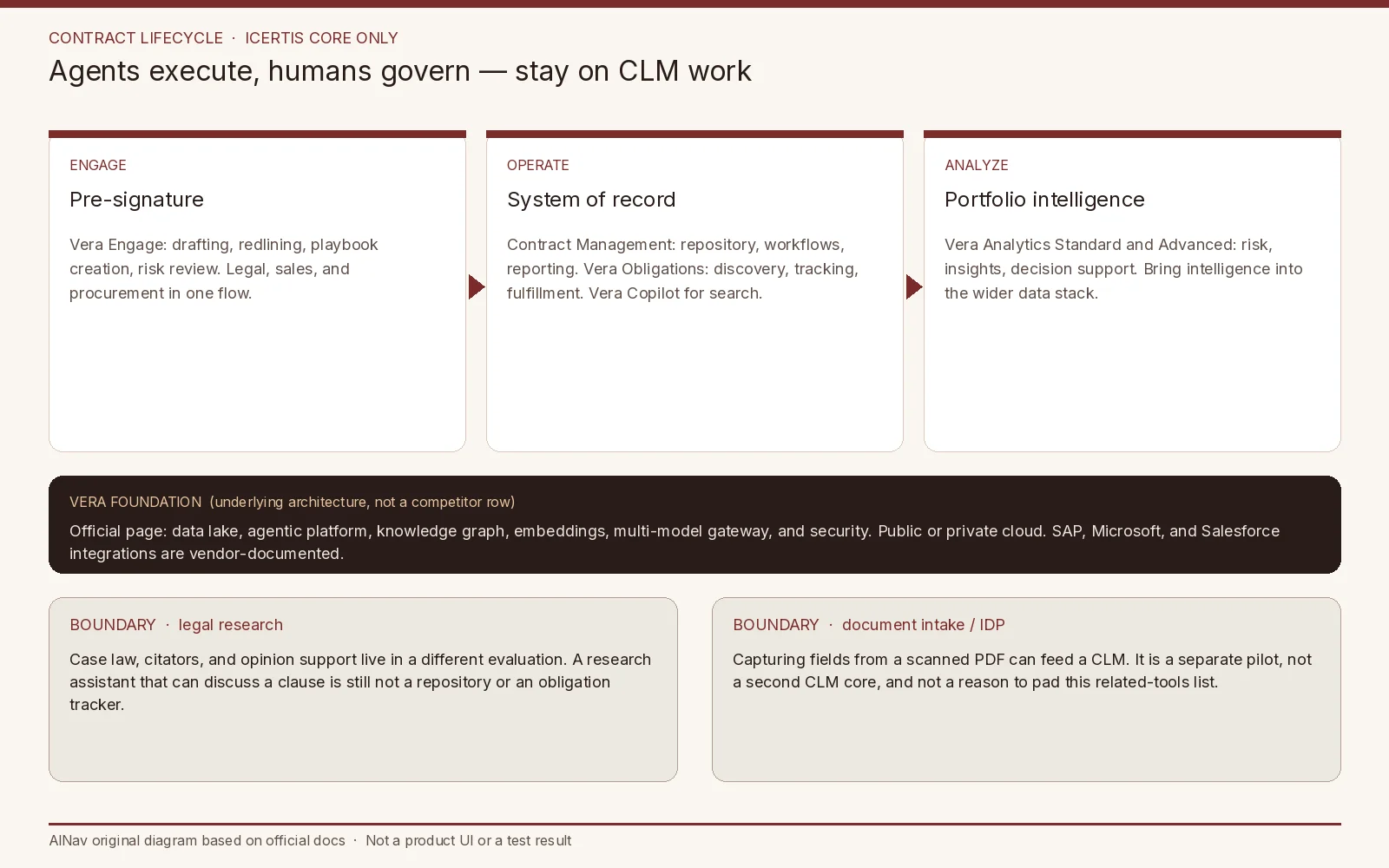
AINav original diagram based on official docs. Sources: Icertis platform, Icertis homepage. Not an official screenshot or a test result.
Name the neighboring jobs so they do not sneak into the pilot
Legal research belongs in a different article. If the need is authority, citators, or opinion-letter support, use a research assistant and start with How to Evaluate AI Legal Research Assistants Before You Buy. A tool in that class may answer questions about a clause; that does not make it a contract repository, an obligation tracker, or a playbook-driven negotiation workspace.
Document intake is another boundary. Intelligent document processing can extract fields from a scanned PDF and hand a structured record to a CLM. That is useful, and it is not the same purchase as Icertis. This guide will not stretch a short CLM core by reviewing intake vendors in depth, and it will not link unpublished intake evaluations. If intake quality is your actual bottleneck, treat that as a separate pilot with its own data-handling review.
A competent CLM pilot can still fail if those boundaries are ignored: research answers pasted into a contract with no playbook, or extracted fields loaded into the repository with no obligation owner.
A pilot checklist that does not require production agreements
Use redacted or fictional contracts, or a small set your counsel has already cleared for a vendor sandbox. Then check five things:
- Lifecycle coverage. Walk one agreement from intake through draft and redline (Engage), into the repository and workflow (Operate), onto an obligation the business must track, and into a portfolio question in Analyze. If a stage is “coming later” or lives only in a slide, write that down.
- Human governance. Official language is “Agents execute + humans govern,” and Automate-style changes are not the Icertis story—approval is. Confirm who can accept a redline, who can close an obligation, and whether the audit trail will satisfy your records policy.
- Playbooks and standards. Engage is sold on playbook creation and enforcement. Bring one real playbook, even a short one, and see whether the official workflow can apply it, or whether the demo only chat-summarizes the paper.
- Systems of record. If Salesforce, SAP, or Microsoft is a hard requirement, ask to see the current official integration—not a roadmap talking point. The SAP Ariba relationship is documented by Icertis as a solution extension; confirm the footprint that applies to your landscape.
- Security and commercial terms. Use the official Icertis Trust Center and the current data-processing terms in a demo cycle. This review opened the product pages first-hand; it did not independently inventory every certification on the Trust Center. Do not assume a public price or a self-serve plan exists.
Stop the pilot if the product cannot hold the executed agreement as a system of record, if obligations cannot be assigned and evidenced, if agents can change a draft without a recorded approver, or if security and training-use questions cannot be answered from current official terms.
Who this pilot is for, and who should look elsewhere
This evaluation is for legal operations, a general counsel’s office, and procurement contracting leads who need a controlled lifecycle for their own contracts, not a faster way to read case law.
It is not for individual practitioners who only need research, for teams whose real gap is scanning and classifying inbound PDFs, or for anyone expecting a public rate card and a weekend self-serve rollout. Icertis, on the pages reviewed here, is an enterprise, demo-led platform.
Frequently asked questions
Why is only Icertis in the related-tools list? Because this article is a CLM evaluation, not a tour of every tool that can touch a contract. A thin, accurate core is better than a padded competitor table.
Can a legal-research assistant replace a CLM? Not on the job defined here. Research tools check authority; they are not, in this guide, the system that drafts against a playbook, stores the executed record, and tracks obligations. See the legal-research evaluation linked above.
Does Icertis publish pricing? Not on the official pages opened for this review. Access is offered through a demo or sales conversation.
Is this legal advice? No. Official product language about risk, playbooks, or audit-ready obligations does not replace counsel, your records policy, or a negotiated contract with the vendor.