guides
How to Evaluate AI Document Automation and IDP Platforms Before You Pilot
A documentation-based guide to piloting intelligent document processing: ingest, classify, extract, send exceptions to a human, then write back to a system of record. PDF question-answering and a contract repository are different jobs. Vendor accuracy percentages were not tested.
Intelligent document processing is a production system, not a chat window over a PDF. A typical official path is: ingest documents, classify them, extract fields, send exceptions to a human, then write validated data into a system of record. Teams that skip the review step, or that buy a PDF assistant and expect it to post invoices to an ERP, usually discover the gap after a pilot has already started.
This documentation-based guide was reviewed on November 10, 2026 (Asia/Shanghai). We did not process customer documents, measure extraction accuracy, or run a bake-off. Descriptions come from official ABBYY Vantage, Instabase, and Tungsten TotalAgility product pages opened that day. Accuracy percentages, time-saved figures, and analyst-positioning language are vendor or customer-story claims, not AINav tests.
The IDP path, and two jobs it is not
The flow above is a sequence, and a platform should document each stage: capture (email, scan, upload, or API), classification, extraction and validation, human-in-the-loop review, and a connector or API into ERP, BPM, or RPA. That is the core set here: ABBYY Vantage, Instabase, and Tungsten TotalAgility.
Two other purchases sit beside that path, not after it. Asking questions of a stored PDF is a document assistant job, already covered in how to evaluate AI PDF and document assistants. FineReader, PDFelement, and Acrobat stay in that boundary. A negotiated-contract repository or contract-lifecycle system is another job again: it stores and manages agreements, it does not replace invoice or claims extraction. Those three categories are alternatives, not steps.
Cloud extraction APIs—Amazon Textract, Azure AI Document Intelligence, Google Document AI, OCI Document Understanding—are a class you wire yourself. They can be the right engineering choice, but they are not treated here as a fourth packaged IDP vendor, and this article does not invent their limits or prices.
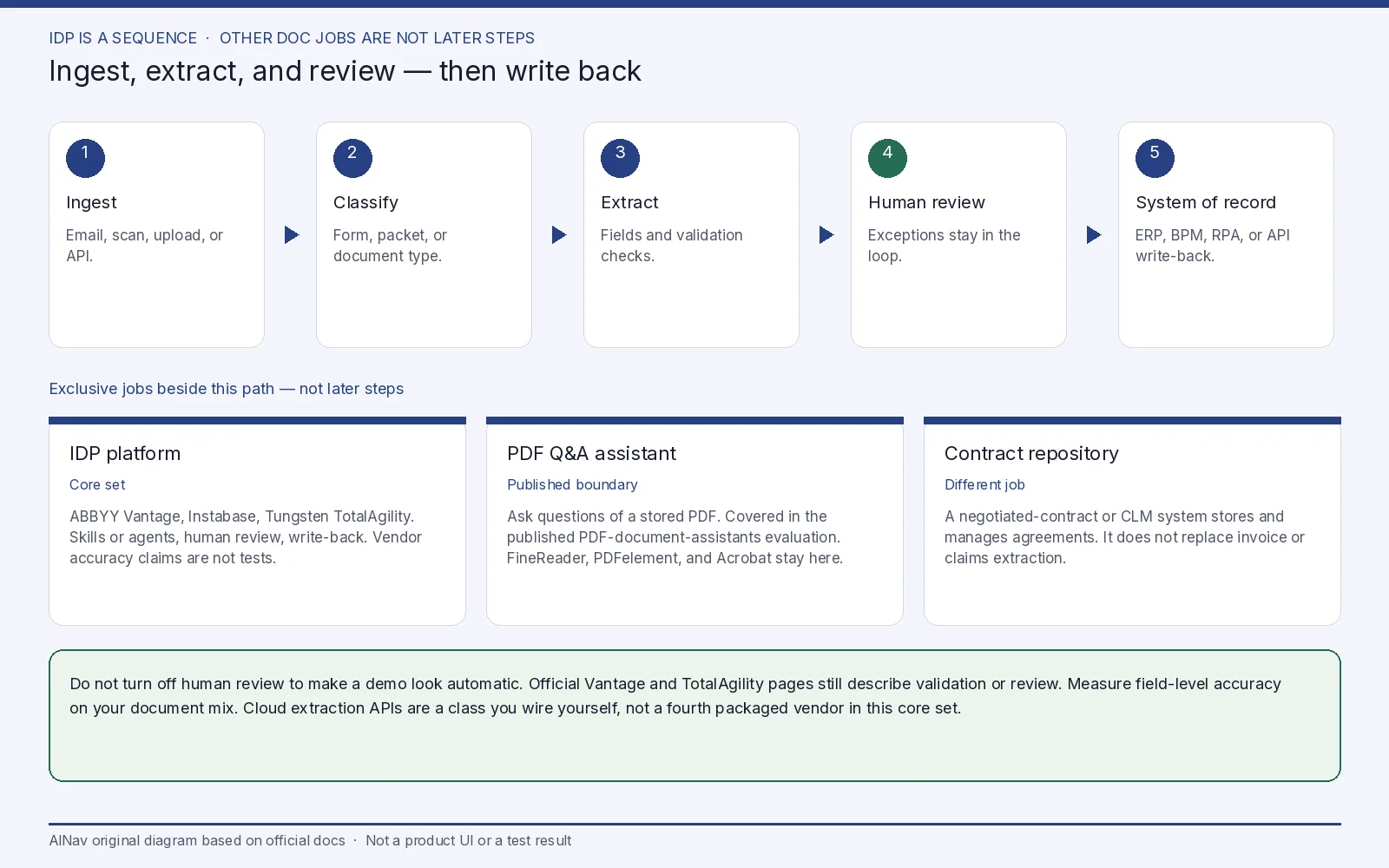
AINav original diagram based on official docs. Sources: ABBYY Vantage, Instabase, Tungsten TotalAgility. Not an official screenshot or a test result.
ABBYY Vantage: skills, review, and a place to write results back
ABBYY’s official Vantage page describes a low-code or no-code intelligent document processing platform. Pre-trained skills, a Marketplace, and a skill designer cover structured, semi-structured, and unstructured documents. Official language is explicit that IDP is not OCR alone and is not RPA alone: OCR recognizes characters, IDP is meant to understand and act, and RPA or BPM is a downstream consumer of the result.
Human review is part of the official design, not an optional afterthought. The page describes a human-in-the-loop review interface and continuous learning from those reviews. Write-back is documented through RPA, BPM, and ERP connectors plus a REST API. Deployment is cloud-first: official text says SOC 2-certified ABBYY Cloud is available in Europe, the USA, or Australia, with on-premises or private Azure options also offered. There is no public list price on the pages opened for this review; access is arranged through ABBYY.
ABBYY markets “90% accuracy at the start” and customer-story figures. Leave those as vendor claims. Your pilot should measure field-level accuracy and exception rate on your document mix, with a human still in the loop.
Instabase: packets, agents, and where the files live
Instabase’s official homepage presents an “Agentic Automation Platform” for turning complex document packets into “verifiable, auditable intelligence.” Official language emphasizes packet-aware agents (a mortgage or claims file is often many documents, not one form), multi-model optimization, and Deep Document Understanding. Data-control language on the same site includes connecting your own cloud storage rather than only uploading into a vendor silo, plus an enterprise security program.
Use those claims as questions, not as scores. In a pilot, ask how a multi-document packet is classified and extracted together, how a reviewer sees lineage, and whether storage stays in your cloud. Public list prices were not on the homepage opened for this review and are not listed here.
Tungsten TotalAgility: extract, validate, then orchestrate
Tungsten Automation’s official TotalAgility page describes a platform that ingests, classifies, extracts, and validates, then orchestrates people, processes, and AI agents around that result. Deployment is documented as public cloud, private cloud, or on-premises. A Marketplace of pre-built solutions is part of the official pitch. Access is through a demo or sales conversation, not a published self-serve price list.
Analyst-quadrant and “time saved” customer quotes on that page are marketing, not measurements from this review. The buying question is whether validation and orchestration are first-class in the product you will actually run, and whether a human can still stop a bad extraction before it posts.
A pilot check that never starts on live customer files
Use a rights-cleared sample set that resembles production: invoices, claims, onboarding packs, or whatever your process actually receives. Redact or synthesize anything you cannot put in a vendor cloud. Then check six things:
- Document mix. Structured forms, messy scans, and multi-document packets fail in different ways. A single clean invoice is not a pilot.
- The full path. Ingest, classify, extract, review, write-back. If any stage is a spreadsheet export you will “fix later,” you do not yet have IDP.
- Human review. Official platforms in this set document review. Define who sees exceptions, what they can change, and how those corrections feed later runs. Do not turn off review to make a demo look automatic.
- System of record. Confirm the connector or API into the ERP, BPM, or case system you already use, including how failures are retried.
- Deployment and data residency. ABBYY documents regional cloud and on-prem or private Azure options. Tungsten documents public, private, or on-prem. Instabase documents connecting your own storage. Match that to your policy before you send a real file.
- Commercial path. None of the three official pages opened here published a simple list price. Budget through a named SKU, volume, and deployment option from the vendor, not a guess.
Stop the pilot, or at least stop going live, if extraction quality is only a vendor percentage, if there is no reviewer of record, if write-back is undefined, or if the problem you actually had was “ask this PDF a question.”
Who this purchase is for, and who should look elsewhere
This evaluation is for operations, finance, insurance, and shared-services teams that need structured data from recurring document types, with exceptions reviewed by a person before anything is posted.
It is not for teams that mainly need a PDF Q&A assistant, a contract-lifecycle repository, or a raw cloud OCR API they already plan to wrap themselves. It is also not a promise of a particular accuracy rate.
Frequently asked questions
Is IDP just better OCR? Official ABBYY language says no: OCR is a component; IDP is meant to classify, extract, validate, and hand work to downstream systems, with people in the loop.
Why not bake off every cloud document API? Those APIs are a real option if you have engineering to own the workflow. This article evaluates packaged IDP platforms that already document review and write-back.
Can we skip human review after a “90%” claim? Not on the evidence in this review. That figure is a vendor claim. Official Vantage and TotalAgility pages still describe validation and review.
Where should a contract repository sit? Beside this purchase, not as the next box in the IDP flow. Use a contract system when the job is managing negotiated agreements, not when the job is posting invoice fields.