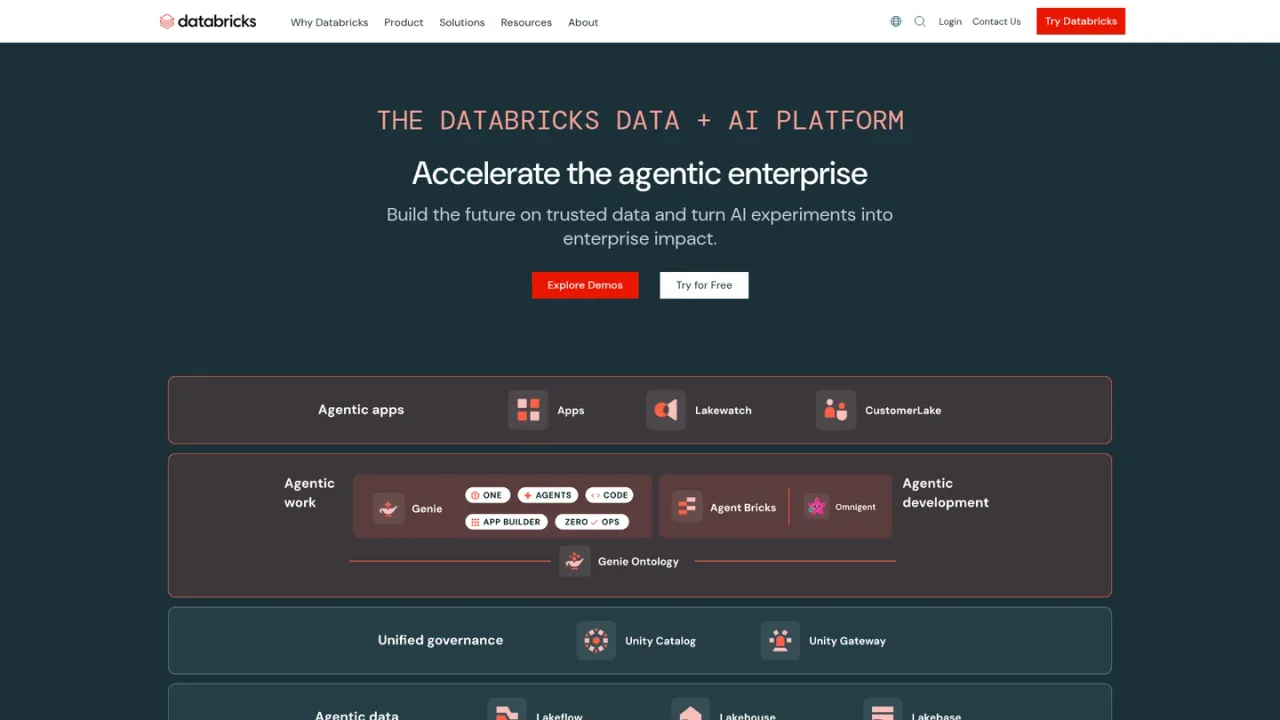
Databricks is a unified Data + AI platform that brings data engineering, analytics, machine learning and generative AI into one collaborative workspace built on Apache Spark and lakehouse architecture. Teams can ingest and transform batch or streaming data, run SQL analytics and business intelligence, train and serve models, and build, evaluate and govern AI agents. Unity Catalog provides consistent permissions, lineage and auditing across data and AI assets, while open formats such as Delta Lake and Apache Iceberg keep data portable. It serves both technical users and business users, including natural-language querying through Genie. Access options include a free trial with no credit card required, a free edition for learning, and pay-as-you-go usage-based pricing.
How to use Databricks
1
Start a free trial
Sign up for Databricks through the official trial page; no credit card is required, and you can invite collaborators during or after the trial.
2
Ingest and prepare data
Use automated workflows and built-in connectors to ingest data from a variety of sources and prepare it for analytics or AI workloads.
3
Run analytics and build models
Query data with SQL for BI reporting, or use interactive compute for data science and machine learning workloads.
4
Build and govern AI agents
Develop agents with Agent Bricks using any model or framework, then evaluate, deploy and govern them with Unity Catalog and Unity Gateway.
5
Ask questions in natural language
Use Genie to ask questions in natural language and get trusted, governed answers from your data.
Databricks Features
Unified workspace for data engineering, data science and machine learning on Apache Spark
Lakehouse architecture combining data lake flexibility with data warehouse reliability via Delta Lake
SQL analytics and business intelligence for reporting and visualization
Build, evaluate, deploy and govern AI agents with Agent Bricks
Unity Catalog for consistent permissions, lineage and auditing across data and AI assets
Unity Gateway to control access, spend and observability across agents, tools and models
Genie natural-language assistance for code, analytics and enterprise knowledge
Open formats including Delta Lake and Apache Iceberg for data portability
Serverless Postgres (Lakebase) for apps and AI agents
Available across AWS, Azure and Google Cloud
Databricks Use Cases
Big data analytics and data lake management
Building and orchestrating batch and streaming data pipelines
Running SQL queries for BI reporting and dashboards
Training, serving and deploying machine learning models
Building and governing production AI agents
Asking natural-language questions and getting governed answers from enterprise data
Developing real-time transactional applications with serverless Postgres
Consolidating separate data, analytics and AI tools into one platform
Databricks FAQs
It is a unified platform for data, analytics and AI that combines data engineering, data science and machine learning in one collaborative environment built on Apache Spark, letting teams clean and process data, train models and deploy analytics at scale.
It serves both business and technical users across data and AI teams. Business users get guided insights, automated workflows and natural-language agent creation, while technical users get help writing code, building apps and handling engineering operations.
You can start a free trial with no credit card required, which gives instant access to the platform, automated data workflows, app and agent building, and natural-language data querying.
Databricks uses a pay-as-you-go approach with no up-front costs, charging only for the products you use at per-second granularity. Committed use contracts offer discounts and benefits for higher usage commitments.
Lakehouse architecture combines the flexibility of a data lake with the reliability of a data warehouse. Delta Lake enforces data quality rules, supports ACID transactions and offers time travel to query data as it existed at a prior point.
Agent Bricks offers multi-harness development so teams can build agents with any model or framework, then evaluate, deploy and optimize them. Unity Catalog manages permissions, lineage and auditing, while Unity Gateway governs access, spend and observability.
With open formats like Delta Lake and Apache Iceberg, data is portable and can be queried from Databricks, Spark or Trino without moving it. Unity Catalog acts as an open governance layer across data and AI assets.
Databricks is available on AWS, Azure and Google Cloud. Pricing for Azure Databricks is set by Microsoft and provided for reference.
Databricks uses pay-as-you-go, usage-based pricing measured in DBUs (or CUs for Lakebase), billed per second with no up-front costs. Committed use contracts offer discounts for higher usage commitments. Azure Databricks pricing is set by Microsoft. A free trial is available with no credit card required; if configured with your own cloud account, your cloud provider still charges for resources used during the trial.
Free Trial
$0USD / trial period
Free access to the Databricks Data + AI Platform without a credit card, intended for evaluating the platform and building initial workflows.
No credit card required
Instant access to the Data + AI Platform
Ingest and prepare data with automated workflows
Build apps and agents
Invite colleagues or collaborators
Pay as you go
$0.07USD / per DBU
Usage-based billing with no up-front costs; you pay only for the products you use, billed at per-second granularity. The starting price shown is the lowest advertised starting rate across product categories.
No up-front costs
Billed per second
Data Engineering starting at $0.15 / DBU
Data Warehousing starting at $0.22 / DBU
Artificial Intelligence starting at $0.07 / DBU
Committed Use Contract
Commit to certain levels of usage in exchange for discounts and other benefits; larger commitments yield greater benefits, with options to flexibly use commitments across multiple clouds.