growth
BILL AI: know which plan includes the Invoice Coding and W-9 agents, and don’t confuse them with BILL Assistant
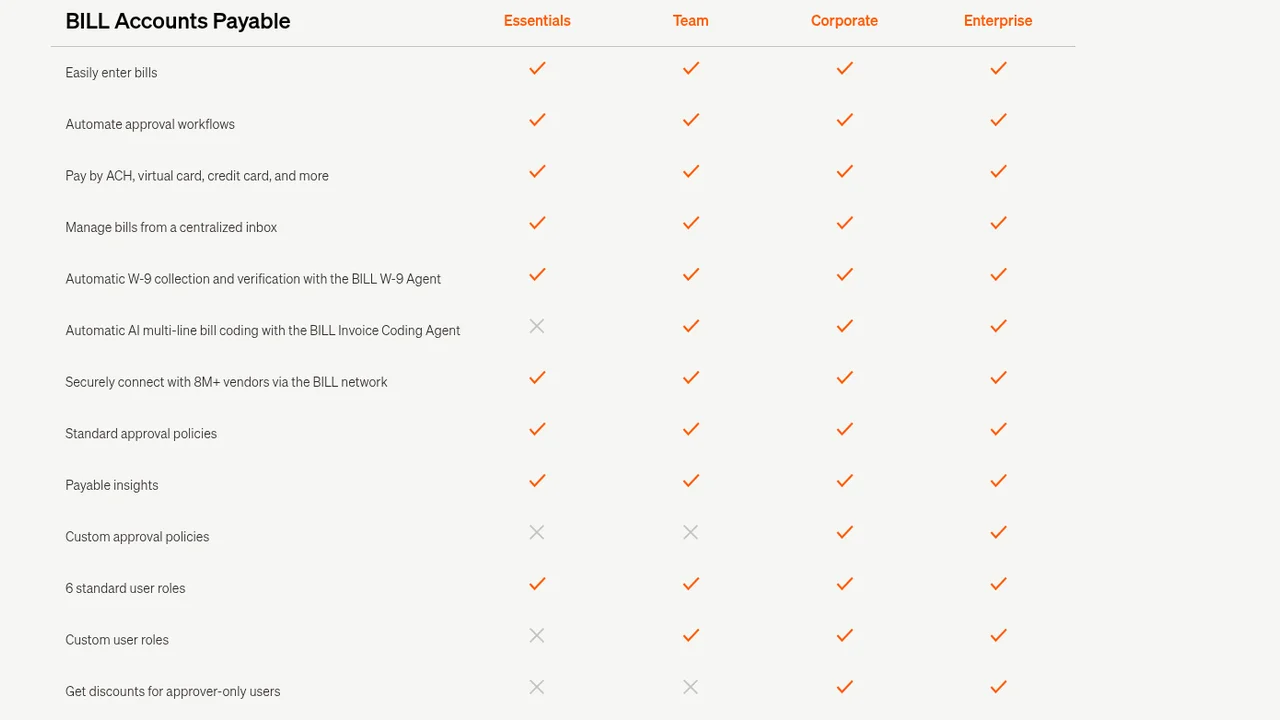
On the public pricing table checked 29 November 2026, the W-9 Agent was included on all four plans, and the Invoice Coding Agent was not included on Essentials. BILL Assistant is a separate surface; its official help article did not render today, so availability is not guessed.
BILL AI is easy to describe as one “AI in BILL” layer. Official pages do not treat it that way. Invoice coding, W-9 collection, unusual-amount flags, AI governance, and MCP access are listed as separate capabilities. BILL Assistant is a different product surface again: it does not appear as a row in the plan comparison table, and the official help article for it did not render for us today.
The official product page AI in BILL and the public pricing page Pricing & Plans were reviewed on November 29, 2026 (Asia/Shanghai). We also tried to open the official help article Meet BILL Assistant (and the help.bill.com equivalent). Both returned a Salesforce shell with a CSS Error, and support.bill.com for the same article ID returned HTTP 403. We did not sign in to a BILL account, run the Invoice Coding Agent, or collect a W-9. This article is about plan gates in accounts payable automation. It is not a financial-planning buyer’s guide; if that is the job, see How to Evaluate AI Financial Planning Assistants Before You Pilot.
Cover source: BILL’s official pricing page Pricing & Plans, captured November 29, 2026 (Asia/Shanghai). The cover is a screenshot of the official “BILL Accounts Payable” comparison table, including the W-9 Agent and Invoice Coding Agent rows and the Essentials / Team / Corporate / Enterprise column headers. The table is official page content; it sits in a section that is hidden until Compare All Plans is expanded, and this still is that official table, not a test account. No cell values were rewritten. Underlying vendor copyright is retained; no blanket reuse licence was established.
Invoice coding, W-9 collection, and Assistant are not the same feature
The official product page splits the AI capabilities rather than offering a single switch.
It describes invoice automation that reads incoming invoices, extracts key fields, and codes multi-line bills. In a separate section, W-9 automation is described as contacting vendors to collect and enter W-9s. Elsewhere on the same page, BILL says the product can flag unusual bill amounts during approval, and that you can toggle AI capabilities on or off and view an audit log of AI actions. A further item describes bringing BILL data into an external LLM workflow through a manual MCP connection.
Those are adjacent features. They are not one entitlement.
BILL Assistant is not listed as a row in the public plan comparison table we opened today, which is one reason to keep it distinct from the Invoice Coding Agent and the W-9 Agent. The official help URL for Assistant still exists, but as noted above, it did not render a readable article body on November 29, 2026. Because we could not read that live page, this article does not state where Assistant is available — including whether it is in Spend & Expense, in mobile apps, or only in some desktop surfaces — and it does not repeat earlier “near future” wording as a current fact.
What the comparison table included today
On November 29, 2026 (Asia/Shanghai), the public pricing page listed four direct AP & AR plans: Essentials, Team, Corporate, and Enterprise. List prices shown on the plan cards were $49, $65, and $89 per user per month for the first three, with Enterprise as Custom. Those figures are what the page showed that day. They are not evergreen. Recheck the live table before you buy or change a plan.
The official comparison table, in the Accounts Payable section, showed:
- Automatic W-9 collection and verification with the BILL W-9 Agent: Included on Essentials, Team, Corporate, and Enterprise.
- Automatic AI multi-line bill coding with the BILL Invoice Coding Agent: Not included on Essentials; Included from Team through Enterprise.
- Approval workflows: included on all four plans in that table.
The Essentials plan card we saw did not list the Invoice Coding Agent among its features; the Team and Corporate cards did. That matches the comparison-table row. The product-page FAQ also says availability and pricing for W-9 automation “depend on your BILL plan and package,” and tells you to confirm with your account team or BILL support. Even a row marked Included should be confirmed against the package you actually bought.
Plan cards and the comparison table did not use the same vendor-network figure: some cards said “+4M” vendors, while the comparison table said “8M+.” This article does not pick one number and treat it as a specification.
Marketing accuracy and time-saved figures are BILL’s claims, dated
The product and pricing pages include several performance claims. They are BILL self-descriptions, with footnotes, from the pages as they stood on November 29, 2026. They are not our measurements, and they are not written here as product specifications.
Examples from those pages today:
- The pricing hero uses “Spend 34% less time on AP,” with a footnote to a January 2026 BILL survey comparing 1,423 customers and 452 non-customers on reported AP activity hours.
- “10 hrs/week saved on average by BILL customers” is footnoted as a BILL survey conducted in January 2026.
- Invoice-field extraction is described as “approximately 99% accurate under tested conditions,” with a note that results vary by invoice layout and data quality and that your team keeps final review and control. The methodology footnote refers to BILL’s analysis of the top 20% of common bills, assuming document layouts and user behaviors stay consistent.
- W-9 automation is described on the product page as collecting and entering W-9s “with 95+ accuracy.” That wording is BILL’s. A nearby page footnote numbered 2 describes data based on one year of invoices for key extraction fields (invoice date, invoice number, and amount) where the field was contained in the invoice. That is invoice-field language, and this article does not treat it as a verified W-9 test method.
- BILL also estimates that AI “eliminates more than 80% of the steps in a typical collection and validation process,” based on BILL’s analysis of a typical 12-step W-9 collection process.
Use those statements as dated vendor claims. Do not paste them into an internal business case as independent results.
Official copy still keeps a person in the review path
The same product page is explicit about human review, which is the operational point of this article.
On invoice coding, official text says you review, edit, or undo the suggestions before finalizing the bill. On W-9 automation, it says the agent can contact vendors, follow up, collect and organize forms, validate names and taxpayer identification numbers, flag mismatches, and update vendor information — and that your team still reviews and approves the final information. Unusual-amount flags are described as appearing during the approval process, not as a posted payment.
Treat coding suggestions, collected W-9 data, and flagged amounts as inputs for your existing approval policy. Payment and posting decisions stay with the people who already own them. Because we could not read the live Assistant help article, we also do not treat any Assistant answer as an approved payment, a posted transaction, or a substitute for that review.
What we did not test
We did not log in, code a live bill, collect a vendor W-9, or open an AI audit log. Plan inclusion and list prices are what the public pricing table showed on November 29, 2026 (Asia/Shanghai). The official Assistant help article did not render, so Assistant availability is left as a gap rather than a guess. Recheck the live pricing table, your contract package, and, when the help article is readable, the official Assistant documentation before you assume a plan includes a given agent — and before you let any of these outputs stand in for an approved payment.