guides
How to Evaluate AI Dubbing and Audio Translation Tools Before You Publish
A documentation-based guide that keeps subtitles, dubbing, speech-to-text, and text translation in separate jobs. ElevenLabs, HeyGen, and Murf are reviewed as spoken-soundtrack products; Speechmatics is adjacent ASR. Official consent and commercial-rights rules are part of the purchase. Lip-sync and cost claims were not tested.
A localization team can buy “AI translation for video” and receive four different deliverables: an on-screen subtitle file, a spoken dubbed soundtrack, a raw transcript from speech recognition, or a written translation of a script. Those outputs are not interchangeable, they do not carry the same voice rights, and a tool that is excellent at one of them can still be the wrong purchase for the others.
This documentation-based guide was reviewed on November 10, 2026 (Asia/Shanghai). We did not upload talent recordings, clone a voice, publish a dubbed video, or score lip-sync or translation quality. Descriptions come from official product, help, and terms pages opened that day. Vendor claims about quality, cost, or time saved are quoted as vendor claims, not as AINav results. This is not legal advice, and not a guide to bypassing consent rules.
Name the deliverable before you compare vendors
Subtitles are timed text. They can be burned in or delivered as a caption file. They do not replace the original voice. If that is the job, start with a subtitle-translation evaluation such as How to Evaluate AI Subtitle Translation Tools Before You Pay, not with a dubbing studio.
Dubbing, in the sense used here, is a spoken translated soundtrack—often intended to preserve a speaker’s identity, timing, or emotional tone, and sometimes accompanied by lip-sync on camera. That is a different artifact, a different review process, and a different rights problem.
Automatic speech recognition (ASR), or speech-to-text, turns audio into a transcript or captions. It is a common upstream step for both subtitles and dubs. It is not itself a dubbed track.
Text machine translation is what you use on a document or a script. For written translation tools, see How to Evaluate AI Translation Tools Before You Subscribe.
Creator text-to-speech tools overlap because some of the same vendors sell both. Voice-cloning and license questions already appear in ElevenLabs vs Murf vs Speechify for creator voiceovers. This article stays on the localization deliverable: can you publish a translated soundtrack, and did you have the right to use that voice?
Dubbing products, and an ASR tool that is not in the same class
ElevenLabs documents an official Dubbing capability: it translates audio and video across more than 90 languages while aiming to preserve emotion, timing, tone, and each detected speaker, and it retains original background audio. Automatic Dubbing on the v2 Alpha model is the current app default; Dubbing Studio is tied to the v1 model and is described as in maintenance mode. Official facts a producer should not skip: dubbed video is “a high-quality preview, not a production master,” commonly at 1080p, with mono or at most stereo audio, so production work should replace the audio on the original video; free-tier dubs are watermarked and paid-tier dubs are not; realtime or live dubbing is not currently available. The ElevenCreative Terms, last updated October 9, 2026, add a commercial boundary on Dubbing v2: unless a written order says otherwise, v2 output must not be used for feature films, television programs or series, streaming or VOD programming, theatrical releases, or other professional audiovisual entertainment productions. User-generated posts on platforms such as YouTube, TikTok, or Instagram, and paid advertising placements (not programming), are described as exceptions. Confirm the current exhibit before you promise a broadcaster a v2-only pipeline.
HeyGen official Video Translator pages describe translating videos into “175+ languages” with AI voices, lip-sync, and subtitles, including voice cloning of the original speaker, a multilingual player, a brand glossary, and a free plan of up to three videos a month, each up to three minutes. The same pages claim “perfect lip-sync,” an “80% reduction in video translation costs,” and customer time savings. Those figures and quality adjectives are vendor claims and were not tested here. HeyGen also documents generating avatar videos from a script in multiple languages—a related path with a distinct consent step, described below.
Murf is in the core set only where official pages document dubbing and commercial rights, not as a generic TTS stand-in. The official site describes video and audio translation in “20+ languages,” a Dubbing Automation API, and voice cloning. Murf Dub pricing help lists three Dub plans: a Free Trial with 200 credits, watermarked export, and one project; Pay-as-you-go at $1 per credit, minimum $5, with up to five projects; and Enterprise, quoted through sales, including volume discounts and “quality-assured dubbing” reviewed by in-house experts. Official Studio help, Do I have commercial rights over the voice-over created?, states that all paid plans offer commercial rights over voiceovers generated in the Studio, with a business license recommended for registered businesses, and broadcasting rights limited to Enterprise plans. The Murf homepage, checked the same day, also states that the free plan does not include a commercial license. Do not assume the Studio commercial-rights article automatically answers every Dub-plan question; confirm the license that applies to the export you will publish.
Speechmatics belongs next to this list, not inside the dubbing bake-off. Its official homepage presents speech-to-text APIs for real-time and file transcription and captions, with 55+ languages, optional on-device or on-prem deployment, and a public starting price of $0.12 per hour plus $100 in trial credit. Official security language includes ISO 27001, GDPR, HIPAA, and SOC 2 Type II, and a statement that data is not logged as standard. A third-party accuracy figure cited on the homepage was not reproduced here. Speechmatics can sit under captions or a dubbing workflow. It is not, on the pages reviewed here, a spoken-soundtrack dubbing product, and it should not be scored as one.
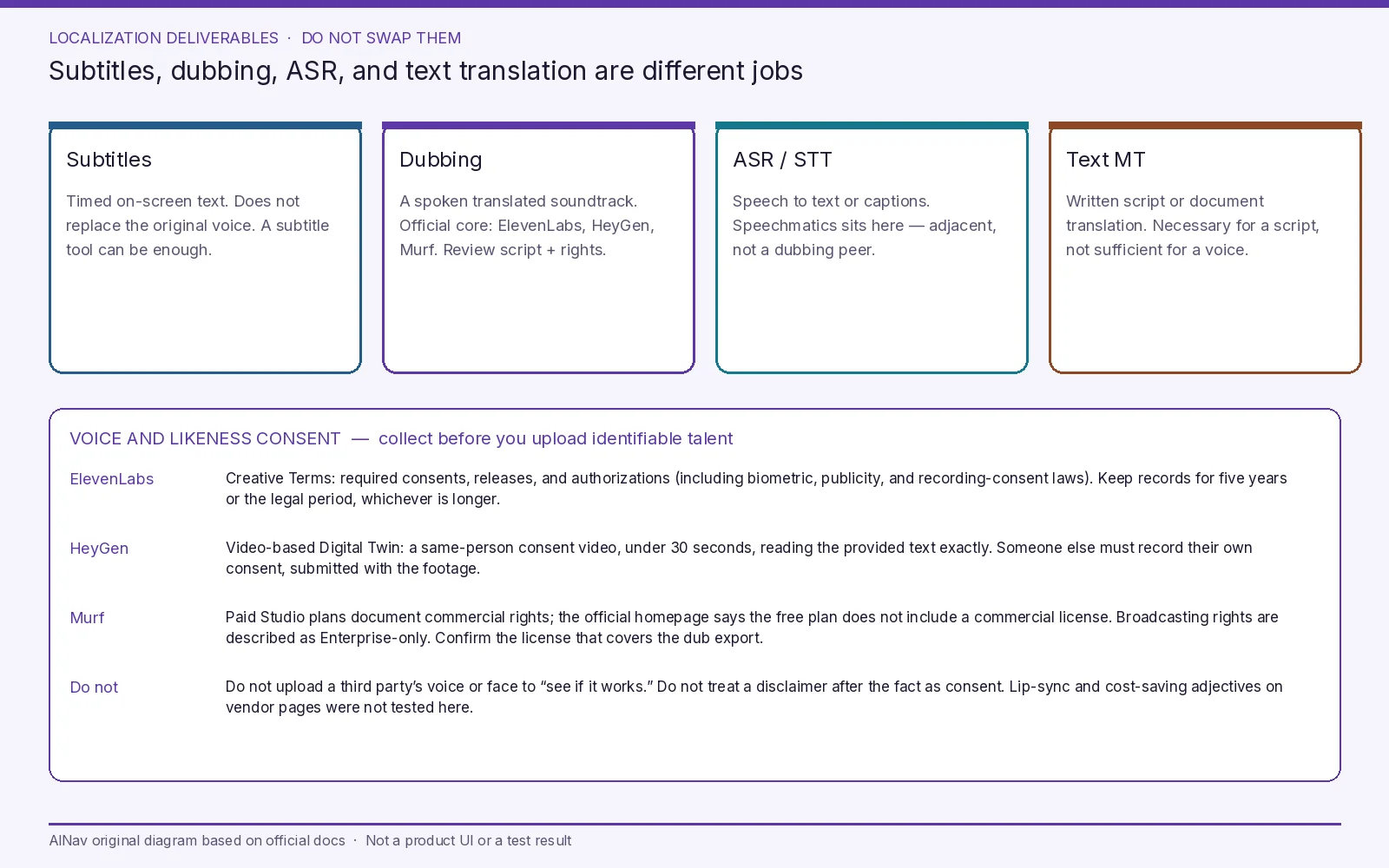
AINav original diagram based on official docs. Sources: ElevenLabs Dubbing, ElevenCreative Terms, HeyGen Video Translator, HeyGen consent video, Murf Dub pricing, Murf commercial rights, Speechmatics. Not an official screenshot or a test result.
Consent and voice authorization are part of the product, not a later email
If the input contains an identifiable person’s voice or likeness, official terms put the authorization burden on you.
ElevenLabs’ ElevenCreative Terms require that, where Input contains the voice, image, or likeness of an identifiable person, you have given required notices and obtained all consents, releases, and authorizations required under applicable law, including biometric, publicity, and recording-consent laws, sufficient for ElevenLabs and its providers to process the input and for you to use the output. You must retain records for the longer of the legal period or five years, and provide them on reasonable request.
HeyGen’s official help article Recording your Consent Video requires a short consent video before creating a video-based Digital Twin. The person in the consent video must be the same person as in the avatar footage. If you are creating an avatar for someone else, that person must record their own consent video, which can be submitted by QR code, at the same time as the footage. The provided consent text must be read exactly, in a clip under 30 seconds; a screen recording of a statement playing on a monitor is not accepted. HeyGen’s Privacy Policy, last updated October 15, 2026, also states that input may be used to train and enhance models, with an email opt-out. Confirm current training and enterprise-contract language before you upload talent footage.
Murf’s official homepage describes ethically developed voices created with permission and partnership from professional voice actors who earn royalties, and it warns that replicating a real person’s voice without permission can violate privacy or publicity laws. Commercial use may require a license; the free plan is described as not including one.
Do not upload a third party’s voice or face to “see if it works.” A pilot should use your own voice, a vendor-licensed stock voice, or talent who have already signed and recorded the required consent.
A publishing check you can run without a real talent’s voice
Use a short clip you own, or a stock voice the vendor already licenses. Then check five things:
- Deliverable. If you only need readable captions, a dubbing product is optional. If you need a spoken track, confirm official dubbing—not only TTS or ASR.
- Review path. ElevenLabs documents that v2 output is a preview and that transcript edits via API are limited by plan. HeyGen documents an Edit & Review step for the translated script. Murf’s Enterprise plan documents human quality assurance. A publish-ready workflow needs a linguistic review, not only a waveform.
- Rights. Confirm paid-plan commercial terms, watermarks, and any genre restrictions (including ElevenLabs’ Dubbing v2 entertainment limits). Recheck the platform you will publish to; Murf itself notes that third-party platform rules for AI voices change.
- Consent records. For any identifiable voice or face, collect the vendor’s required consent artifact and keep it with the project. A vendor safety check is not a substitute for your talent agreement.
- Technical fit. Official language coverage differs (90+ at ElevenLabs, 175+ at HeyGen, 20+ at Murf, 55+ at Speechmatics for STT). Lip-sync quality was not tested here; if on-camera sync is mandatory, budget a human review.
Stop the purchase if the tool only gives you a transcript or a subtitle file, if commercial rights are limited to a plan you will not buy, if you cannot satisfy the official consent step, or if the intended use is barred by current terms (for example, a v2-only feature-film plan at ElevenLabs).
Who this purchase is for, and who should look elsewhere
This evaluation is for localization producers, course and video publishers, and teams moving existing spoken content into other languages, who will keep a human in the review and rights loop.
It is not for buyers who only need captions, only need document translation, or who want to clone a voice they do not control. It is not a translation-management evaluation.
Frequently asked questions
Is a dubbed video the same as translated subtitles? No. Subtitles are text. Dubbing, as documented by ElevenLabs and as marketed by HeyGen and Murf, is a spoken translated track, sometimes with lip-sync. You can need both; you should not buy one and expect the other.
Is Speechmatics a dubbing tool? Not on the official pages reviewed here. It is a speech-to-text / captioning API. Treat it as an adjacent ASR layer.
Can I clone someone else’s voice or face if I add a disclaimer later? Official ElevenLabs terms require prior consents and retained records. Official HeyGen help requires a same-person consent video for a Digital Twin, recorded with the footage. This guide will not describe a workaround.
Are vendor lip-sync and cost-saving claims verified? No. They are documented as vendor statements and were not tested in this review.