reviews
HubSpot AI vs Adobe Journey Optimizer for Lifecycle Marketing
Map a synthetic onboarding journey to HubSpot Marketing Hub, Breeze, Agent Hub, and Adobe Journey Optimizer. Contentsquare is analytics support only. Documentation-based, with no live sends, tested winner, or verified price comparison.
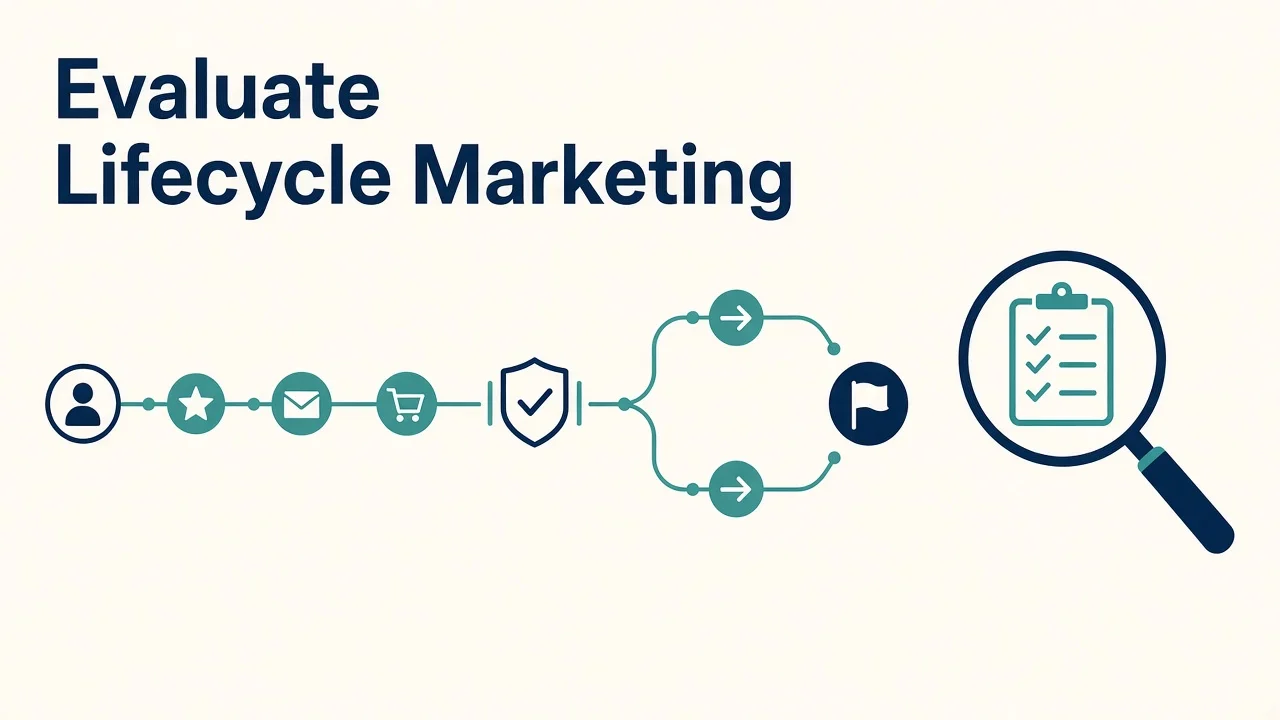
Lifecycle marketing requires a chain of decisions about identity, consent, timing, content, and delivery. An AI drafting feature addresses only part of that chain. Before comparing platforms, define the customer event that begins a journey, the records involved, and the outcome that should end it.
This comparison is documentation-based. Hands-on tests were not run, and no customer messages were sent. Official public materials were reviewed on November 7, 2026. Account entitlements, operational reliability, prices, and deployment details are not verified. The onboarding scenario below is a proposed sandbox evaluation.
For a team already operating in HubSpot, start by mapping the scenario to its existing subscriptions and CRM configuration. For a team with Adobe infrastructure, map the same scenario to Journey Optimizer and its data dependencies. Treat existing infrastructure as an implementation input, then verify every mandatory requirement before choosing.
Separate HubSpot's product packages
The HubSpot AI directory entry is a starting point for discovering relevant capabilities. Procurement needs a more precise product map. Keep Marketing Hub, Breeze, and Agent Hub in separate rows, with a source and an entitlement check beside each required task.
Marketing Hub is the marketing product to investigate for campaign and marketing automation requirements. Its product page describes marketing capabilities, while HubSpot's automation documentation identifies workflow subscription requirements. Confirm the exact tier and actions needed for your onboarding scenario. Marketing Hub access should be assessed through its own documentation and your account entitlements. Marketing Hub product page
Breeze identifies HubSpot's AI capabilities in the reviewed workflow documentation. That documentation describes using AI to generate enrollment triggers and actions from prompts. This supports an AI-assisted workflow design claim. It does not establish that a particular account can execute every generated action or send through every requested channel. HubSpot automation documentation
Agent Hub has its own workflow documentation. The reviewed action reference includes agent and AI actions and states that credits are required for AI and agentic workflow actions. Use this source to investigate those specific functions. Full lifecycle marketing entitlement is not verified by an Agent Hub page. Verify the marketing package, action permissions, channel configuration, and any additional dependency separately. Agent Hub workflow actions
A useful procurement record names both the capability and its source. For example, distinguish an AI-assisted design step from an automated marketing send. If the documentation does not clearly assign ownership or entitlement, enter not verified and request clarification about that specific step.
Establish the Adobe Journey Optimizer boundary
Adobe Journey Optimizer documents multistep journeys with event or audience entry, conditions, waits, messaging actions, and contextual data. Its getting-started guide also describes validation and testing approaches. These are documented orchestration capabilities, with configuration and access still to be established for a particular organization. Adobe journey documentation
Map the intended journey to the appropriate entry mechanism and data source. Record which identifiers connect an event to a profile and which attributes drive a branch. Ask the implementation owner to identify the required Adobe services, permissions, schemas, and channel setup.
AI-assisted content creation and orchestration deserve separate acceptance checks here too. A generated message can be editorially acceptable while the surrounding journey still has unresolved consent, suppression, or identity behavior. Keep those decisions visible in the implementation record.
Define a shared onboarding scenario
Use a fictional software trial with synthetic profiles and events. The proposed journey has three stages. First, an eligible trial-start event leads to a welcome message. Next, an incomplete setup condition leads to a reminder. Finally, an activation event ends the reminder path and records completion.
Before building anything, write an expected event table. Include profile identity, event identity, event time, trial status, contact permission, language, and activation status. Assign a business owner to each field. State how missing or conflicting values should be handled.
Include negative cases. A duplicated trial event should have a defined expected outcome. An unsubscribed profile should have a documented suppression expectation. A profile that activates during a waiting period should have an explicit exit expectation. These are proposed acceptance requirements, and their behavior in either platform remains not verified.
Keep all evaluation delivery within an authorized sandbox using designated test recipients if sending is later approved. For the current draft, no sandbox was configured and no journey was executed. Documentation alone cannot establish that the expected events would produce the intended messages.
Compare the same operational questions
Audience entry and branching
Ask whether entry depends on a CRM property, an ingested event, an audience calculation, or an integration. Determine when the condition is evaluated and whether a later attribute change affects an existing journey instance. Document any delay between the originating event and the platform's usable record.
For each branch, identify the source field and expected handling of an empty value. Test records should include both ordinary and incomplete data. A visual canvas can communicate a design while leaving these operational details unresolved.
Channels, approval, and suppression
List each required channel separately. Confirm the sending configuration, recipient eligibility, approved content state, and subscription dependency. Do not infer one channel's availability from another channel's documentation. Regional availability and account configuration are not verified here.
Describe what should happen if consent changes after enrollment. Ask when suppression is checked and whether a scheduled message can be canceled. Identify who approves a journey change and who can activate it. Role names alone leave the actual separation of duties unproven.
Failure and retry behavior
Define expected handling for rejected events, unavailable integrations, invalid addresses, and failed actions. Ask where an operator sees the failure, how it is identified, and which recovery actions could cause duplicate processing. Retrying an action and reenrolling a profile may have different consequences.
Require evidence from the intended environment before relying on recovery behavior. No retry safety, delivery guarantee, processing latency, or SLA was tested or contractually verified for this article.
Experiments and attribution
Specify the business question before choosing an experiment feature. A trial onboarding evaluation might compare message approaches against a defined activation event. Keep assignment, eligibility, and outcome measurement explicit so the team can explain what the experiment measures.
Also document how an event becomes attributable to a journey. Email engagement, website activity, and product activation represent different observations. Ask which system owns each metric and whether data can be reconciled. No uplift or attribution accuracy is claimed here.
Place Contentsquare in the analytics layer
Contentsquare AI belongs in this comparison as experience analytics support. Its public materials describe AI-assisted analysis of digital experiences. It can inform investigation of where users encounter friction, subject to instrumentation and access. In this evaluation, it is experience analytics only. It is not a journey send platform. Contentsquare AI overview
For the fictional onboarding journey, an analytics investigation could examine where setup stalls. Any transfer of those findings into audience rules or messaging needs a separately verified workflow. Identity matching, consent handling, and integration availability are not verified. Keep the analytics question separate from permission to contact a person.
Compare implementation scope and total cost
Build a dependency sheet covering product subscriptions, data preparation, connectors, channel providers, seats, usage, onboarding, and ongoing administration. For HubSpot, keep Marketing Hub entitlements, Breeze functions, and Agent Hub actions distinct. For Adobe, request a scoped list of required services and implementation responsibilities.
Prices and usage allowances are not verified, so this guide provides no numeric cost comparison. Obtain dated terms for the relevant region and billing cycle. Include internal work to maintain schemas, investigate failures, update approved content, and reconcile reporting.
Set acceptance conditions before a pilot. Require evidence for correct entry, duplicate handling, branching, suppression, exit, approval, and recovery. Preserve configuration and event records so another operator can repeat the evaluation. Confirm the available export and rollback path before extending the workflow to real customers.
FAQ
Does Breeze replace Marketing Hub?
The reviewed documentation supports AI assistance within workflows. It does not establish equivalent marketing entitlements. Verify Marketing Hub requirements and each AI or agent action separately for the intended account.
Can Agent Hub documentation prove the complete onboarding journey?
It can support claims about documented Agent Hub actions. Full lifecycle delivery requires separate evidence for the marketing package, data, permissions, channels, suppression, and execution. Those account-specific items remain not verified.
Which platform should an existing CRM team choose?
Start with the scenario and existing data ownership. Compare implementation dependencies and verified acceptance results. This documentation review provides no tested winner or migration recommendation.