news
Reading AI Product Updates: How to Decide Whether a New Feature Justifies Switching
Product updates are often treated as switching signals, but what actually matters is a change in your workflow. This evergreen guide offers a reusable framework, grounded in published feature information for Gemini, Claude, and ChatGPT, for turning a new feature into a testable hypothesis before you migrate.
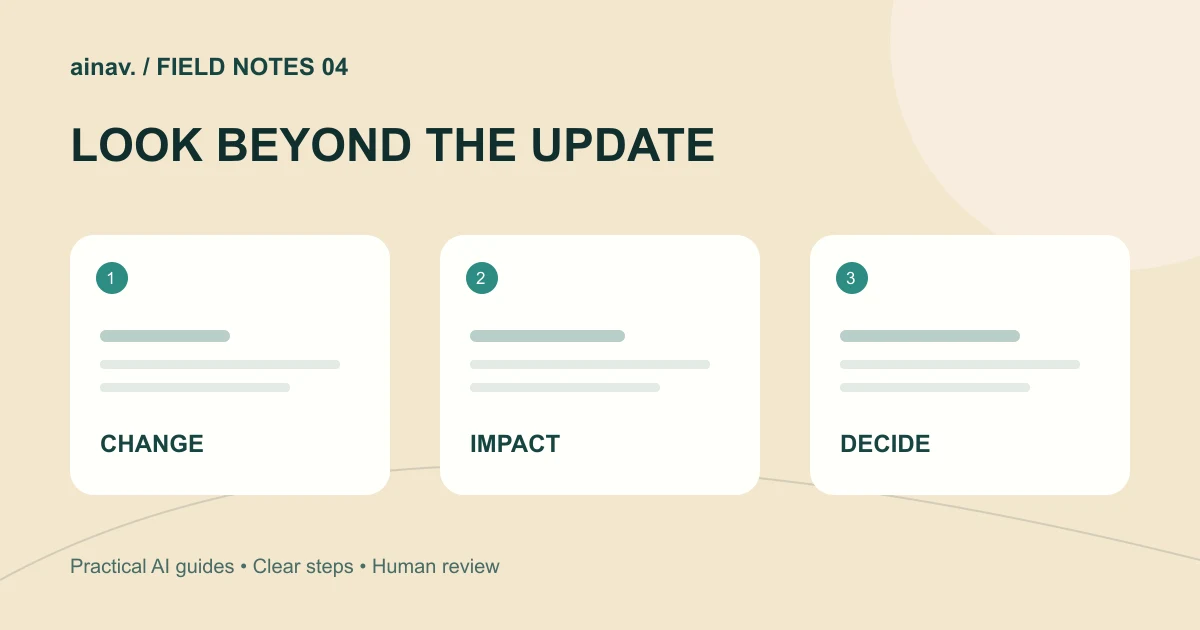
Separate a feature launch from a reason to switch
When an AI assistant ships something new, the most common reaction online is some version of "time to switch." But a launch and a justified migration are separated by real distance. The new capability may cover only a slice of your workflow, may be gated behind a particular plan, or may conflict with habits you have already built. Treating updates as an evergreen question rather than breaking news makes the criteria more stable: the question is not who shipped first, but which capability actually changes how you produce work.
A practical starting point is to write the new feature as a testable hypothesis. For example: "If I use Deep Research in Gemini to compile industry material, I will save two hours of source-sifting each week." The more specific the hypothesis, the cheaper it is to test, and the harder it is for marketing language to pull you off course.
Filter the noise with three layers
The first layer is capability: does this feature address a real bottleneck in your current process? Take Gemini. Its published materials describe Deep Research as investigating a topic, Canvas as a space to develop documents and code, Gemini Live as supporting voice conversations, and image generation and editing as listed in the plan comparison. Each maps to a different scenario, so confirm it lands on your bottleneck before discussing a switch.
The second layer is access: the same feature is available to different degrees across plans. Gemini's Free option includes the Flash-Lite model in the app along with image generation and editing, Deep Research, Gemini Live, Canvas and Gems, while paid plans provide higher usage limits. Claude's Free plan lists web search, file creation, code execution, and memory across conversations, with Pro and Max adding usage and task hand-off. ChatGPT's Free plan sets limits on uploads, image creation, voice, and deep research, with paid tiers expanding access. Ask first whether the capability you need is sufficient at the tier you are willing to pay for.
The third layer is migration: switching means rebuilding habits, reconfiguring connectors, and re-accumulating context. Claude supports connecting apps and tools and keeps memory across conversations; ChatGPT offers memory and context features, with expanded access on paid plans. These stickiness factors often determine the net benefit of a switch more than any single feature.
A four-step validation process you can run
Step one: write down the bottleneck and its cost. Not "inefficient," but "four hours a week compiling competitor material, three of them spent filtering sources."
Step two: design a minimum task for each candidate and run it on the same input. For instance, give the same meeting notes to two assistants and ask for structured minutes. Gemini's documented entry path is to open gemini.google.com and start a new chat, sign in with a Google account to save activity, type the prompt in the conversation view, use dictation if preferred, and open the Images section for image work. Claude's path is to open claude.ai, sign in, and type a request; paid plans can hand off tasks and return finished docs, slides, sheets, and designs. ChatGPT lets you start a chat at chatgpt.com, and signing in enables file uploads, image creation, and deep research.
Step three: check outputs against fixed criteria. Four are enough: whether facts are verifiable, whether the structure is directly usable, whether key constraints from the input were missed, and how many rounds of rework were needed. If two of the four regress clearly, a new feature alone is not a reason to migrate.
Step four: estimate switching cost and set an observation window. Convert learning time, connector rebuilds, and history migration into hours, then compare against the time saved in step two. If the net is positive, run one real project for two weeks before cancelling the old tool.
Reusable example prompts
For assessment: "Here is my weekly task list with time estimates. Identify which steps suit an assistant with web search, file creation, and code execution, and explain the basis for each; avoid generic advice."
For comparison: "I will test two assistants on the same input. Design a scorecard for structured meeting minutes covering factual accuracy, structural usability, constraint coverage, and rework rounds, with a pass line for each."
For migration: "I plan to move my research compilation to a new tool. List what I should back up, which connections I must reconfigure, and the three steps most likely to break in the first two weeks."
Output checks and common misjudgments
When checking output, prioritize verifiability over fluency. Deep Research-style features combine sources into reports, and the published description itself notes that important answers should be checked for accuracy, so treat "are sources cited and traceable" as a hard criterion. Next, check constraint coverage: were stated length, format, and exclusions respected? Finally, check stability: run the same prompt three times and see whether variance is acceptable.
Three misjudgments recur. The first is mistaking plan differences for capability differences, assuming a demo reflects your own tier. The second is treating a demo scenario as general capability, ignoring that features vary by plan, region, and device, as Gemini's own materials note. The third is equating "new" with "better for me," while discounting accumulated memory and existing connections.
Realistic limits and room to decide
Every assistant has limits. Generated content needs human review, usage limits affect heavy use, prices exclude applicable tax and vary by region, and feature lists can change. So base a switching decision on repeatable measurement, not a single session.
One simple rule to close with: if a new feature optimizes less than a tenth of your process, stay put; if it changes how you deliver finished work, for example from suggestions to finished documents, then a migration deserves serious evaluation. Updates will keep coming, and a stable framework beats chasing every launch.