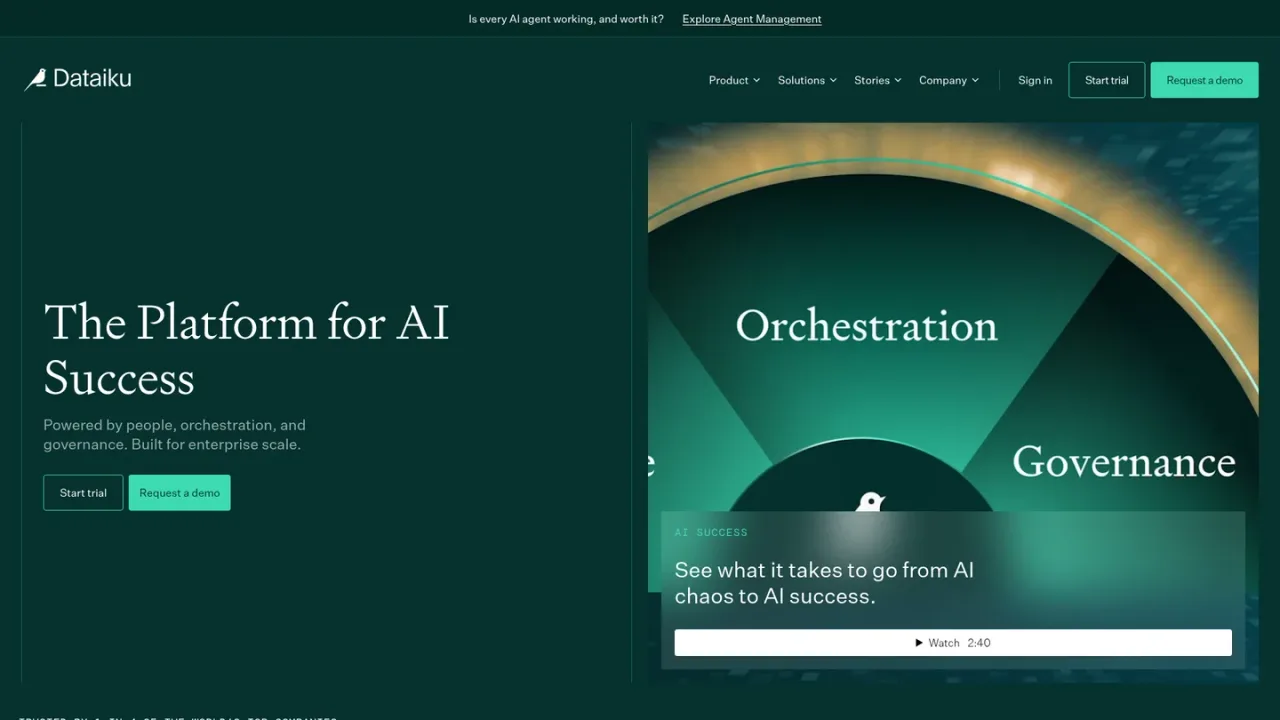
Dataiku is an enterprise AI platform that brings analytics, machine learning models, and AI agents together in a single governed system. Teams can prepare and transform data with visual or code recipes, build and deploy models through visual ML, AutoML, or full-code workflows, and design multi-step agents using visual logic or code. Dataiku Cobuild adds a natural-language interface for exploring data, creating governed projects, and overseeing agents. The platform connects to existing clouds, data platforms, and LLM providers, with governance, lineage, and monitoring built in. A 14-day free trial of Dataiku Cloud is available, and a Free Edition can be installed locally.
How to use Dataiku
1
Start a trial or install the Free Edition
Sign up for the 14-day Dataiku Cloud trial, or install the Free Edition on Mac, GNU/Linux, or Windows for an on-premise experience.
2
Prepare and transform data
Use visual recipes or Python, R, and SQL to join, clean, and transform data, with lineage and versioning in the Flow.
3
Build and deploy models
Create models with visual ML, AutoML, or full-code development, then deploy them to APIs, batch scoring, or production pipelines.
4
Design governed AI agents
Build structured, multi-step agents using visual logic blocks or code frameworks, combining prompts, tools, APIs, and models.
5
Use Cobuild for natural-language work
Ask data questions, describe goals to generate inspectable projects, and manage agents through the Cobuild interface.
Dataiku Features
Visual and code recipes for data preparation using Python, R, and SQL
Visual ML, AutoML, and full-code model development
MLOps deployment to APIs, batch scoring, and production pipelines
Visual and code agents with multi-step reasoning workflows
Agent Hub for centralized agent creation and orchestration
LLM Mesh for centralized routing, quotas, and monitoring across providers
Cobuild natural-language interface for data exploration and project creation
Governance with lineage, model registry, approval workflows, and monitoring
Connectors to Snowflake, Databricks, Redshift, S3, and enterprise systems
Dataiku Use Cases
Enterprise data preparation and transformation
Machine learning model development and deployment
Building and orchestrating governed AI agents
Natural-language data exploration with access controls
Centralized LLM provider management and cost monitoring
AI governance and risk oversight across models and agents
Dataiku FAQs
Cobuild is a natural-language interface across Dataiku for asking data questions, creating governed AI projects, and overseeing agents.
The free trial lasts for 14 days. After that, you can request an extension by reaching the support team.
No, you do not need a credit card to sign up for the Dataiku free trial.
The trial gives access to a space with 2 users, an API node with 1 API service, 4 CPUs, and 32 GiB of elastic compute.
All features are available except Govern and advanced LLM Mesh.
Yes, the Free Edition can be installed on Mac, GNU/Linux, and Windows, with Windows described as an experimental version.
Cobuild supports models from Anthropic, OpenAI, and Google, as well as providers like Snowflake Cortex AI, Databricks AI Gateway, AWS Bedrock, and Microsoft Foundry, including open-source and on-premises models.
Yes, with Dataiku Headless, teams can build pipelines, models, and agents in Dataiku from Claude Code, Codex, and similar tools.
The 14-day free trial is a fully managed Dataiku Cloud instance; no credit card is required. The Free Edition can be installed locally. Enterprise pricing is available through a demo request.
Free Trial
$0USD / 14 days
A fully managed Dataiku Cloud instance for evaluating the platform, with access to all features except Govern and advanced LLM Mesh.
Access to all features except Govern and advanced LLM Mesh
Space with 2 users
API node with 1 API service
4 CPUs and 32 GiB of elastic compute
Onboarding resources including Dataiku Academy and Community
Free Edition
$0USD
A locally installable edition for users who prefer full infrastructure control, available on Mac, GNU/Linux, and Windows.