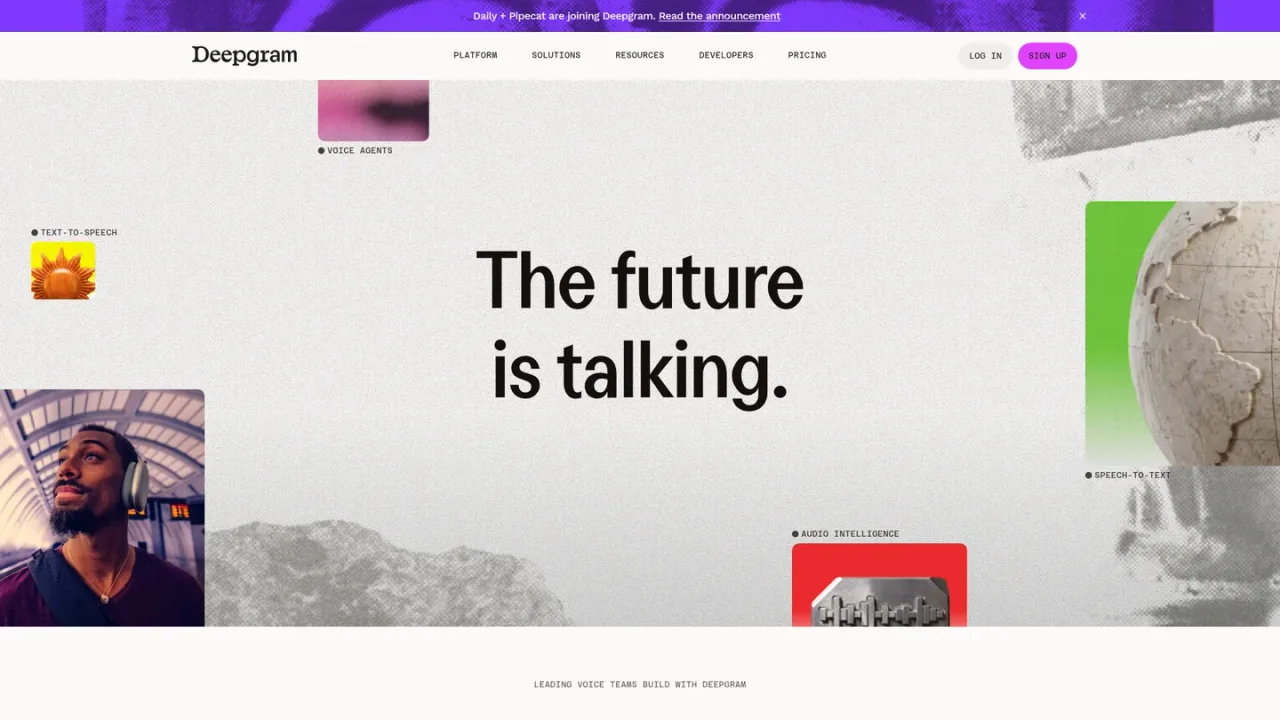
Deepgram is a voice AI platform that provides APIs for speech-to-text, text-to-speech, voice agents, and audio intelligence. Developers use it to transcribe audio, generate natural-sounding speech, build conversational voice agents, and extract insights from audio. The platform supports real-time and batch processing, with models like Flux TTS designed for conversational speech. It serves voice teams, contact centers, and enterprises building voice-enabled applications. Access is available through a web console, API, and playground, with pricing details on the official pricing page.
How to use Deepgram
1
Sign up for an account
Create a Deepgram account via the console signup page to access APIs and manage projects.
2
Explore the playground
Use the Deepgram Playground to test speech-to-text, text-to-speech, and other models interactively.
3
Integrate via API
Follow the developer documentation to integrate speech-to-text, text-to-speech, or voice agent APIs into your application.
Deepgram Features
Speech-to-text API for transcription
Text-to-speech API with Flux TTS for conversational speech
Voice agent API for building conversational agents
Audio intelligence for extracting insights from audio
Real-time and batch processing support
Developer playground for testing models
Enterprise-grade reliability
Deepgram Use Cases
Transcribing audio and video content
Building voice-enabled chatbots and virtual assistants
Generating natural-sounding speech for applications
Analyzing call center audio for insights
Creating voice agents for appointment booking and customer service
Deepgram FAQs
Deepgram offers speech-to-text, text-to-speech, voice agent, and audio intelligence APIs.
Flux TTS is a conversation-native text-to-speech model designed for real-time voice agents.
Yes, you can use the Deepgram Playground to test models interactively.
Documentation is available at developers.deepgram.com.
Yes, Deepgram supports real-time and batch processing for speech-to-text.
Deepgram serves contact centers, restaurants, pharma, medical, and government industries, among others.
You can visit the contact page or use the help center and community forums for support.
Pricing details, including any free tier, are available on the official pricing page.
Deepgram is an API platform; consumer membership prices are not listed. Rates are usage-based: speech-to-text from $0.0077/min (Pay as you go) and $0.0065/min (Growth) for Flux STT English and Nova-3 Monolingual; text-to-speech from $0.0150/1k characters (Aura-1) to $0.0450/1k characters (Flux TTS); Voice Agent from $0.050/min (Custom, BYO LLM and TTS) to $0.163/min (Advanced); Audio Intelligence $0.0003/1k input and $0.0006/1k output tokens. The $200 credit is a starting credit, not a permanently free plan. Enterprise pricing is custom and not published.
Pay as you go
$0USD / usage-based; $200 free credit, then pay-as-you-go
No-commitment usage-based plan billed against credits as you use them. New accounts start with a $200 free credit that does not expire and requires no credit card.
$200 free credit, then pay-as-you-go with no minimums
Billed per second of processed audio with no block rounding
$4000USD / per year (pre-paid annual credits, starting at)
Pre-paid annual credits redeemed against actual usage, starting at $4,000 per year. Offers up to 20% savings and higher concurrency than Pay as you go.
Pre-paid credits for the year, redeemed against actual usage
Voice Agent concurrency up to 60 in North America and up to 45 in Europe, Australia, and India
Overages billed at Growth rate plus 10%, charged weekly
Enterprise
/ custom
Custom pricing for businesses with large volumes, data or deployment requirements, or support needs. Includes options such as self-hosted deployment and a named account team.
Custom pricing with volume-based ladders
Self-hosted containers in your own VPC or on-prem hardware (requires NVIDIA GPUs)
HIPAA BAA available for ePHI handling
Enterprise concurrency limits set to your peak traffic