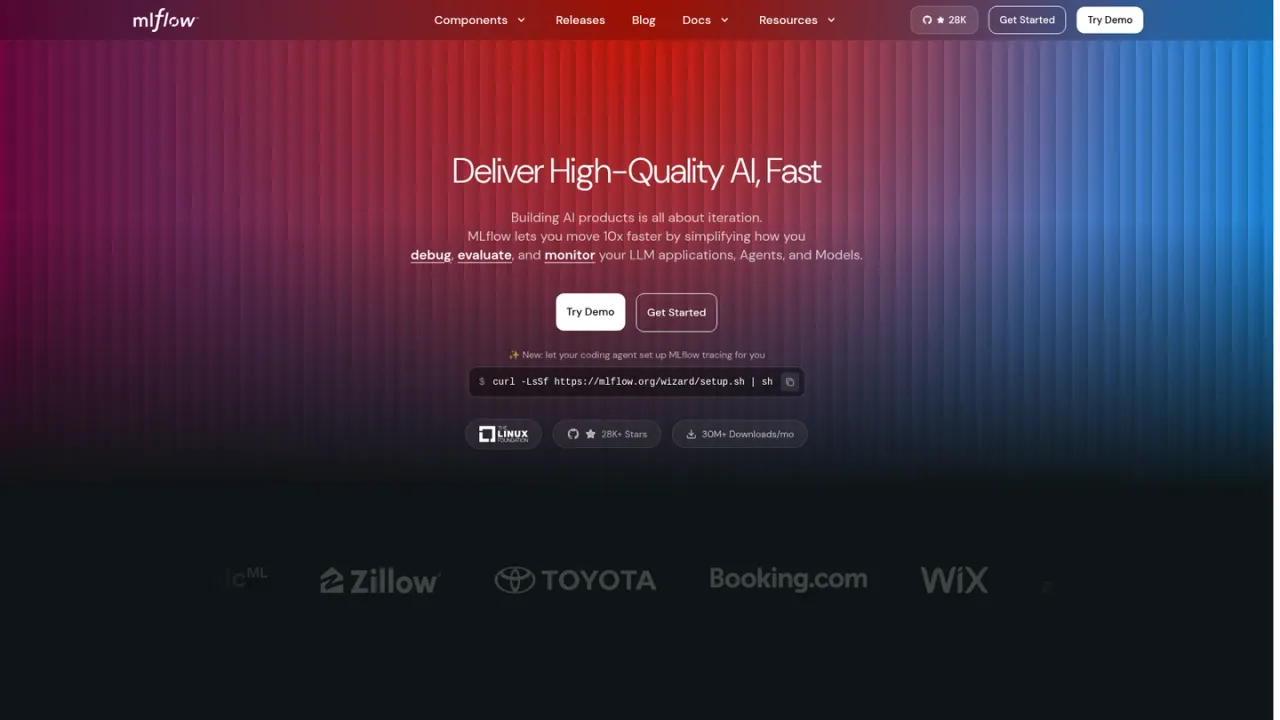
MLflow is an open source AI engineering platform for agents, LLM applications, and machine learning models, backed by the Linux Foundation. For LLM and agent work it provides OpenTelemetry-compatible tracing and observability, systematic evaluation with LLM-as-a-judge scorers and custom metrics, prompt versioning and optimization, an AI Gateway for routing and cost control, and an Agent Server for deployment. For traditional ML it offers experiment tracking, model evaluation, a model registry, and deployment tools. It integrates with 100+ frameworks and supports Python, TypeScript/JavaScript, Java, and R. Teams use it to debug, evaluate, and monitor production AI applications while controlling costs and model access. MLflow is fully open source under Apache 2.0 and can run locally, on-premises, or on managed services.
How to use MLflow
1
Start an MLflow server
Run `uvx mlflow server` (or use the Docker setup) to launch a local MLflow tracking server in about 30 seconds.
2
Enable tracing
Point the SDK at your server with `mlflow.set_tracking_uri` and enable automatic tracing, for example `mlflow.openai.autolog()`, to capture traces, metrics, and parameters.
3
Run your code and inspect traces
Execute your application as usual, then open the MLflow UI to explore traces, metrics, and evaluation results.
4
Try the public demo
Visit demo.mlflow.org or run `uvx mlflow demo` to explore a pre-loaded MLflow instance without a running server.
MLflow Features
OpenTelemetry-compatible tracing for LLM and agent observability
Systematic evaluation with LLM-as-a-judge scorers and custom metrics
Prompt versioning, lineage tracking, and automated prompt optimization
AI Gateway with unified OpenAI-compatible routing and cost control
Agent Server for deploying agents with request validation and streaming
Experiment tracking, model evaluation, model registry, and deployment for ML
Integrations with 100+ frameworks and support for Python, TypeScript/JavaScript, Java, and R
MLflow Use Cases
Debugging LLM applications and agents with detailed traces
Running regression tests and evaluations before production releases
Monitoring production AI quality, latency, and token costs
Managing and optimizing prompt templates across application versions
Routing LLM requests across providers and controlling costs
Tracking ML experiments and managing model versions and deployment
MLflow FAQs
MLflow is an open source AI engineering platform for agents, LLM applications, and ML models. It helps teams debug, evaluate, monitor, and optimize AI applications while controlling costs and managing access to models and data.
MLflow is described as 100% open source under the Apache 2.0 license and forever free. Managed MLflow services offered by cloud providers are documented separately by those providers.
Start an MLflow server with `uvx mlflow server`, set the tracking URI, and enable tracing such as `mlflow.openai.autolog()`. You can also explore the public demo at demo.mlflow.org or run `uvx mlflow demo`.
MLflow supports Python, TypeScript/JavaScript, Java, and R, and integrates with 100+ tools including OpenAI, Anthropic, LangChain, PyTorch, and HuggingFace. It also natively integrates with OpenTelemetry.
Yes, MLflow Tracing is described as stable and production ready. For production, the lighter `mlflow-tracing` SDK is recommended, and asynchronous logging can reduce performance overhead.
MLflow runs evaluations over datasets using built-in LLM-as-a-judge scorers or custom scorers, and tracks quality metrics over time to catch regressions before production.
The AI Gateway is a unified OpenAI-compatible API gateway for LLM providers that routes requests, manages rate limits, handles fallbacks, and controls costs.
MLflow provides documentation, a Slack community, and a GitHub issue tracker for questions and bug reports.
Free refers to the open-source, self-hosted MLflow software under Apache 2.0; no paid tiers or prices are listed on the supplied official pages. Checked 2026-11-19.
MLflow (Open Source)
$0USD / forever
Open source AI engineering platform under Apache 2.0, free to use with no vendor lock-in.
100% open source under Apache 2.0 license
Forever free, no strings attached
Works with any cloud, framework, or tool
LLM tracing, evaluation, prompt management, AI Gateway, Agent Server
Experiment tracking, model registry, and deployment tools