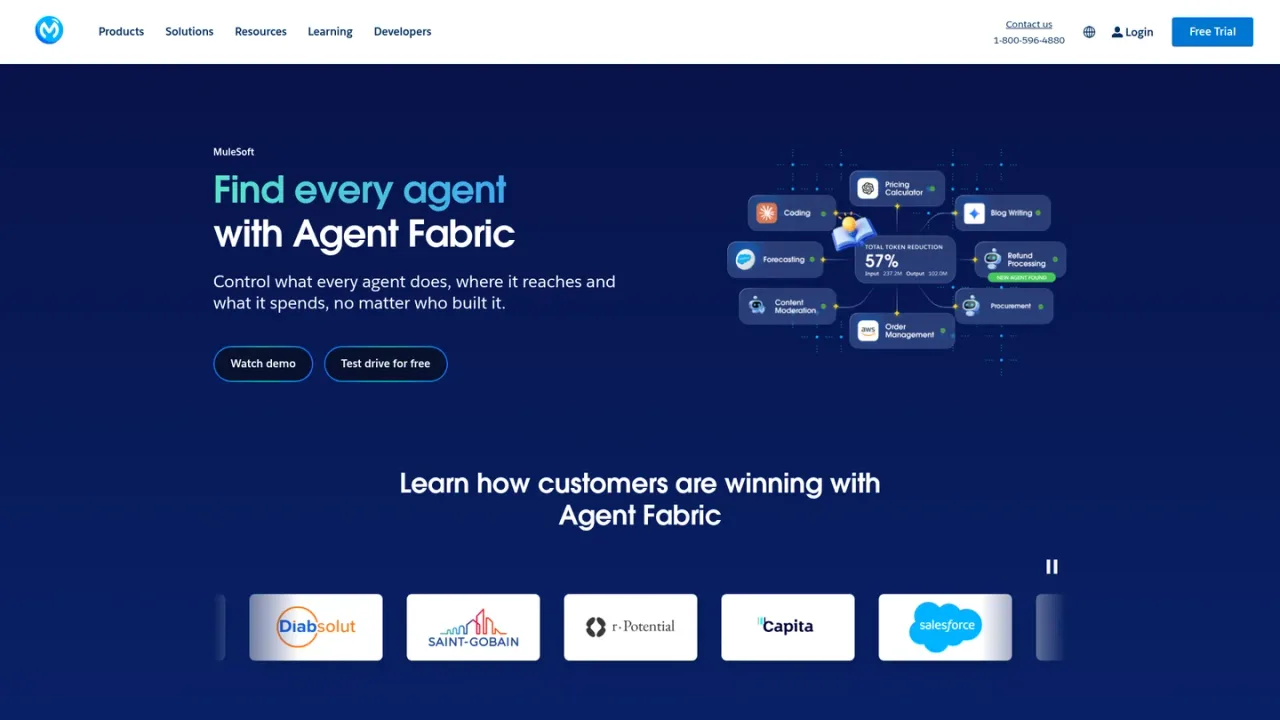
MuleSoft is an integration and API platform whose Agent Fabric acts as a vendor-agnostic AI control plane. It scans platforms such as AWS Bedrock, Azure AI Foundry, Google Vertex AI and Microsoft Copilot to register every agent, MCP server and API in one searchable catalog. A unified AI Gateway applies guardrails, authentication, PII detection and masking, rate limiting and an agent kill switch, while trusted identity carries user context through agent, MCP and API calls. MCP support turns existing APIs into agent-ready tools, connectors reach systems like SAP, Workday and mainframe, and multi-agent orchestration routes work to fit agents. Semantic model routing, prepaid token budgets and a FinOps dashboard help control AI spend. Packages start at $2,000 per month billed annually, and a 30-day free trial is offered.
How to use MuleSoft
1
Point Agent Fabric at your platforms
Connect Agent Fabric to the platforms your teams already use so scanners register every agent, MCP server and API they find into one searchable registry.
2
Review discovered assets
Review what scanners discover before promoting assets into the governed registry, and register manually anything scanners do not yet reach.
3
Apply guardrails and identity
Use the unified AI Gateway to enforce rate limiting, authentication, PII detection and masking, and data access controls, with trusted identity carrying user context through call chains.
4
Connect systems and orchestrate
Turn existing APIs into agent-ready tools with MCP, reach systems such as SAP, Workday and mainframe through AI Connectors, and route work across agents.
5
Set budgets and monitor spend
Use semantic model routing, prepaid token budgets and the FinOps dashboard to track and cap AI spend by team, app or agent.
MuleSoft Features
Agent Registry: cross-platform catalog of agents, MCP servers and APIs
Scanners that pull agent metadata from AWS Bedrock, Azure AI Foundry, Google Vertex AI, Microsoft Copilot and more
Unified AI Gateway with rate limiting, authentication, PII detection and masking, and data access controls
Agent kill switch at the network, credential and identity layer
Trusted agent identity carrying user context through call chains
MCP support to turn existing APIs into agent-ready tools
AI Connectors to systems such as SAP, Workday, mainframe and partner data
A2A support and multi-agent orchestration
Semantic model routing, semantic caching and cost optimization
Prepaid token budgets and a unified FinOps dashboard
MuleSoft Use Cases
Discover and inventory agents, MCP servers and APIs across multiple cloud platforms
Govern third-party and internally built agents without rebuilding or instrumenting them
Enforce guardrails and identity across LLM, MCP and agent calls
Connect agents to enterprise systems such as SAP, Workday and mainframe
Route requests to cost-effective models and cap AI spend by team, app or agent
MuleSoft FAQs
Agent Fabric is a vendor-agnostic AI control plane that finds every agent, MCP server and API a business runs, governs what they can do, connects them to systems, and tracks their costs.
Scanners connect to each platform's native APIs, pull metadata such as capabilities, model, tools, ownership, version and deployment status, and normalize it into one searchable registry on a schedule. Assets can also be registered manually.
Policy is applied at the communication layer, so third-party agents are governed without being modified or instrumented, and identity travels with the call using existing OAuth and identity provider setup.
It provides visibility through a unified FinOps dashboard and budget management, efficiency through semantic routing, semantic caching and cost optimization, and enforcement through prepaid Model Wallet budgets and an agent kill switch.
Yes. Agent Fabric is generally available, with new and enhanced capabilities rolling out each month.
Point Agent Fabric at the platforms your teams already use so it registers every agent, MCP server and API it finds, then add guardrails, connect systems and set budgets. An interactive tour and account team are available.
MuleSoft packages start at $2,000 per month, billed annually, and include access to core platform capabilities plus an allocation of Mule Credits. Exact features and credit allocation depend on the package selected.
The 30-day free trial includes access to the full portfolio so you can explore key features and test real workflows.
Packages start at $2,000 per month, billed annually. A 30-day free trial includes access to the full portfolio. Pricing options include Pre-Purchase, Pre-Commit and Unlimited; contact sales for comparisons.
MuleSoft Package
$2000USD / per month, billed annually
Starting package for access to core platform capabilities with an allocation of Mule Credits shared across eligible integration, API management, automation and agent capabilities.
Access to core platform capabilities
Allocation of Mule Credits usable across eligible capabilities
Exact features and credit allocation depend on the selected package
Additional credits can be purchased if usage exceeds allocation