
Free cloud cluster
$0USD / free forever
0.5 vCPU, 1 GB RAM and 4 GB disk.
AI Search & Research Tools
PRODUCT OVERVIEW
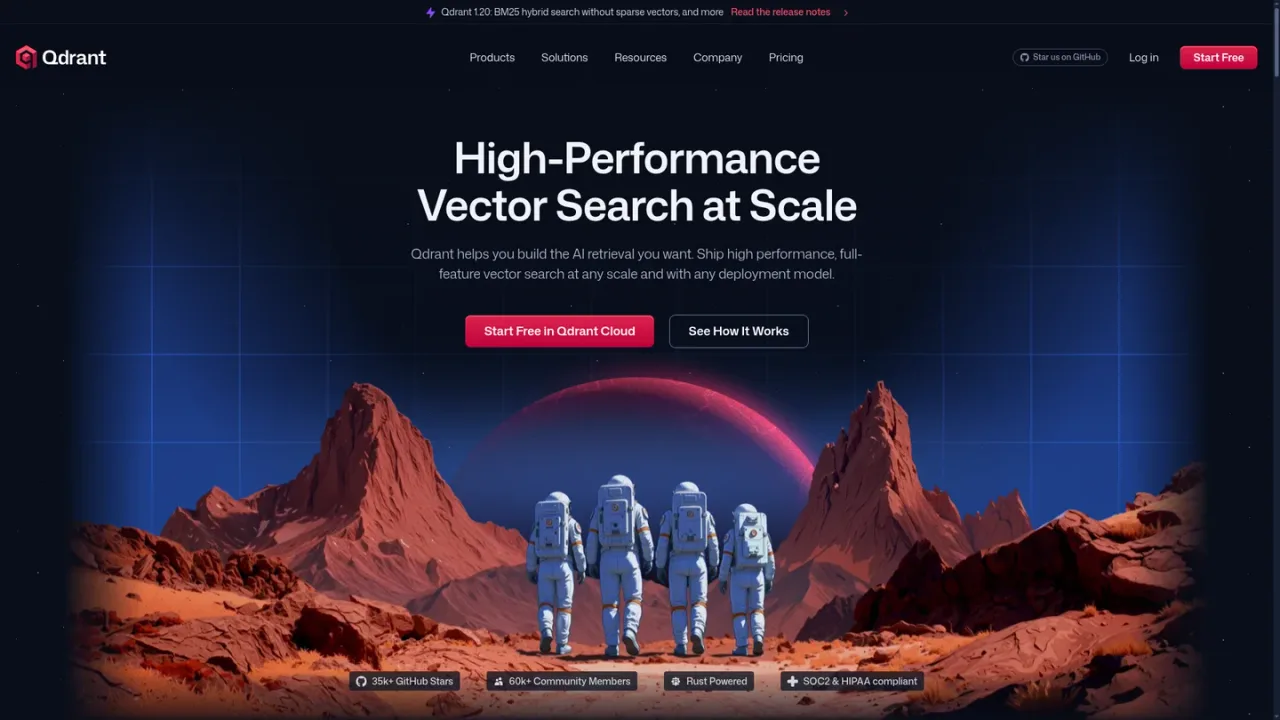
Qdrant is a high-performance vector search engine built in Rust, designed for production-grade AI retrieval. It supports dense and sparse vectors, native hybrid search with BM25, SPLADE++, and miniCOIL, multivector representations, and efficient one-stage metadata filtering during HNSW traversal. Developers can use REST, gRPC, or official clients (Python, JavaScript, etc.) and a built-in Web UI to explore collections and test queries. Qdrant powers RAG, semantic search, recommendation systems, AI agents, and anomaly detection. It is available as open-source software, Qdrant Cloud (managed on AWS, GCP, Azure), Hybrid Cloud, Private Cloud, and Edge (Beta). A free tier and paid plans are offered.
Sign up for a free Qdrant Cloud account to spin up a cluster in seconds.
Interact with Qdrant via REST, gRPC, or official clients such as Python and JavaScript.
Use the built-in Web UI to inspect collections, test vector and metadata queries, and apply filters.
Choose Qdrant Cloud, Hybrid Cloud, Private Cloud, or Edge (Beta) based on your infrastructure needs.
RAG and GenAI context retrieval
AI agents with persistent memory
Semantic search beyond keywords
Recommendation systems with real-time similarity matching
Data analysis and anomaly detection
Qdrant is a high-performance vector search engine for AI retrieval, supporting dense and sparse vectors, hybrid search, and advanced filtering.
Qdrant can be deployed as open-source software, Qdrant Cloud (managed on AWS, GCP, Azure), Hybrid Cloud, Private Cloud, and Edge (Beta).
Yes, Qdrant supports native hybrid search blending dense and sparse vectors, with BM25, SPLADE++, and miniCOIL.
Qdrant provides REST, gRPC, and official clients for Python, JavaScript, and other languages.
Yes, Qdrant Cloud offers a free tier; paid plans are also available.
Yes, Qdrant is designed for RAG and GenAI, delivering context-rich answers with hybrid retrieval and metadata filters.
The built-in Web UI allows you to explore collections, test vector and metadata queries, apply filters, and inspect results.
Yes, Qdrant supports asymmetric, scalar, and binary quantization to reduce memory usage.
Official pricing and capacity calculator checked 2026-11-09. Paid pricing depends on provider, region, memory, storage, vector dimensions and replication. The unconfigured calculator gives no quote; prior generic $25/month and $0.12/hour are not verified.
0.5 vCPU, 1 GB RAM and 4 GB disk.
COMMUNITY REVIEWS
No reviews yet.

Vector and hybrid search on live operational data in MongoDB for semantic search, recommendations, and generative AI applications.

Search and inference APIs for AI, with real-time web search, content extraction, cited answers, multi-step research, and an OpenAI-compatible inference router.

Open-source AI database for vector search, RAG, and agent memory, available self-hosted or as managed Weaviate Cloud.