tutorials
From Brief to Deliverable Draft: A Complete AI-Assisted Writing Workflow
A reusable workflow for AI-assisted writing: turn a vague request into a structured brief, build and refine the draft through conversation, then run language and consistency checks before accepting the deliverable against a fixed checklist.
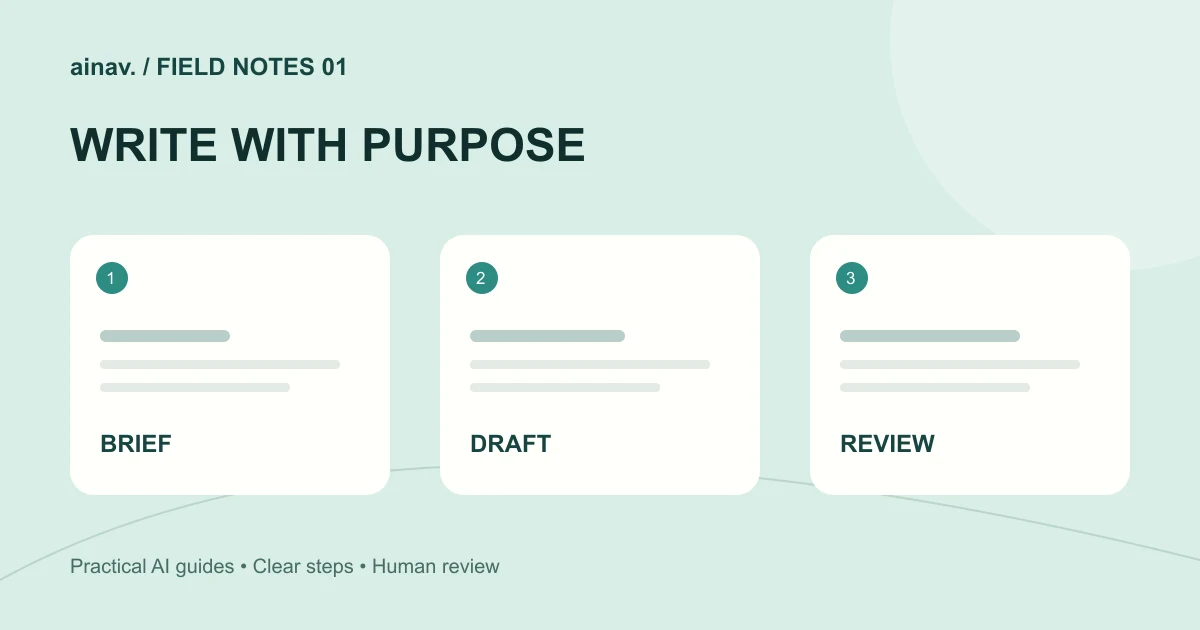
What this workflow actually solves
Most AI writing failures start before the model is involved. A request arrives as one sentence — "write a proposal" — and the draft is generated immediately, producing loose structure, drifted emphasis, and repeated rework. This article lays out a repeatable path from brief to deliverable draft for reports, proposals, explainers, and external articles. It is an evergreen method, not a product update notice. Claims about tools reflect their published official descriptions; check current product pages for features and limits.
The workflow has four stages: write the brief, build the skeleton, fill the content, run acceptance. Each stage has a defined input and output, so "generated" never gets mistaken for "finished."
Step one: turn the request into a structured brief
Do not write a prompt first. Write a brief. It needs six items: who the reader is, what decision or action they should take after reading, the points that must be covered, what must be avoided, length and format constraints, and which source material may be cited. Write these as short sentences, not stacked adjectives.
Then use a conversational assistant for a clarification pass. For example, ask ChatGPT: based on the brief below, list three places that remain ambiguous and give one clarifying question for each; do not start writing. The value here is making hidden assumptions visible. ChatGPT supports multi-turn chat, file uploads, and web search, and signed-in users can save chats, which suits this back-and-forth front end; free and paid plans differ in usage and capabilities, so read the official pricing page before relying on it heavily.
Step two: ask for structure before prose
Once clarifications are in, request an outline rather than a draft. A usable prompt: you are a senior editor; produce a three-level outline for this [format] aimed at [reader]; for each section state the reader question it answers, the type of evidence needed, and the target word count; do not write body text and avoid marketing language.
Judge the outline yourself: does the order match how the reader thinks, are there duplicates, are there gaps. Expand section by section afterward. Writing section by section is more controllable than generating the whole document at once, because evidence and tone can be calibrated per section.
If the draft must become a document, slide deck, or spreadsheet, you can move it forward in an assistant such as Claude, which lists file creation and task hand-off among its capabilities; its free plan includes web search, file creation, and code execution, while paid plans add more usage and features like Projects. Converting a confirmed outline into a structured draft there, then returning to prose polishing, is steadier than asking one tool to do everything.
Step three: fill content with reusable prompts
Keep a fixed prompt set so you are not re-explaining context each time. Example one (expand): write section X of the approved outline; open with one conclusion sentence, then two supporting points, each with a concrete example; avoid empty words like "leverage" and "synergy"; mark anything uncertain as needs verification. Example two (compress): cut this passage to half its length, keep conclusions and numbers, remove modifiers, and afterward list the key information you removed. Example three (stress test): as a skeptical reviewer, identify the two claims in this passage most likely to be challenged and state what evidence would make them stand.
Put hard constraints in the prompt: do not invent data or sources; explicitly flag anything that cannot be confirmed; preserve original attribution when citing external material. Models can produce plausible but inaccurate statements, so every number, quotation, and regulatory clause must be checked against the original source.
Step four: language and consistency checks
Once the content holds together, move to the language layer. Running the draft through a writing assistant such as Grammarly for grammar, clarity, and tone is efficient: it works across browsers, desktop apps, mobile keyboards, and integrations including Google Docs and Microsoft Office. The free plan offers basic checks, tone detection, and a limited monthly AI prompt allowance, while paid plans add full-sentence rewrites, tone adjustment, and plagiarism and AI-generated text detection. Treat detection results as signals rather than verdicts; compliance judgments still need human review.
A consistency checklist covers: unified terminology, correct heading hierarchy, consistent numeric definitions, stable tense and person, and whether each section actually answers the question it promised.
Step five: accept against fixed criteria
Before delivery, self-check against explicit criteria rather than feel. Five are enough: first, can the reader tell within three sentences what this solves; second, does every claim have support or an explicit label as opinion; third, are there numbers or sources that cannot be verified; fourth, does length and format match the brief; fifth, if any paragraph were deleted, would the piece still stand — if so, consider deleting it.
Realistic limits
This workflow reduces rework but does not replace judgment. The model does not know your business context or internal data; long documents generated in one pass tend to lose focus in the middle and later sections; usage limits differ by plan and affect continuous handling of long drafts; AI-text detection itself carries error. Keep AI in the roles of clarifying, structuring, expanding, and checking, and keep fact verification and final sign-off with a person. That is the sustainable way to use it.