guides
Compare Databricks Unity Catalog and Snowflake Horizon Catalog before an assistant queries production data
A documentation-based comparison of two official catalog and metadata layers, not a second analytics-assistant or MLOps review. Official Unity Catalog and Horizon Catalog documentation reviewed November 23, 2026 (Asia/Shanghai). No warehouse was provisioned and no catalog prices are invented. AINav has no live Alation, Collibra, or Atlan tool pages; related tools are the live Databricks and Snowflake Cortex Analyst listings.
An analytics assistant that can ask questions in English is only as trustworthy as the catalog beneath it: the objects it can see, the policies that follow those objects, the lineage that explains an answer, and the semantic definitions that tell an agent what a metric means. That catalog-and-metadata job is not the same as buying a natural-language analytics assistant, and it is not the same as committing to an MLOps or model-governance platform.
This documentation-based guide was reviewed on November 23, 2026 (Asia/Shanghai). We did not provision a warehouse, enable a catalog on a production account, or run a query. No coverage, performance, or “completeness” score is claimed. Descriptions come from official product documentation opened that day. Catalog capabilities are documented platform features, not separately verified invoices; this article does not invent a Unity Catalog or Horizon Catalog list price.
A comparison, not a second assistant review
AINav already has How to Evaluate AI Analytics Assistants Before You Buy, which includes Databricks Assistant and Snowflake Cortex Analyst among related tools, and How to Evaluate MLOps and Model Governance Platforms Before You Commit, which is about model lifecycle controls. This article does not restage those buying guides. It compares two official catalog and metadata layers — Databricks Unity Catalog and Snowflake Horizon Catalog — as the prerequisite you should be able to describe before an assistant queries production data.
A limitation belongs up front. AINav’s live directory, checked against the November 23 sitemap, does not currently list standalone tools named Alation, Collibra, Atlan, or a generic “Snowflake Horizon” product page. The closest live tool pages with HTTP 200 and the expected H1s are Databricks and Snowflake Cortex Analyst. Cortex Analyst is an official natural-language analytics product, not the catalog itself. It is listed here because it is the live Snowflake-side tool a buyer is most likely to pair with Horizon Catalog, and because this article needs a real, verified related-tool target. The comparison evidence is the official Unity Catalog and Horizon Catalog documentation, not a claim that Cortex Analyst is a catalog.
Official frames for the two catalogs
Databricks official documentation, “What is Unity Catalog?”, last updated September 11, 2026 on the page reviewed today, describes Unity Catalog as the unified governance layer for data and AI built into Databricks. When it is enabled for a workspace, the docs say it operates beneath data and AI interactions: enforcing access control when you query a table or call a model, tracking lineage as data and AI assets are used, and logging activity for auditing. Assets such as tables, views, volumes, functions, models, and services follow a three-level namespace, catalog.schema.object. Unity Catalog is automatically enabled for Databricks workspaces created after November 8, 2023; older workspaces have a documented upgrade path. The official setup guide says a workspace on the Premium plan or above, plus the right admin role, is required to complete setup, and that compute must meet Unity Catalog access-mode requirements.
The same official overview lists capability areas you can demand in writing: access control (including privileges, attribute-based policies, row and column filters, and workspace bindings), discovery through Catalog Explorer, lineage, auditing, data classification, data quality monitoring, data sharing, and AI governance through Unity Catalog and AI Gateway. Those are documented capability families, not a promise that every workspace already uses them.
Snowflake official documentation, “Snowflake Horizon Catalog,” describes Horizon Catalog as the agentic catalog for data inside or outside Snowflake, with discovery, semantic context, and governance that includes sensitive-data protection, data quality, end-to-end lineage, AI guardrails, and AI governance. Horizon Context is documented as the governed context layer inside Horizon Catalog. Official pages describe semantic views as governed, business-aligned definitions that AI agents use to understand data; column-level lineage across Snowflake, external databases, BI tools, and OpenLineage feeds; auto-generated descriptions from Snowflake Cortex; and object tagging.
On enforcement, the official Horizon Catalog page says governance policies execute at the query-engine layer, not the application layer, and apply automatically to every caller: a human analyst, a BI tool, or an AI agent, with no separate governance configuration for AI workloads. It also documents masking and row-access policies, sensitive-data classification, AI Guardrails that can detect, redact, and block PII and PHI from agent outputs, and RBAC that official text says agents operate under just as human users do. Horizon Context documentation adds that access to metadata can be managed separately from access to the underlying data. Those are official statements to verify in a tenant, not a certification that your account already has every preview connector or guardrail enabled.
What to compare before anyone asks a production question
Write the comparison down as a catalog decision, then, if needed, return to the analytics-assistant guide for the question-asking product.
- Object model. Can you point to the official namespace or catalog object you will use for a non-production schema? Unity Catalog’s official model is
catalog.schema.object, including AI assets. Horizon Catalog’s official docs emphasize a catalog that can also describe data outside Snowflake, including Iceberg and catalog-linked databases. If your estate is mostly outside one platform, ask which official external-catalog path you would actually enable. - Access and policy attachment. Who can grant privileges, and do row or column controls travel with the object when an assistant, not a person, asks the question? Unity Catalog officially documents privileges, attribute-based policies, and row and column filters. Horizon Catalog officially documents masking and row-access policies enforced at the query engine for humans, BI, and agents. Ask for the same policy to be demonstrated on a restricted column in a sandbox, not on production customer data.
- Lineage and semantics. If an assistant answers “revenue,” can you name the official lineage view and the official semantic definition you would trust? Unity Catalog officially documents automatic lineage from source data through models, services, and dashboards. Horizon Catalog officially documents column-level lineage and semantic views, including creation from scratch, Autopilot, or ingestion from Tableau and Power BI. This review did not generate a semantic view or inspect a lineage graph.
- AI-specific controls. Unity Catalog officially includes AI governance and AI Gateway for AI assets and traffic. Horizon Catalog officially includes AI Guardrails and a model registry under the same RBAC model as tables. Neither page is a reason to skip a human review of assistant output.
- Prerequisites you can fail. Confirm Unity Catalog is enabled on the workspace, or that the official upgrade path applies, and that compute is a supported access mode on a Premium-or-above workspace. On Snowflake, confirm which Horizon Catalog and Horizon Context features are generally available in your account and region, and which are preview. If you cannot name those prerequisites, do not let an assistant query production.
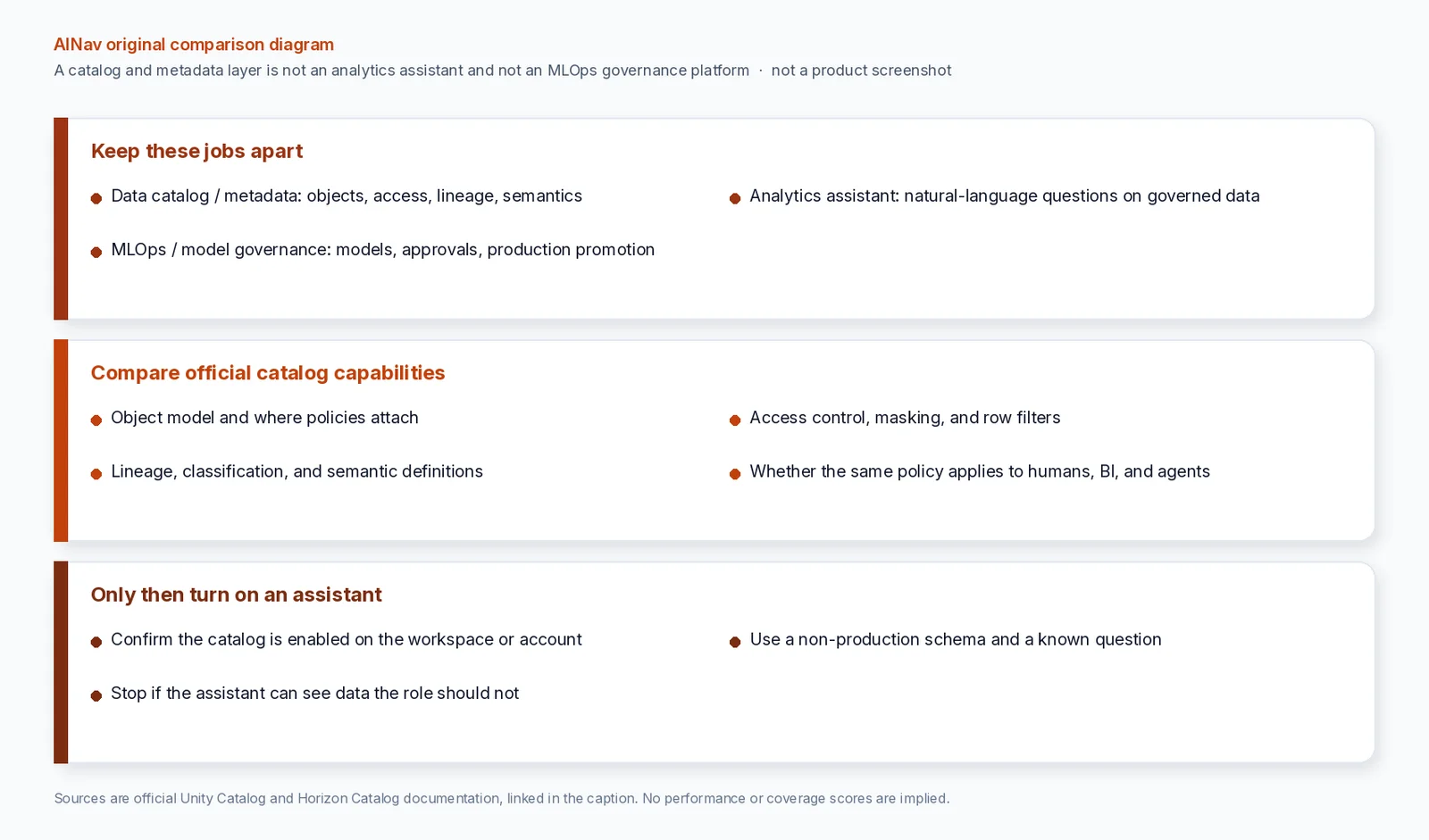
AINav original diagram based on official docs. Sources: What is Unity Catalog?, Unity Catalog setup guide, Databricks Unity Catalog product page, Snowflake Horizon Catalog, Horizon Context. Not an official screenshot or a query-quality test.
Who should make this comparison, and who should wait
This comparison is for data and analytics teams that already have, or are shortlisting, Databricks or Snowflake, and that have been asked to “just turn on” an assistant against production tables. It is also for readers coming from the analytics-assistant or MLOps articles who need the catalog layer those guides do not settle.
It is not a directory of third-party data catalogs that are not live on AINav, and it is not a price sheet. Wait if you cannot get a non-production catalog or schema, cannot name an official admin role, or cannot accept that lineage and semantic views were not inspected in this review.
Frequently asked questions
Is Unity Catalog a separate product I can buy on AINav? The official Databricks documentation describes Unity Catalog as a governance layer built into Databricks, automatically enabled on workspaces created after November 8, 2023, with a Premium-or-above setup prerequisite in the official setup guide. This article does not invent a per-catalog list price. The live AINav related tool is the Databricks platform page.
Is Snowflake Cortex Analyst the same thing as Horizon Catalog? No. Official Horizon Catalog documentation is about the catalog and context layer. Cortex Analyst is a natural-language analytics product listed on AINav. Use this article for the catalog prerequisite, and the analytics-assistant article for the assistant itself.
Do official policies automatically cover every AI agent a team might plug in? Official Horizon text says policies apply to human, BI, and AI-agent callers at the query engine, and Unity Catalog text says the layer can enforce access when you query a table or call a model. Confirm the official path for the specific agent or API you would use. This review did not test an external agent.