guides
How to Evaluate MLOps and Model Governance Platforms Before You Commit
A documentation-based guide to committing to MLOps and model-governance platforms. Official Dataiku docs treat Govern as an additional node with Standard versus Advanced licenses. Official DataRobot docs still describe production-model governance controls, even where current catalog language emphasizes an agent workforce. Official Domino docs treat reproducibility, lineage, and a Governance Center as foundational. This slot replaced a diligence-research topic after official Rogo positioning did not clearly match that job. Not investment advice, and no model accuracy was tested.
A model-governance or MLOps platform is useful when it can inventory what you run, record lineage, require an approval before production, and leave an audit trail after the model (or a later agent that calls one) is live. It is a different job from an analytics assistant that answers questions on a semantic layer, and from a vector database that stores embeddings for retrieval-augmented generation. Those products may all appear under “enterprise AI.” They are not interchangeable.
This documentation-based guide was reviewed on November 22, 2026 (Asia/Shanghai). We did not deploy a model, run a fairness or drift study, or complete an official model-risk file. Descriptions come from official Dataiku, DataRobot, and Domino pages opened that day. Any accuracy, lift, or “faster decisions” language on a vendor page is the vendor’s claim, not an AINav test. This is not a model-performance benchmark, and it is not investment advice.
This slot was originally reserved for diligence and evidence-pack research assistants. Official Rogo pages and the live AINav tool page describe a finance-institution agent and workflow platform, not a clearly scoped diligence evidence-pack product, and the other planned catalog peers were not present as live tool pages. The slot was therefore replaced with this MLOps and model-governance evaluation.
Governance platforms, analytics assistants, and RAG data layers are different jobs
The catalog cores for this review are Dataiku, DataRobot, and Domino. Official Dataiku documentation describes Dataiku Govern as “a unified platform for overseeing and managing data and AI initiatives,” integrated as an additional node, with Standard and Advanced licenses. Official DataRobot documentation still describes model governance for MLOps deployments: access control, testing and validation, model history, humility rules, fairness monitoring, and traceable prediction results. Official Domino documentation describes a platform for building and governing AI in environments with strict compliance requirements, including model development and MLOps, model risk management, and a Governance Center for policies, FinOps, and an audit trail.
Analytics assistants and BI chat are a published, different purchase: see How to Evaluate AI Analytics Assistants Before You Buy. A vector or RAG data layer is another job: see How to Evaluate Vector Databases for RAG Before You Pilot. Do not score a governed ML workbench as if it replaced either of those tools, and do not skip official approval or inventory features because a catalog blurb now also mentions agents.
Current public language around these vendors is not identical. Official Dataiku pages still center a governed data-science and AI platform, with Govern as a distinct node and license. Official DataRobot documentation reviewed here is the classic MLOps governance set, while the live catalog description emphasizes an “enterprise agent workforce” for building and governing agentic applications — evaluate the official controls you actually need (model, agent, or both) rather than assuming the 2019 AutoML story or the catalog sentence is the whole product. Official Domino pages describe MLOps and governance as foundational, alongside newer app-and-agent hosting.
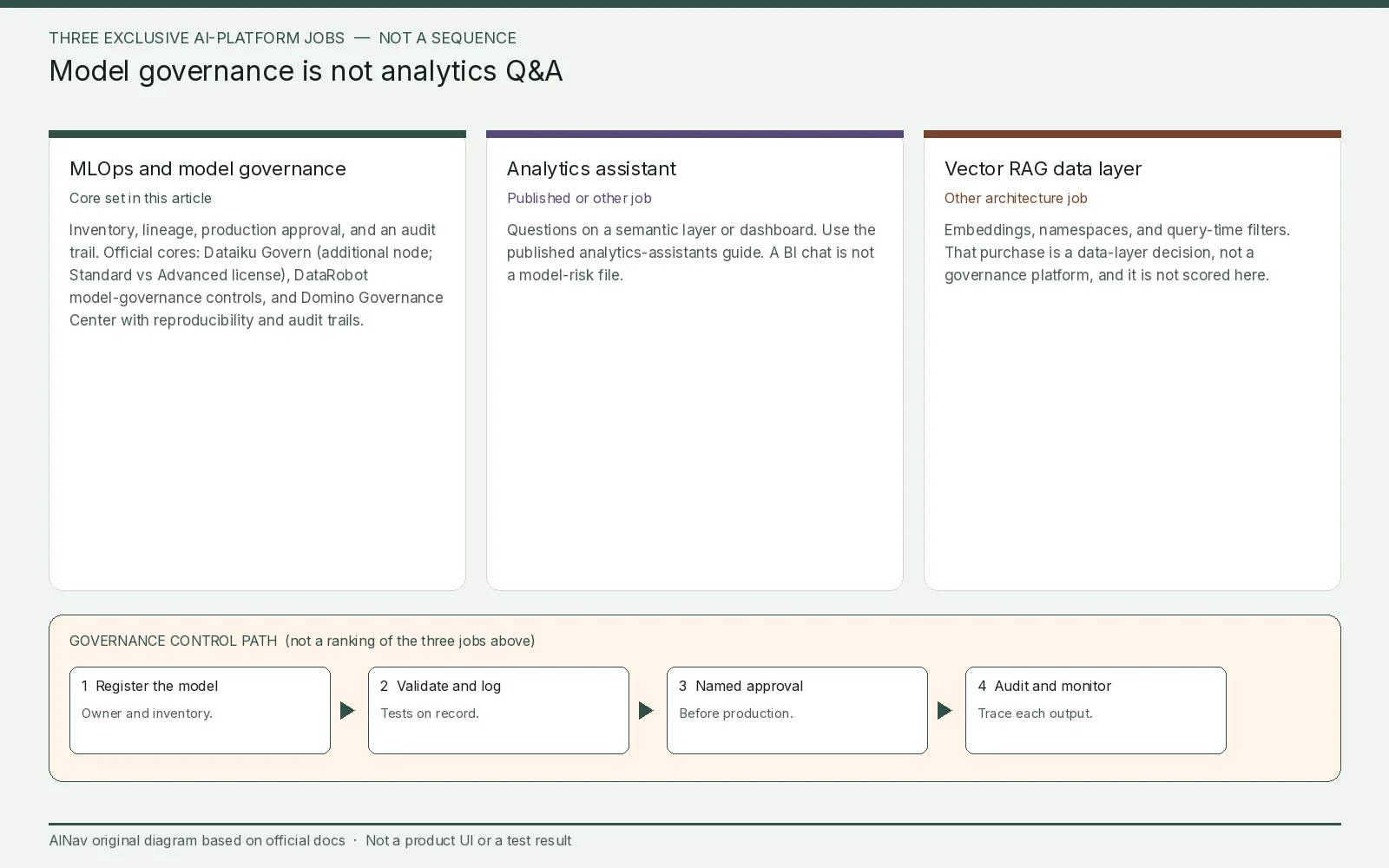
AINav original diagram based on official docs. Sources: Dataiku AI Governance, DataRobot Governance, Domino overview. Not an official screenshot or a test result.
Official controls to demand before anything reaches production
Official Dataiku documentation treats governance as a node you install and configure, not as a checkbox that appears automatically on every trial. Official text distinguishes a Standard license (core platform features) from an Advanced license that adds governance of agentic items, an Agent registry page, custom actions, custom governance templates, custom pages, and scripted settings. Official sections cover instance governance settings and deployment governance policies. A buying implication is immediate: confirm whether Govern is in the contract, which license you are being quoted, and whether the policies you need are Standard or Advanced. Do not assume a generic “Dataiku” entitlement includes the Advanced designer features or even the Govern node.
Official DataRobot governance documentation is written for the moment “machine learning models in production become critical to business functions.” Official aspects include: clearly defined roles, including MLOps admins; access control so only a limited set of people can update production training data, deploy models, or change production environments; testing and validation of each new or refreshed model, with results logged for approval; complete model history, artifacts, and changelogs; humility rules that trigger on individual uncertain predictions, which official docs distinguish from data-drift statistics over time; fairness monitoring against predefined criteria, including recent predictions; and traceable results so a prediction can be attributed to the model version that produced it, even months later when a different model is in production. Official text says a record of request data, response values, timestamps, and a model ID in the response supports that requirement. If your current DataRobot conversation is mostly about agents, ask which of these official model-governance controls still apply to the agentic path, and which require a different SKU or workflow. Do not invent a coverage map the official pages do not state.
Official Domino documentation starts from a different emphasis that matters in regulated shops: the platform “automatically captur[es] reproducible results … and audit trails,” and treats governance as “a foundational capability, not something bolted on.” Official overview language lists reproducibility, auditability, and lineage as built in from the beginning. Official uses include model development and MLOps, a “modern Model Risk Management platform for models in financial services,” and a Statistical Computing Environment for biostatistics. Official structure separates an AI Factory for builders, an App & Agent Hub for hosting, and a Governance Center for lifecycle policies, FinOps, and an audit trail of actions. Official deployment language says Domino can run in private cloud or on-premises infrastructure when required, or as managed SaaS. Confirm which of those official deployment modes is actually quoted; list prices were not used in this review and are typically provided by quote.
Failure conditions: a proof of concept trains a model but never registers it; Govern or Governance Center is demoed on a slide and missing from the lease; production can be updated without a logged approval; predictions cannot be traced to a model version; a fairness or humility rule exists in docs but is not in the pilot; or an analytics assistant is signed as if it were model-risk infrastructure.
A commit check that starts with a non-production model
Use a non-production workspace, a disposable dataset, and a model that is allowed to fail. Do not promote a customer-impacting model until inventory, approval, and audit settings are recorded. Then check six things:
- Job fit. MLOps and model (or agent) governance, analytics Q&A, or a RAG data layer — pick one official job.
- Inventory. Every candidate in the pilot appears in the official governance inventory or registry, with an owner.
- Approval path. A named role must approve production deployment. Official DataRobot language expects tests and results to be logged for that approval.
- Lineage and reproducibility. You can see how the candidate was trained or built, and official Domino language about captured results and audit trails should be verified, not assumed.
- Production monitoring. Confirm which official controls — drift, humility, fairness, or policy engines — are in scope, and who is alerted.
- Contract shape. For Dataiku, confirm the Govern node and Standard versus Advanced license. For Domino, confirm SaaS versus self-managed. For DataRobot, confirm whether official MLOps governance, agent-workforce features, or both are in the quote.
Stop the evaluation, or keep the candidate in the lab, if production changes have no approver, if you cannot attribute an output to a version, or if the product in front of you is a BI assistant or a vector store you mistook for a governance platform.
Who this purchase is for, and who should look elsewhere
This evaluation is for ML platform owners, model-risk staff, and enterprise AI leads who need official inventory, approval, and audit controls before a model or governed AI system is promoted.
It is not an analytics-assistant comparison, not a vector-database review, not a diligence or investment-research tool, and not a claim that any vendor reduced risk or improved accuracy in this review.
Frequently asked questions
Why was this article not written as a diligence-research guide? Official Rogo positioning, confirmed on the official site and the live AINav tool page, is a finance-institution agent and workflow platform. That identity does not clearly match a diligence evidence-pack category, so this reserve MLOps topic was used instead.
Does buying Dataiku automatically include Dataiku Govern? Official documentation describes Govern as an additional node with its own Standard and Advanced licenses. Confirm it is in the contract.
Is DataRobot still an MLOps governance product? Official DataRobot documentation reviewed for this article still describes model-governance controls for production ML. Current commercial language also emphasizes agentic applications. Ask which official controls are in the offering you are being sold.
Can we treat a vendor audit log as a completed model-risk file? No. Official features can support an audit trail and approval workflow. A human still has to review each required artifact. This article is not a regulatory opinion and is not investment advice.