guides
How to Evaluate AI Lead-Generation and Prospecting Tools Before You Buy
A documentation-based guide to buying list, enrichment, and outbound tools. Official Apollo terms put lawful-basis and marketing-law compliance on the customer, prohibit unauthorized scraping and LinkedIn API automations, and say compiled data may contain errors. Conversation intelligence is a different job. Not legal advice.
Lead generation, in the sense of this article, is the work of finding and enriching business contacts, then running outbound from that list. Conversation intelligence (recording and coaching sales calls) and sales enablement (content and playbooks for reps already in a deal) are different purchases. Mixing them usually produces a second seat no one uses, or an outreach tool asked to score meetings it never joined.
This documentation-based guide was reviewed on November 21, 2026 (Asia/Shanghai). We did not build a prospect list, send outreach, or measure reply rates. Descriptions come from official Apollo product pages and Apollo’s Terms of Service, last updated August 10, 2026, opened that day. Contact-database sizes, “verified” language, and meeting-lift quotes are vendor or customer-story claims, not AINav tests. This is not legal advice, and it is not a guide to scraping, evading platform rules, or contacting people without a lawful basis.
Three exclusive sales jobs, not a funnel in one vendor
The core catalog product here is Apollo: an official go-to-market platform that combines a contact and account database, enrichment, and multi-channel outreach.
A sales-intelligence or conversation-intelligence purchase is a different job. If you need recorded-call coaching, intent data, or a broader intelligence bake-off, start with how to evaluate AI sales-intelligence tools. ZoomInfo Copilot, LinkedIn Sales Navigator, Gong, and HubSpot AI belong in that conversation or in their own official docs—not as padded “also core” rows in this one. SeekOut is a recruiting product and stays out.
Enablement platforms that store battle cards and training are a third column. They do not build your outbound list.
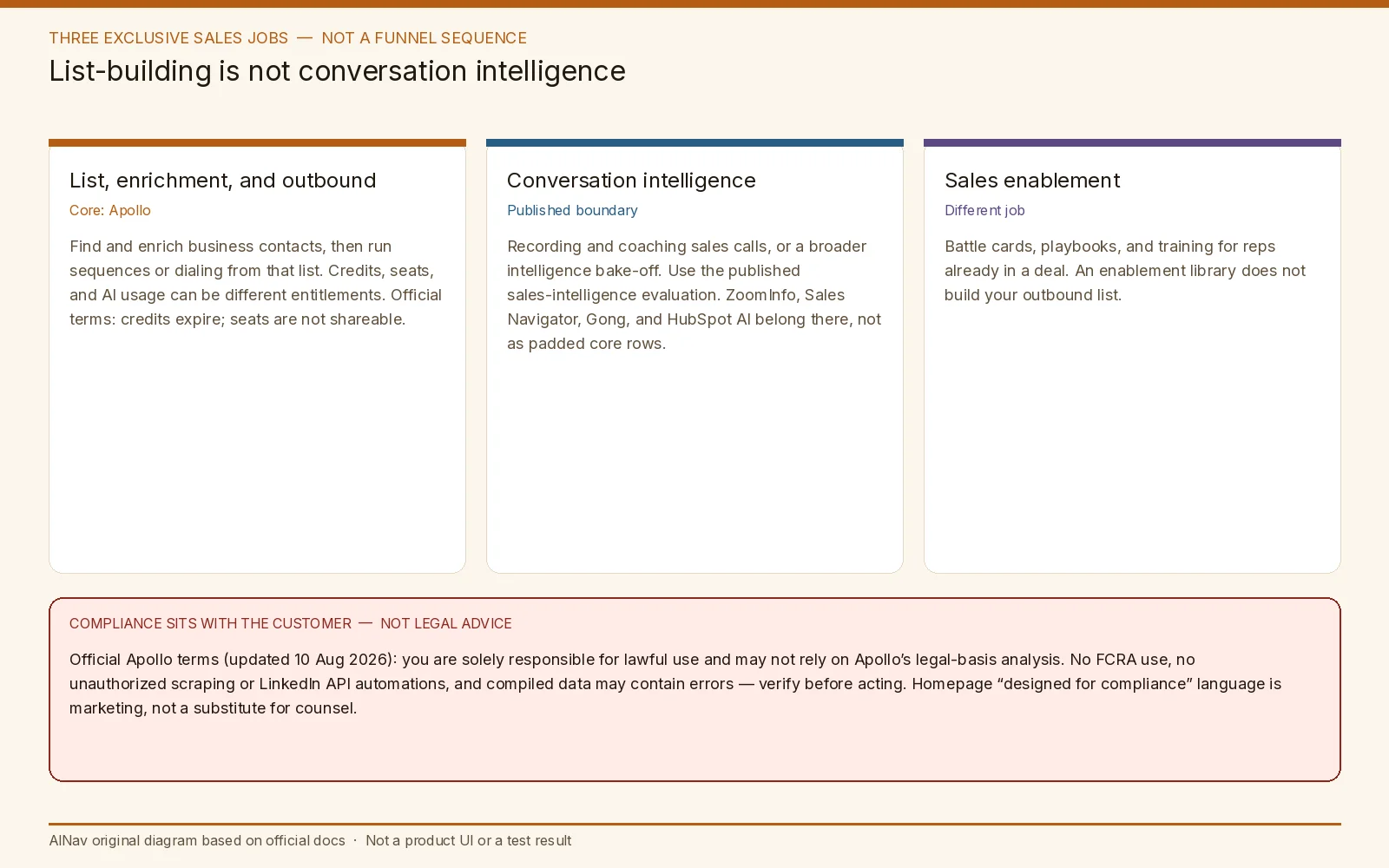
AINav original diagram based on official docs. Sources: Apollo, Apollo Terms of Service. Not an official screenshot or a test result.
What Apollo officially sells, and what it puts on you
Apollo’s official homepage markets prospecting, enrichment, sequences, dialing, and agents that can research accounts, build lists, and draft outreach. It also states large database figures (240 million-plus contacts and 30 million-plus accounts on the pages reviewed) and “designed for compliance” language that mentions GDPR, CAN-SPAM, and do-not-call marketing. Treat the counts as vendor claims. Treat the compliance headline as marketing until you read the terms.
The Terms of Service are more specific than the homepage, and they put the legal burden on the customer. Official terms state that you are solely responsible for the lawfulness of your use, and that you must independently ensure compliance with privacy, data-protection, data-broker, marketing, communications, and AI laws. You may not rely on Apollo’s own legal-basis analysis. The terms prohibit FCRA uses (credit, insurance, employment, or tenant screening of a consumer in the FCRA sense), illegal marketing, and failing to follow CAN-SPAM, CASL, and TCPA where they apply. They also prohibit scraping, bots, or crawlers except as the product expressly includes, LinkedIn automations via the API, and reselling the Contributor Database. Business contact information may not be used to train third-party models, with only a narrow official exception for certain internal models. Data compiled from third parties “may contain errors”; the terms tell you to verify information before you act on it.
Those are buying constraints, not footnotes. If your team’s plan is “the vendor already checked lawful basis,” official terms say otherwise. If the plan is to automate LinkedIn or to scrape a site the product does not authorize, official terms forbid it.
Commercial packaging is a second axis. Official terms say credits expire at the end of the billing cycle and do not roll over, and that seats are not shareable. Auto-renewal applies unless you give the required non-renewal notice (thirty days on the terms reviewed). Exact list prices and regional tax are omitted here because they should be read from the current official pricing page for your plan and billing cycle; annual versus monthly, credit packs, and seat minimums are different SKUs, not automatically an official-price conflict.
Features on the homepage are still entitlements to verify
Official product pages describe more than a raw contact list: filters and saved lists, enrichment (including language about filling gaps from additional sources), sequences, a dialer, buying-signal style features such as website visits or job changes, CRM connections, and agents that draft or operate outreach. Those are reasons to trial the workspace. They are not, on the pages opened for this review, measured reply-rate or meeting-lift results.
Two practical implications follow. First, list access, credits, dialer features, and AI-agent usage may be packaged as different entitlements on the same platform. Confirm which of those you are actually buying, on which cycle, and whether unused credits expire—as official terms say they do at the end of a billing cycle. Second, a “signal” is only useful if your team will review it before a sequence starts. Official terms already tell you compiled data can be wrong; a job-change flag or a website-visit label should get the same check as an email address.
If the feature you cannot live without is call recording, deal coaching, or a different vendor’s intent graph, you are no longer evaluating this job. Stay with the published sales-intelligence article rather than stretching Apollo, or any one prospecting tool, into that role.
A buying check that does not start with a live campaign
Use a small, lawful test: a handful of already-known, appropriately permissioned contacts or a sandbox, not a cold blast to a purchased-looking list you have not reviewed. Then check five things:
- Job fit. Do you need list, enrich, and outreach in one workspace, or do you actually need call recording and coaching? If it is the latter, you are in the sales-intelligence article.
- Data you will act on. Official terms say records can be wrong. Spot-check emails, titles, and do-not-contact flags before a sequence goes out.
- Lawful basis and marketing rules. Confirm, with your counsel, the basis on which you will contact people in each country you target. Apollo’s homepage compliance language does not replace that review.
- Product limits in the terms. No unauthorized scraping, no LinkedIn automation via the API, no FCRA use, no seat sharing, and no assuming leftover credits will roll over.
- CRM and human approval. Know what syncs into Salesforce or HubSpot, who can launch a sequence, and what happens when a prospect opts out.
Stop the purchase if the database cannot be verified on a sample, if your use case is screening consumers under FCRA, if the team’s intended workflow is a prohibited automation, or if nobody owns opt-out and complaint handling.
Who this purchase is for, and who should look elsewhere
This evaluation is for B2B sales and marketing teams that need documented prospecting and outreach, with a person accountable for list quality and legal use.
It is not for recruiting, consumer credit or tenant screening, or teams whose real gap is conversation intelligence. It is not permission to contact anyone in the database. Official terms leave that responsibility with you.
Frequently asked questions
Does a large contact count mean the emails are verified? Official pages use “verified” and large-database language. Official terms still say third-party compiled data may contain errors and that you should verify before acting. This review did not audit match rates.
Is “designed for compliance” enough to start outbound? No. Official terms say the customer cannot rely on Apollo’s legal-basis analysis and must comply with applicable marketing and privacy laws. Get counsel. This article is not legal advice.
Why is only Apollo in Related tools? It is the live catalog core for this job in this review. Adjacent intelligence and enablement products are covered in the published sales-intelligence evaluation or in their own official docs, not padded into this list.
Can we scrape additional sites or automate LinkedIn to fill gaps? Official terms prohibit scraping or bots except as expressly included, and prohibit LinkedIn automations via the API. Do not treat this article as a workaround.