guides
How to Evaluate AI Sales Intelligence Tools Before You Buy
A documentation-based sales intelligence buying guide: separate research, Sales Navigator outreach, conversation analysis, and enablement. No real contacts tested; accuracy and compliance not guaranteed; prices not verified.
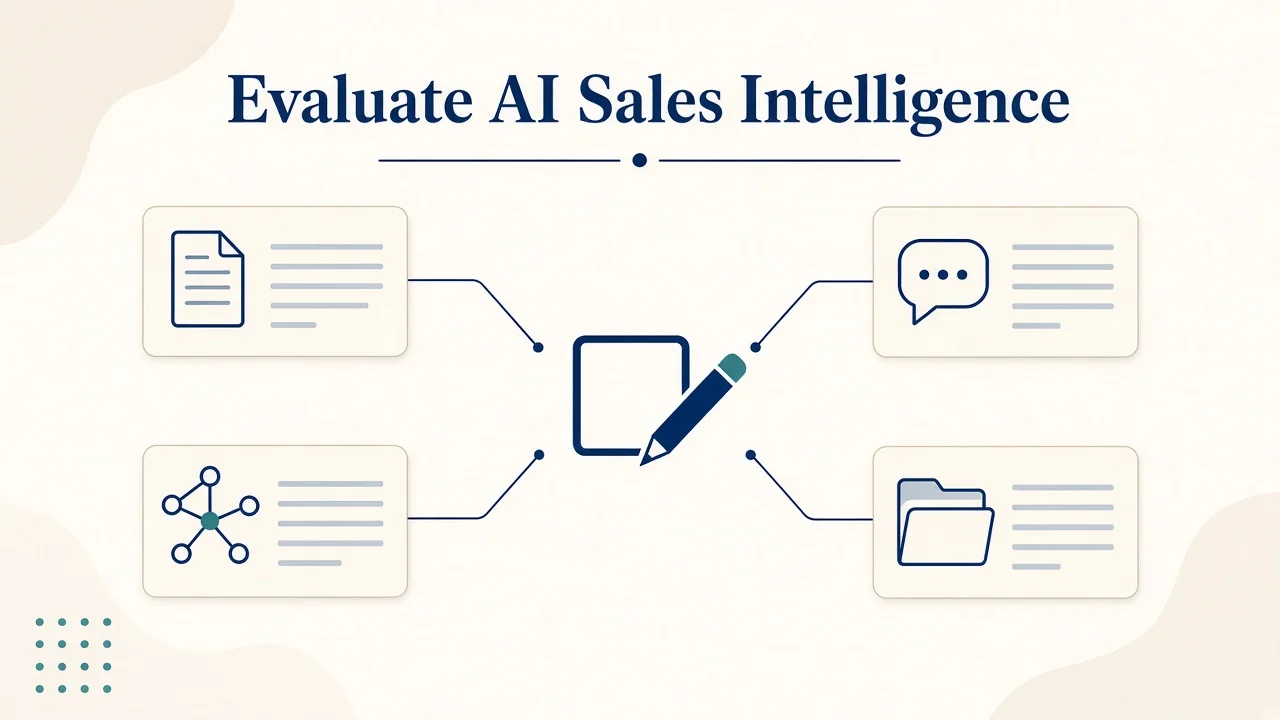
Buying sales intelligence starts with locating a failure in the sales process. Missing account context, difficulty finding stakeholders, poor visibility into conversations, and inconsistent use of approved sales material are different problems. A product can contribute to several stages without being the right first purchase for all of them.
This documentation-based guide was reviewed on November 10, 2026. We did not enter a sales tenant, retrieve real contacts, record calls, connect a CRM, or send outreach. Product descriptions identify areas to investigate; the acceptance criteria are proposed buyer checks. No data coverage, contact accuracy, privacy compliance, pipeline improvement, or win-rate result is guaranteed.
Choose the sales problem before the platform
ZoomInfo Copilot is a candidate for account research and buying-signal workflows. ZoomInfo's official Copilot overview video describes account summaries drawing on CRM data and customer engagement. That older overview establishes the intended category, not today's complete package. Current Copilot SKU boundaries, required data subscriptions, and exact included AI functions are not verified here. Request a current written scope before treating a feature as included.
LinkedIn Sales Navigator addresses finding buyers and developing sales relationships through LinkedIn's network. Its official product page describes search, lead and account signals, InMail, and plan-dependent CRM capabilities. It is not LinkedIn Recruiter. A hiring workflow involving candidate search and an applicant tracking system is a separate buying decision, even if both products use professional profiles.
Gong is relevant when the missing evidence sits in sales interactions and deal execution. Gong's official FAQ describes conversation capture and analysis alongside revenue applications. Evaluate the path from an interaction to an inspectable coaching observation or proposed action. Do not reduce this purchase to generic meeting notes, and do not assume that conversation analysis supplies an external prospect database.
Highspot by Seismic belongs in the discussion when sellers need governed content, plays, practice, and guidance. Its official platform page explicitly uses that name and describes revenue execution. Seismic's merger completion announcement independently supports the corporate relationship. The identity is verified from the vendors, rather than inferred from AINav's directory label. Combined ownership does not establish that every Seismic capability is included in a Highspot contract.
Define the environment and the red lines
Before a vendor presentation, record the CRM and edition, sales regions, approved communication channels, data owners, and the activities that require human review. Identify who may correct a contact, change account ownership, update a deal stage, or approve an outbound message. Write these as permissions and business rules rather than a vague request for automation.
Separate research access from write access. A system that reads an account record should not automatically receive permission to overwrite it. Decide whether a proposed recommendation should remain a note, become a draft task, or enter a review queue. Automated CRM writes and outreach require sales operations and qualified legal or privacy review under the organization's applicable obligations.
Use a fictional ideal customer profile for evaluation planning: an invented supplier selling inventory software to mid-sized manufacturers. Create three synthetic account profiles with different operational needs and procurement stages. Do not use real company contacts, invented people attached to real employers, personal email addresses, or exported customer records. The goal is to evaluate reasoning and workflow requirements without exposing identifiable people.
Ask where every recommendation comes from
Require the vendor to distinguish supplied CRM facts, external data, inferred intent, and model-generated suggestions. A useful account summary should make those boundaries visible. Ask how stale or disputed data is corrected, what refresh information is available, and what happens when two sources disagree. A confident sentence is not evidence that the underlying account fact is current.
For the synthetic profiles, prepare questions such as: what supplied evidence supports this priority, what information is missing, and which recommendation depends on an assumption? Define a passing response as one that preserves uncertainty and lets a reviewer inspect the basis. This is a proposed exercise; we did not run it in any product.
Buying signals deserve particular care. A signal can suggest an investigation without establishing budget, authority, timing, or consent to contact someone. Do not allow a scoring label to become an unsupported statement about an individual's intentions. Request documentation of source categories and permitted uses rather than demanding a vendor promise that all data is always accurate.
Examine CRM behavior field by field
“CRM integration” is too broad to serve as an acceptance condition. Specify objects, fields, sync direction, timing, duplicate handling, and the authority used to perform changes. Ask whether the integration reads a contact, creates a new record, enriches an existing one, logs an interaction, or starts a sequence. Each action can have a different entitlement and operational consequence.
LinkedIn's product documentation explicitly separates some CRM features by plan. Apply that same discipline to every shortlist entry: mark a requirement as documented, separately licensed, integration-dependent, or not verified. Do not use a partner logo as evidence that the required write path works with your CRM edition and field rules.
A future authorized sandbox evaluation should include conflicting updates and a duplicate synthetic record. Require an identifiable reviewer, a change history, and a recovery plan before any write-enabled pilot. We did not perform synchronization, duplicate resolution, permission enforcement, or rollback tests. A documentation review cannot establish how a connector behaves in a particular tenant.
Keep conversation analysis and coaching reviewable
For conversation-oriented evaluation, use a written fictional discussion rather than a real recording. Include a buyer question, an unresolved objection, and a seller statement that should not be treated as a commitment. Ask how the product distinguishes what was said from what it infers, and how a manager can challenge a summary or recommendation.
Recording permissions, notices, retention, access controls, and cross-border handling require qualified review for the actual deployment. Do not assume a vendor's security page makes recording lawful in every region. Likewise, a coaching score should not become an unreviewed assessment of an employee. Define who can inspect, correct, and contest it before deciding how managers will use it.
For enablement, ask how approved material is selected and how obsolete content is withdrawn. A proposed practice scenario should use fictional personas and approved product facts. Check the intended boundary between a suggested sales play and an action taken on a buyer's behalf. No role-play, content recommendation, or coaching feature was tested for this article.
Recognize the CRM and marketing boundary
HubSpot AI represents a customer-platform route: HubSpot's official AI overview places agents within its broader marketing, sales, and service platform. Existing CRM context may make that route relevant, but a CRM-native assistant is not automatically a replacement for independent external account intelligence. Compare the missing job, data source, and permission path rather than the word “AI.”
Lifecycle marketing concerns coordinated customer journeys and campaign execution—see HubSpot AI vs Adobe Journey Optimizer for Lifecycle Marketing. Recruiting concerns candidates and hiring workflows; for that separate pilot frame, see How to Evaluate AI Recruiting Tools Before You Pilot. Generic meeting transcription concerns records of discussions. These areas can overlap with sales operations, but buying one category does not resolve the others. Keep the decision centered on account research, sales relationships, interaction analysis, or enablement execution.
Resolve commercial scope before committing
Comparable prices, seat requirements, data packages, AI usage allowances, InMail entitlements, recording storage, implementation charges, and renewal conditions are not verified for this buying scenario as of November 10, 2026. No subscription figure or free-access promise is used here. Public feature descriptions do not establish an organization's purchasing eligibility or complete bill.
Request a quotation that identifies country, currency, billing period, product name, edition, seats, required integrations, usage meters, overages, and services. For Highspot by Seismic, ask which platform and modules the proposal covers. For ZoomInfo Copilot, request the current relationship between the AI functions and underlying data access. Keep unresolved items visible rather than estimating them from directory descriptions.
Set an exit condition for the pilot
A contained future pilot should answer one business question with synthetic records and approved review steps. Judge traceable evidence, correction paths, reviewer effort, and workflow fit. Do not present a short exercise as a win-rate experiment. Stop if sources remain opaque, permissions exceed the agreed scope, or the team cannot recover its own evaluation materials and revoke access.
Frequently asked questions
Must we buy all four categories? No. Investigate the bottleneck first and document what existing systems already cover. Overlap is a reason to clarify scope, not to accumulate subscriptions.
Does verified vendor identity prove capability? No. Highspot by Seismic's identity is confirmed, while specific entitlements and tenant behavior still need separate evidence.
Can a good recommendation be sent automatically? Treat it as a draft until an authorized reviewer approves the facts, recipient, channel, and applicable contact rules. This evaluation sent no messages.