reviews
n8n vs Zapier Agents vs Coze for No-Code AI Workflows
Same end-to-end no-code AI workflow across n8n, Zapier Agents, and Coze: n8n for controllable/self-host paths, Zapier Agents for SaaS-heavy business users, Coze for conversational bot+plugin orchestration—compare auth, human approval, retries, and deploy model before locking in.
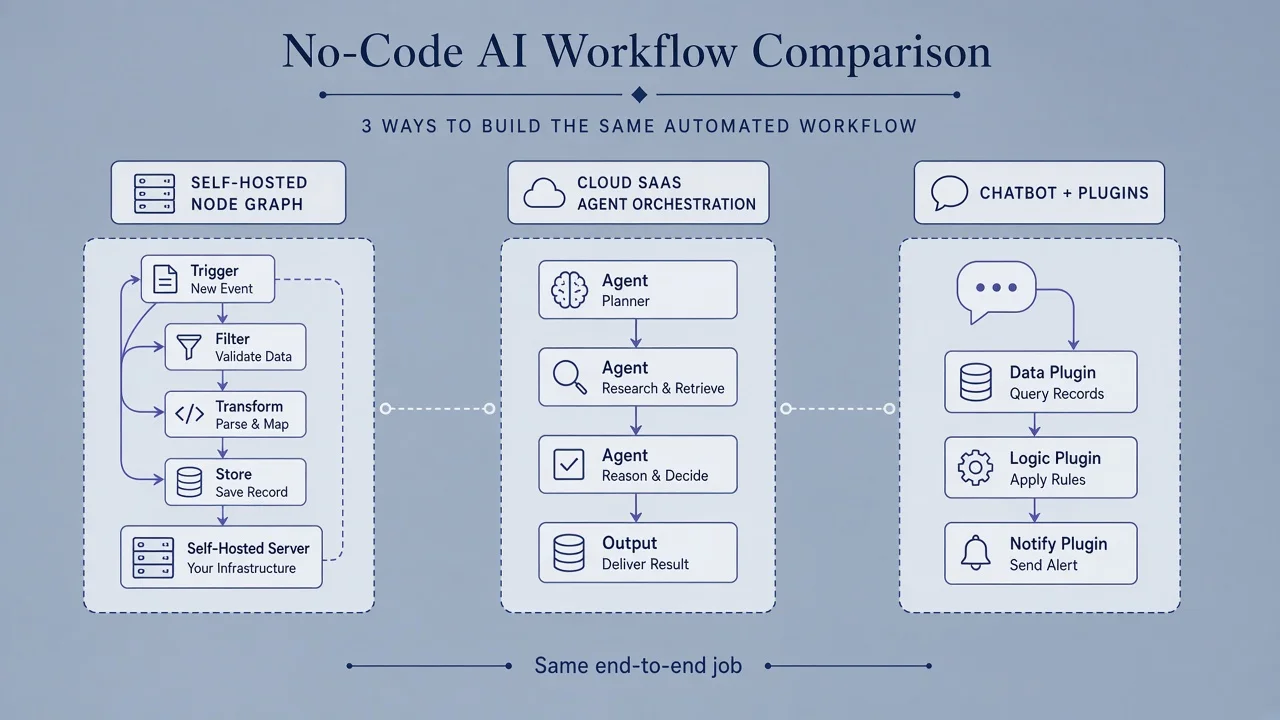
Buying the wrong automation surface costs more than a failed demo Zap: leaked API keys, silent retries that double-charge a CRM, or a bot that writes customer data with no human gate. Primary: n8n, Zapier Agents, Coze. Optional adjacency only—Dify, CrewAI, AgentBuilder—do not expand into a “50 agent platforms” listicle. For the five-pillar pre-commit checklist, see How to Evaluate AI Agent / Automation Platforms Before You Commit.
Bottom line:
- Choose n8n when you need a visual node graph, configurable retries, and a self-host option for data-residency-sensitive teams.
- Choose Zapier Agents when business users already live in the Zapier SaaS graph and want agent behaviors on top of connected apps with minimal ops.
- Choose Coze when the product is a conversation-first bot with plugins/workflows aimed at end-user assistants rather than back-office ETL.
Do not rank by “most AI.” Split by auth hygiene, human approval before write-backs, observability, and self-host vs pure SaaS.
Findings: public docs + limited hands-on (verification 2026-11-06, Asia/Shanghai). No invented accuracy %, token-cost guarantees, MAU, or locked dollar prices.
What each product is optimized for
| Product | AINav | Public positioning (shape) | Best first fit |
|---|---|---|---|
| n8n | /tool/n8n | Workflow automation with AI nodes; Cloud or self-hosted; execution-based Cloud metering | Ops / IT workflows needing graph control + residency options |
| Zapier Agents | /tool/zapier-agents | AI agents on Zapier’s app graph; activity-based Agents usage; sits beside classic Zaps | Business teams already on Zapier who want agent teammates |
| Coze | /tool/coze | Bot / agent studio with plugins + workflows; usage via credits/tokens | Chat-first assistants and plugin-orchestrated UX |
How we tested (identical five tasks)
One shared end-to-end job. Same five checks on each tool.
Shared job: inbound Webhook or form submit → LLM summarize (fixed prompt) → write a row to a sheet / table or post a notify → stop. Freeze the prompt and the destination schema before comparing UIs.
| # | Shared task | What “good” looks like |
|---|---|---|
| 1 | Webhook/form → LLM summary → sheet/notify | One clean end-to-end run without silent double writes |
| 2 | Auth: OAuth / API key rotation + least privilege | Keys scoped; failed auth surfaces clearly; retries configurable |
| 3 | Human approval before external write | Pause / confirm node (or equivalent) before CRM/sheet write |
| 4 | Observability | Run log; cost/token or task/activity meter visible on public capability |
| 5 | Deploy model | Self-host vs SaaS path + public data/residency statements only |
Task 1 — Same end-to-end job
| Product | Fit | Watch-out |
|---|---|---|
| n8n | Native webhook + AI/LLM nodes + Sheets/Slack-class connectors in one graph (limited hands-on). | Cloud bills on workflow executions—debug loops burn quota; prefer pinned test data. |
| Zapier Agents | Agent behaviors on connected Zapier apps; strong when the destination already exists as a Zapier action (limited hands-on). | Agents activities are a separate meter from classic Zap tasks—do not mix the two in a budget spreadsheet. |
| Coze | Bot + plugin/workflow path fits “user asks → agent acts” more than pure webhook ETL (limited hands-on). | Map whether your trigger is chat, API, or workflow run; billing uses credits/tokens per public docs. |
Takeaway: Back-office webhook ETL leans n8n. “Teammate that uses our SaaS apps” leans Zapier Agents. “Customer-facing assistant with tools” leans Coze.
Task 2 — Auth, rotation, retries
| Product | Fit | Watch-out |
|---|---|---|
| n8n | Credentials store + per-node auth; self-host can keep secrets on your infra (limited hands-on). | Rotate keys in the credential object, not hard-coded in Function nodes. Configure error workflows / retries explicitly. |
| Zapier Agents | Uses Zapier’s connected accounts; least-privilege is “only connect apps the agent needs” (limited hands-on). | Public notes: Enterprise app/action restrictions may not fully apply to Agents—confirm before regulated rollouts. |
| Coze | Plugin auth + bot publish surfaces; API/Web SDK paths meter separately (limited hands-on). | Treat plugin secrets like production secrets; revoke on publish/unpublish. |
Task 3 — Human approval before write-back
| Product | Fit | Watch-out |
|---|---|---|
| n8n | Wait / form / webhook-continue patterns and explicit branches before write nodes (limited hands-on). | If nobody owns the approval inbox, the “human gate” becomes an infinite wait—set SLAs. |
| Zapier Agents | Behavior design should require confirmation for irreversible actions; pair with Zap paths that stage drafts (limited hands-on). | Chatty agents can skip gates if you over-grant write tools—strip write actions until review passes. |
| Coze | Conversation UX can ask the user to confirm before plugin write (limited hands-on). | Silent plugin side-effects are the failure mode—default deny on mutating plugins. |
Takeaway: Any path that can create invoices, tickets, or PII rows needs a deliberate pause. If the product cannot pause, keep writes in a staging sheet first.
Task 4 — Observability & metering
| Product | Fit (public capability) | Watch-out |
|---|---|---|
| n8n | Execution history; higher Cloud tiers advertise longer insights windows; self-host can stream logs (limited hands-on). | Know whether you are debugging an execution failure or an LLM hallucination—different fixes. |
| Zapier Agents | Activity counting for agent actions/chat/browse per public Agents FAQs (limited hands-on). | Team plans may share an activity pool—spot noisy agents early. |
| Coze | Credit/token deduction for models and chargeable plugins; free API/Web SDK call allowances called out in billing docs (limited hands-on). | Studio testing credits ≠ API token pool—budget the path you will actually ship. |
Task 5 — Deploy model & public residency statements
Re-open vendor docs before a security review; do not invent compliance conclusions.
| Product | Deploy shape (public) | What to verify | Source |
|---|---|---|---|
| n8n | n8n Cloud or self-hosted / Business+ self-host options on public pricing | Where workflow data and credentials live; SSO/LDAP on higher bands; queue mode / environments | n8n.io/pricing |
| Zapier Agents | Pure SaaS on Zapier; try via agents.zapier.com with a Zapier login | Task plan vs Agents activity plan; Team shared pools; Enterprise restriction caveats | zapier.com/pricing, agents.zapier.com |
| Coze | SaaS bot platform; usage-based credits/tokens | Model vs plugin charges; API vs in-product credit paths; publish regions you actually need | docs.coze.com/guides/billing |
Residency note: Self-host n8n is a control option, not an automatic compliance stamp. SaaS Agents/Coze need your legal team to read the live DPA—not this article.
Scenario picks (not a leaderboard)
- Data-residency-sensitive ops team that wants a node graph → n8n (often self-host)
- RevOps / marketing already paying for Zapier tasks who want an agent teammate → Zapier Agents
- Product/support shipping a chat assistant with tools → Coze
- Doc-heavy LLM apps with custom RAG UX → consider Dify as adjacency
- Code-first multi-agent crews → CrewAI
- Builder-oriented agent IDEs after the no-code fork → AgentBuilder
FAQ
When is n8n the wrong buy?
When non-technical users need a chat-shaped agent on top of 50 SaaS apps with zero graph literacy—and you refuse to own hosting or Cloud ops.
When is Zapier Agents the wrong buy?
When you must self-host, keep credentials off a multi-tenant SaaS, or need fine-grained Enterprise action restrictions that Agents do not yet honor.
When is Coze the wrong buy?
When the job is silent back-office ETL with no conversational surface—or when you need a self-hosted workflow engine first.
What did we not measure?
No SOC2/ISO legal opinions, no invented token $ / 1k pricing tables, no MAU. End-to-end runs and approval UX notes are limited hands-on.
How should pricing be re-checked before an annual commit?
Open n8n pricing, Zapier pricing + Agents activity FAQs, and Coze billing docs on purchase day. Map executions vs tasks vs activities vs credits/tokens separately. Screenshot the plan card; never lock blog dollar figures into a SOW.
Related on AINav
- Tools: n8n · Zapier Agents · Coze · Dify · CrewAI · AgentBuilder
- Guide: How to Evaluate AI Agent / Automation Platforms Before You Commit
List your AI tool
Building an AI workflow, agent, or automation product worth cataloging on AINav?
List your AI tool → /submit
(Standard Listing is currently US$9.90 one-time on the submit flow—confirm the live checkout; weights may change later.)