growth
After launch: an AI visibility and user-feedback loop
Turn a scoped Brand Radar finding and existing Typeform feedback into one verified page improvement, without inventing conversion attribution.
Your product is live. An AI answer mentions it, visitors arrive, and a few users send feedback. That does not yet explain what to change. A visibility dashboard measures one part of discovery; a user’s unanswered question may expose a different problem between discovery and first value.
This post-launch growth loop combines Ahrefs Brand Radar with existing, appropriately collected feedback in Typeform AI. The goal is one evidence-backed landing-page or help-page improvement, followed by a scoped review—not a claim that AI mentions caused sign-ups. It is an editorial operating method based on official documentation checked November 25, 2026. We did not connect accounts, collect feedback, change a website, or measure growth. All worked examples are fictional.
1. Choose the decision after launch, not another launch checklist
Start after the site and basic product experience exist. If you still need those assets, use the separate product-launch preparation checklist. Here, the question is narrower: what misunderstanding or missing information prevents an interested person from trying the product appropriately?
Write a decision statement before opening dashboards. For example: “Decide whether the setup page needs a supported-file-types table before the next acquisition push.” Identify the page owner, the product fact to verify, the first useful action a visitor should understand, and a review window. Do not invent a conversion event merely because a chart needs a denominator.
Keep three signal families apart: AI visibility, observed website/product behavior, and what respondents report. This workflow uses the first and third directly. If you already have lawfully configured analytics, behavior can add context, but Brand Radar mentions are not sessions and Typeform answers are not a complete record of visitors. Without a measured acquisition path, do not calculate an “AI-to-sign-up conversion rate” by dividing unrelated numbers.
2. Turn AI visibility into a specific information gap
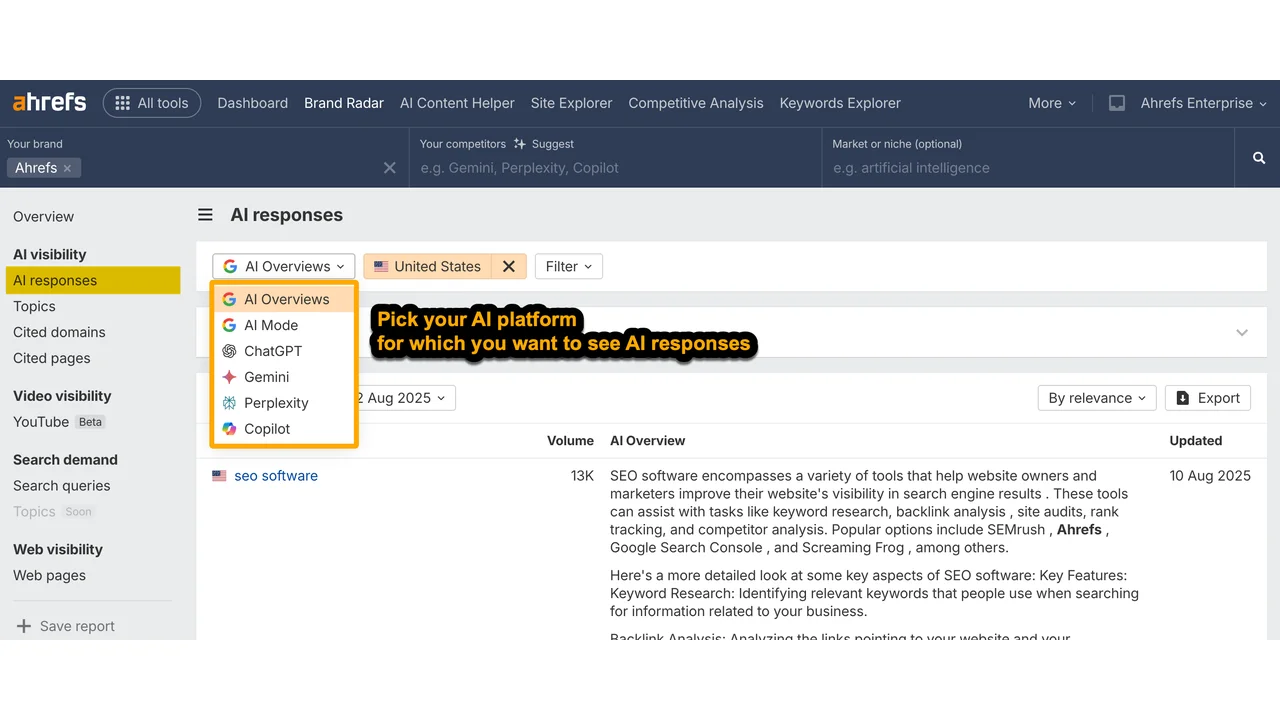
In Brand Radar’s documented AI responses report, search for your brand, choose the relevant AI platform, and read the questions beside the answers. Fix the country/location and other filters you intend to compare. Save the query, answer date, platform, cited pages, and the exact sentence needing attention.
Run two different checks. For non-branded discovery, look for queries that do not contain the brand while the response or citation does. For an owned-source gap, inspect branded queries and answers that mention the brand but do not cite your website. A missing citation is a candidate investigation—not proof that an AI platform excluded you unfairly or that publishing another page will win a citation.
Read the metric definitions too. Ahrefs counts a mention once per response even when the brand appears repeatedly. Estimated impressions are search-volume-based visibility estimates, not measured people viewing your product. Keep platform and competitor definitions stable before interpreting share-of-voice changes.
New brands may have little coverage in the pre-collected index. The current product page explicitly distinguishes that index from Custom Prompts, whose data accumulates after tracking starts. No indexed mention does not prove zero real-world discovery. If you use custom tracking, budget checks rather than assuming unlimited monitoring: the page lists Lite with 150 included checks/month, illustrating five prompts checked daily on one platform. More platforms consume more checks; Claude consumes 8 checks per update, so the five-prompts-daily example is not a universal allowance for every platform. This is an allowance within a paid plan, not a free Ahrefs subscription. We do not quote a localized currency price as a universal offer.
3. Check whether real users have the same unanswered question
Use an existing feedback form only when its purpose and permissions support this review. Do not send a new survey simply to populate this method. Typeform’s official response-review instructions place individual answers under Results → Responses, separate from aggregate summaries.
Narrow the date range, inspect relevant completed or partial responses deliberately, and open individual answers for context. A partial response is not necessarily a failed customer, and a completed response does not prove activation. If your existing form asks how someone found you, treat that as self-reported attribution, not an exact link to a particular AI answer.
Use a small manual response tag such as “file-limit-question” to retrieve the relevant evidence, if appropriate. The documented manual Tags column is different from automated tagging rules configured before submission. This method does not require Smart Insights, AI-generated themes, a new integration, or uploading responses into another model. Typeform documents limits of 30 tags per response and 100 unique tags per form; a compact vocabulary is easier to maintain than a tag for every sentence.
Keep the context privately, and summarize only what the answer actually says. Do not paste names, email addresses, private contract details, or raw customer comments into Brand Radar prompts. Your research question can be public even when the evidence used to prioritize it is confidential.
4. Choose one growth hypothesis from two separate evidence streams
The following is a fictional planning example, not an Ahrefs or Typeform result. “DemoDesk” is a made-up product. No rows were generated in either service.
| Evidence stream | Illustrative observation | Proposed response |
|---|---|---|
| AI answer | Describes DemoDesk as accepting every spreadsheet format; no owned specification is cited. | Check the actual supported formats before correcting the public explanation. |
| Existing feedback | A respondent says, “I couldn’t find whether CSV imports are supported.” | Improve information findability; do not assume the feature is broken. |
| Product facts | The team’s verified specification lists only particular formats. | Publish an accurate, discoverable support table rather than promising an unbuilt feature. |
These signals justify investigating a page change. They do not establish that the respondent saw the sampled AI answer, that all visitors are confused, or that a citation caused lost revenue. Do not join datasets at an individual level without a lawful, appropriately disclosed basis.
Write a short hypothesis: “A clearer, verified format table may reduce uncertainty before a first import.” Add the current page, approved factual source, change owner, observed user question, chosen review period, and a reason to abandon the idea. If users already understand the formats but encounter a reproducible product error, route the issue to the product team instead of treating copy as the cure.
5. Make one approved change and keep its measurement honest
The page owner should verify the product claim and approve the edit through the normal publishing process. Useful changes might include a specific setup prerequisite, an answer to a recurring evaluation question, or a clearer link to the canonical specification. Do not manufacture testimonials, competitor claims, or supposedly independent recommendations to influence AI answers.
Record what changed and when, rather than rewriting several acquisition pages, pricing, and onboarding simultaneously. Decide what you will inspect next: fewer repeated support questions, clearer user descriptions of the requirement, or progress through an already instrumented first-value event. If analytics is unavailable, report qualitative evidence as qualitative evidence—not as an estimated conversion lift.
For an actual controlled experiment, define assignment, exposure, success criteria, and an adequate analysis plan separately. A before/after comparison alone cannot isolate your edit from traffic mix, a campaign, a release, or model changes. Small teams can still learn from a documented change, but should not disguise an observational review as an A/B test.
Keep AI visibility checks on the same saved scope. An improvement in user understanding may be valuable even if no new citation appears. Conversely, a growing mention count can coexist with a misleading answer and an unresolved user problem.
6. Close the loop: keep, revise, or stop
At the review point, revisit both the specific AI answers and relevant feedback. Ask whether the product explanation is now correct and discoverable, whether new answers still expose the same uncertainty, and whether an observed behavior change has a credible interpretation. Record a decision: keep the edit, revise the explanation, investigate the product, or stop spending effort on this hypothesis.
Respect the reporting cadence. The current Brand Radar page describes monthly re-testing for the pre-collected index and a 90-day reporting window; custom tracking can use a selected cadence. Reopening the dashboard tomorrow does not guarantee a fresh measurement of yesterday’s edit. For a new brand, a carefully chosen custom prompt may answer a narrow monitoring question better than waiting for broad index coverage, subject to your actual plan and check budget.
Privacy and cost remain operating constraints. Brand Radar runs tracked questions through AI platforms; keep confidential customer evidence out of those prompts. Review applicable terms before submitting non-public information. Typeform response review stays inside the access-controlled workspace in this method, but that is not a promise of zero retention or a substitute for the form’s consent, organizational policy, and any separately enabled AI settings. If an export is necessary, protect it and reconcile time zones before comparing review periods.
A useful growth handoff is small: one visibility gap, a private reference to relevant feedback, a verified product fact, one approved change, and a dated decision record. It should say what remains unknown. That is a feedback loop your next teammate can continue—not a dashboard screenshot presented as evidence that growth happened.
Cover: Ahrefs Academy’s official AI responses screenshot, including its own platform-selection annotation, location filter, and query/answer table. Source: AI responses lesson, acquired November 25, 2026 (Asia/Shanghai). The screen contains 2025 dates and historical example data; it is not our account, a current performance report, or an AINav test. No displayed labels or values were rewritten.