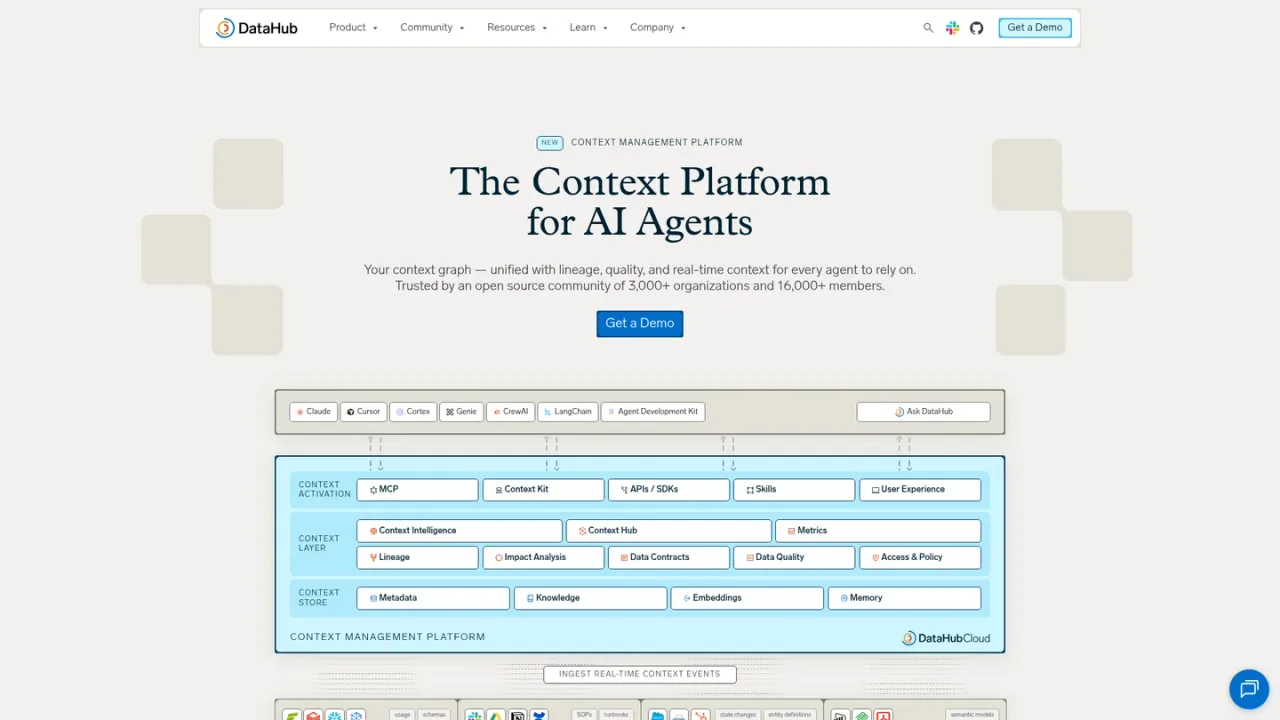
DataHub is a data catalog and context platform for enterprise data teams. DataHub Cloud unifies technical metadata, business knowledge, and documentation into a context layer that serves both people and AI agents. Core capabilities include conversational data discovery through Ask DataHub, automated column-level lineage and impact analysis, data observability with smart assertions, governance workflows with role-based access control, and AI-generated documentation. A hosted MCP Server and Agent Context Kit connect tools such as Claude, Cursor, and Windsurf to governed metadata. DataHub Core is an open-source metadata platform that teams can self-host; DataHub Cloud is the managed enterprise offering with onboarding, security features, and support.
How to use DataHub
1
Explore the product tour
Use the interactive product tour on the official site to see discovery, lineage, governance, and observability workflows before requesting a demo.
2
Connect your data sources
Ingest metadata from supported platforms such as Snowflake, Databricks, dbt, and Airflow through native connectors, scheduled ingestion, or event-driven streams.
3
Ask questions in natural language
Use the Ask DataHub chat agent in DataHub, Slack, or Teams to find trusted datasets, assess quality, and understand impact without memorizing table names.
4
Trace lineage and impact
Open lineage views to follow column-level dependencies from sources to dashboards and models, and check downstream impact before changing schemas.
5
Connect AI agents through MCP
Use the hosted MCP Server to let MCP-compatible tools query metadata, traverse lineage, and assess quality programmatically.
DataHub Features
Conversational data discovery with the Ask DataHub chat agent in DataHub, Slack, and Teams
Automated column-level lineage and bidirectional impact analysis across 100+ integrations
Data observability with smart assertions for freshness, volume, and column metrics
Governance workflows with role-based and attribute-based access control, compliance forms, and business glossary
AI-generated table and column documentation from schema, lineage, and usage patterns
Hosted MCP Server and Agent Context Kit for connecting AI agents to governed metadata
Automated metadata ingestion through event-driven connectors and scheduled ingestion
DataHub Actions Framework for event-driven workflows such as notifications and ticket creation
DataHub Use Cases
Data analysts find trusted datasets and validate quality before building reports
Data engineers assess downstream impact before schema or pipeline changes
Data scientists locate and vet training data with lineage and quality signals
Governance teams automate compliance tracking, ownership assignment, and access workflows
Platform teams provide a governed context layer for AI agents and MCP-compatible tools
Organizations deprecate unused data assets safely using lineage and usage analytics
DataHub FAQs
DataHub Core is the open-source metadata platform that teams self-host and maintain. DataHub Cloud is the managed enterprise offering built on Core, adding guided onboarding, AI automation, advanced security, an SLA, and dedicated support.
DataHub Core is open source and free to deploy. DataHub Cloud pricing depends on data volume, users, and required capabilities; contact sales for a quote or use the ROI calculator to estimate cost and savings.
DataHub connects to Snowflake, Databricks, dbt, Airflow, and 100+ other platforms through native connectors, with scheduled ingestion or event-driven streams.
Yes. DataHub automatically generates column-level lineage through built-in SQL parsing across integrated platforms, and supports the OpenLineage standard for cross-platform lineage.
Yes. The hosted MCP Server exposes DataHub's context graph to MCP-compatible tools such as Claude, Cursor, and Windsurf, and the Agent Context Kit provides SDKs and native integrations for platforms like Snowflake Intelligence, LangChain, and Google ADK.
DataHub Cloud includes a 99.5% uptime SLA, fine-grained access control, AWS PrivateLink support, IP address restrictions, and an in-VPC remote ingestion agent for sensitive data sources. It is SOC 2 compliant.
Yes. DataHub Cloud runs on the same open metadata model as DataHub Core, so existing ingestion, lineage, and glossary work carries over.
Yes. DataHub AI analyzes schema definitions, column names, lineage relationships, and sample values to generate table and column descriptions, which data owners can review and refine.
DataHub Core is free and open source. DataHub Cloud pricing is not published and is scoped to your use case and data environment; contact sales for a quote. Prices checked 2026-11-19.
DataHub Core
0
Open-source, self-hosted metadata platform covering discovery, lineage, observability, governance, and context management; your team owns installation, upgrades, and uptime.
Open source
Self-hosted
Community support via DataHub Community Slack and self-service docs
Basic access controls (no SSO or fine-grained permissions out of the box)
Data discovery, lineage, observability, governance, context management
DataHub Cloud
Contact sales
Fully managed enterprise context platform built on DataHub Core, with guided onboarding, SLA-backed availability, advanced security, and dedicated support; pricing is scoped to your use case and data environment.