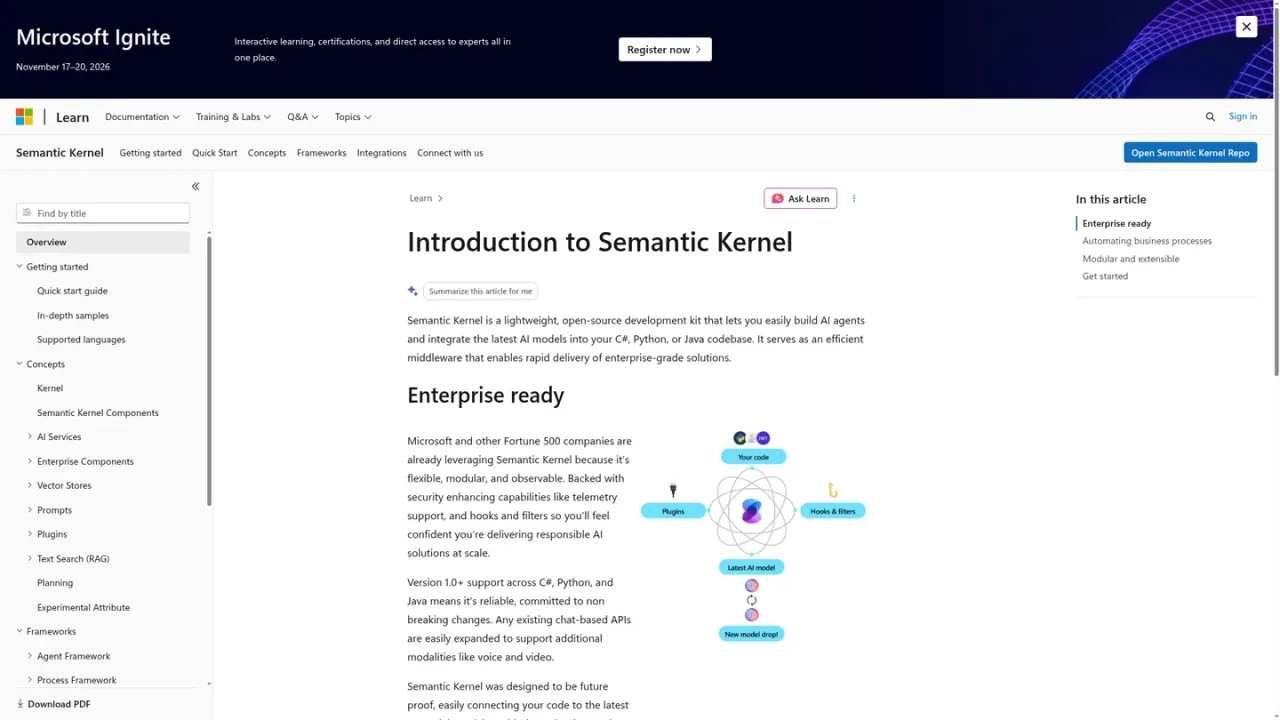
Microsoft Semantic Kernel is a lightweight, open-source development kit for building AI agents and integrating AI models into C#, Python, or Java codebases. It acts as middleware that combines prompts with existing APIs, letting models call functions and return results. Developers add existing code as plugins and connect AI services through out-of-the-box connectors, using OpenAPI specifications so extensions can be shared with other pro or low-code developers. Version 1.0+ support across the three languages targets enterprise use, with telemetry, hooks and filters for responsible AI at scale. Planning is handled through automatic function calling, which runs the loop of invoking functions and feeding results back to the model.
How to use Microsoft Semantic Kernel
1
Read the overview
Start with the Semantic Kernel overview to understand the kernel, plugins, connectors and planning concepts.
2
Follow the quick start
Use the quick start guide to build your first agent that automatically calls functions to perform actions.
3
Add your code as a plugin
Describe existing code to AI models as plugins so the model can call functions to address requests.
4
Enable automatic function calling
Register the plugin with the kernel, set execution settings to auto function calling, and invoke the chat completion service.
Microsoft Semantic Kernel Features
Open-source development kit for C#, Python and Java
Build AI agents that call functions to perform actions
Combine prompts with existing APIs as plugins
Out-of-the-box connectors for AI services
OpenAPI specifications for sharing extensions
Automatic function calling and planning loop
Telemetry, hooks and filters for responsible AI
Version 1.0+ support with non-breaking changes
Microsoft Semantic Kernel Use Cases
Integrate the latest AI models into an existing C# codebase
Build agents that automatically call functions to complete tasks
Expose existing APIs to AI models as plugins
Share AI extensions with pro or low-code developers via OpenAPI
Add telemetry and filters for responsible AI at scale
Microsoft Semantic Kernel FAQs
Semantic Kernel supports C#, Python and Java, with version 1.0+ support across all three languages.
Yes. The overview describes Semantic Kernel as a lightweight, open-source development kit.
It combines prompts with existing APIs so that AI models call functions to address requests, with Semantic Kernel translating the model's request into a function call and passing results back.
Semantic Kernel uses function calling as the primary way to plan and execute tasks, automating the loop of invoking functions and returning results to the model.
Yes. Semantic Kernel uses OpenAPI specifications so you can share extensions with other pro or low-code developers in your company.
The overview cites telemetry support plus hooks and filters to help deliver responsible AI solutions at scale.
According to the overview, new models can be swapped in without rewriting your entire codebase.
The quick start guide and in-depth samples are available in the Semantic Kernel documentation on Microsoft Learn.
Semantic Kernel is provided as an open-source development kit at no cost; no paid plans or pricing are listed on the official page. Checked 2026-11-19.
Semantic Kernel (Open Source)
$0USD / forever
Lightweight, open-source development kit for building AI agents and integrating AI models into C#, Python, or Java code.