reviews
Elicit vs Consensus vs Connected Papers: Which Fits Literature Research?
Same four literature-research tasks across Elicit, Consensus, and Connected Papers: use Elicit for question-to-paper tables, Consensus for claim-vs-evidence search, and Connected Papers for seed-paper graphs—combine freely.
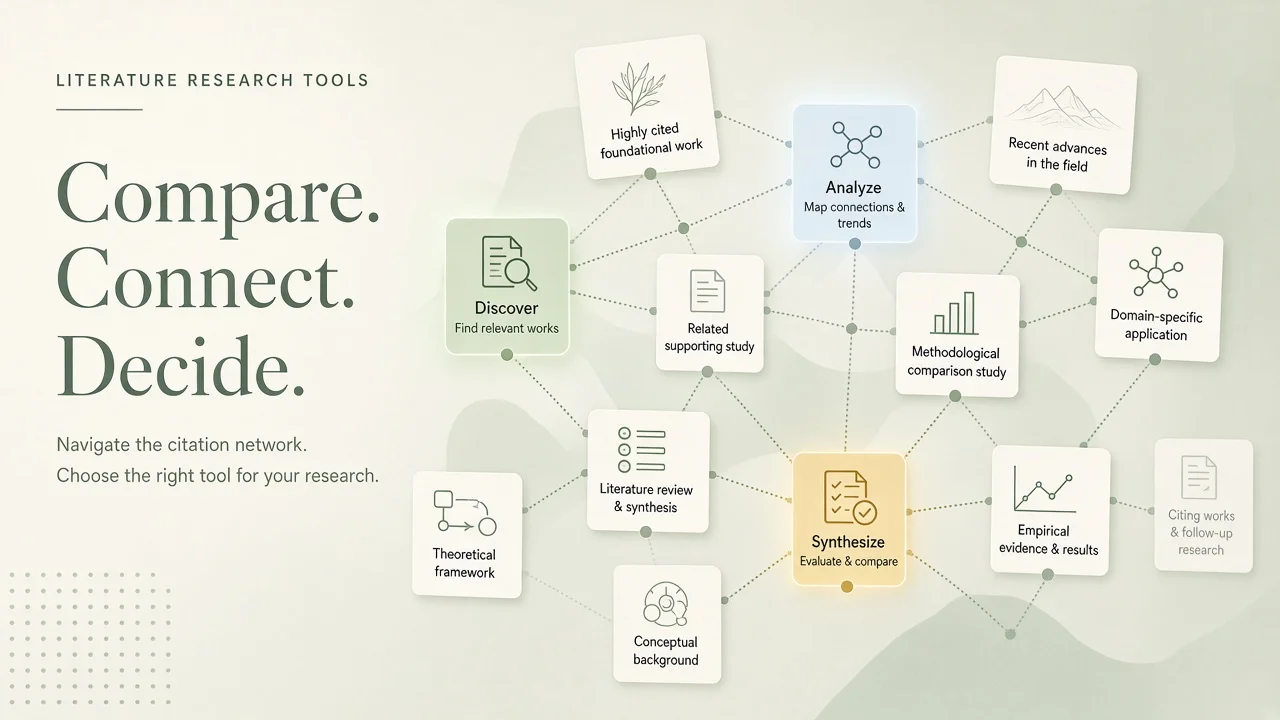
Literature tools fail when you treat them as interchangeable “ChatGPT for papers.” They are not. For academic and evidence-oriented research, should you start on Elicit, Consensus, or Connected Papers?
This comparison runs the same four literature tasks across all three. Note apps and general assistants—Notion AI, ChatGPT, Kimi, ima—appear only as optional capture/writing layers. This is not a general note-taking bake-off.
Bottom line: Question → structured paper table / review workflow → Elicit. Natural-language claim → what does the literature say? → Consensus. One seed paper → visual neighborhood of related work → Connected Papers. Most serious projects use two of these, not one forever.
Findings: public docs + limited hands-on / vendor claims (verification 2026-11-04, Asia/Shanghai). No invented precision/recall %. Re-check pricing and institutional access before you renew.
What each product is optimized for
| Product | AINav | Public positioning (shape) | Best first fit |
|---|---|---|---|
| Elicit | /tool/elicit | Research agent, reports, systematic review workflows over a large paper index | Extraction tables, screening, repeatable review steps |
| Consensus | /tool/consensus | Evidence search with Pro/Deep research modes over papers | “Does the literature support this claim?” |
| Connected Papers | /tool/connected-papers | Similarity graphs from a seed paper; prior/derivative views | Mapping a field from one known paper |
Practical rule: buy the bottleneck. Screening thousands of rows → Elicit. Claim checking for writing → Consensus. Finding what to read next from a classic paper → Connected Papers.
How we tested (identical four tasks)
| # | Shared task | What “good” looks like |
|---|---|---|
| 1 | Same research question → top 5 results with year + DOI/link when available | Real papers; links resolve; no invented titles |
| 2 | Same seed paper → related recommendations / graph | Neighbors are on-topic; note similarity ≠ quality |
| 3 | Same claim sentence → support / refute / mixed evidence | Honest empty state if the product lacks claim mode |
| 4 | Free path completes tasks once | Quotas visible; upgrade wall documented |
Shared materials (freeze this):
- Question: “What interventions reduce burnout among hospital nurses? Prefer empirical studies since 2018.”
- Seed: One real DOI you already trust in your field.
- Claim: “Mindfulness apps alone eliminate clinical nurse burnout.” (Expect pushback / mixed evidence.)
Task 1 — Same research question, top 5 + identifiers
Why it matters: A pretty summary over fake citations is worse than PubMed boredom.
Protocol: Run the frozen question. Export or copy five titles with year and DOI/URL. Spot-check two full records.
| Product | Fit | Watch-out |
|---|---|---|
| Elicit | Unlimited search/summaries called out even on Basic/Free; tables/columns scale on Pro+ | Research Agent / report usage is metered by plan |
| Consensus | Unlimited Papers search on Free; Pro messages / Deep reviews capped on Free | Confirm you are in Papers vs Pro/Deep mode |
| Connected Papers | Not primarily Q→list search—graph needs a seed | Use after you have one good paper from Elicit/Consensus/Google Scholar |
Winner for Q→list: Elicit or Consensus (both search-first). Connected Papers is a follow-on.
Task 2 — Seed paper → related work
Why it matters: Reviews stall when you cannot expand from a known classic.
Protocol: Enter the same seed. On Connected Papers, build one graph and open Prior / Derivative views. On Elicit/Consensus, use “similar” / related features if present; otherwise note “no graph mode.”
| Product | Fit | Note |
|---|---|---|
| Connected Papers | Purpose-built similarity graph; Free includes 5 graphs/month (all features) | Proximity ≠ endorsement of methods or conclusions |
| Elicit | Strong when you turn related papers into columns/extractions | Different metaphor than a visual graph |
| Consensus | Good for re-querying the claim space around the seed’s topic | Still claim/search oriented |
Winner: Connected Papers for map-from-seed. Feed discoveries back into Elicit tables or Consensus queries.
Task 3 — Claim support / refute
Why it matters: Writers need evidence posture, not only a reading list.
Protocol: Paste the frozen claim. Prefer tools that return supporting vs opposing studies or an explicit mixed/uncertain summary. If a product has no claim mode, write that honestly—do not force the UI.
| Product | Fit | Note |
|---|---|---|
| Consensus | Built around research questions / Pro & Deep reviews over papers | Free includes limited Pro messages & Deep reviews (help center) |
| Elicit | Reports / research agent can synthesize with sources—verify quotes | Best when you need extractable fields, not only a yes/no |
| Connected Papers | No primary “support vs refute claim” mode | Use for discovery, then verify claims elsewhere |
Winner for claim-vs-evidence: Consensus. Use Elicit when the next step is a screening spreadsheet. Use Connected Papers when you still lack the right papers.
Task 4 — Free tier once + pricing snapshot
Verification: 2026-11-04 (Asia/Shanghai).
Elicit (elicit.com/pricing)
| Plan | Public price | Notes |
|---|---|---|
| Basic | Free | Limited Research Agent / Reports; unlimited search & summaries (138M+ papers claimed); chat with full-text access where available; Zotero import |
| Pro | $49/user/mo billed annually as $588/yr (~35% save vs monthly—confirm monthly sticker) | Systematic review workflow (screen up to 5,000 papers), more columns, routines, API |
| Scale | $229/user/mo billed annually as $2,748/yr | 5× usage, collaboration, admin |
| Enterprise | Custom | No training on your data by default; larger screening limits; SSO |
Consensus (help center subscription plans; pricing UI at consensus.app/pricing)
| Plan | Public price | Notes (help center, Sep 2026 article still live at check) |
|---|---|---|
| Free | $0 | Unlimited Papers searches; 10 Pro messages/mo; 3 Deep reviews/mo; snapshots/API caps |
| Pro | $20/mo or $144/yr (~$12/mo) | Unlimited Pro messages; 15 Deep reviews/mo |
| Deep | $65/mo or $540/yr | 200 Deep reviews/mo |
Confirm live cards—marketing pages are JS-heavy.
Connected Papers (connectedpapers.com/pricing)
| Plan | Public shape | Notes |
|---|---|---|
| Free | $0 | 5 graphs/month, all features included (FAQ) |
| Academic Premium | Sticker commonly ~$6/mo billed annually (third-party page checks Oct 2026)—confirm live checkout | Unlimited graphs; academic/nonprofit/personal |
| Business Premium | Sticker commonly ~$20/mo billed annually—confirm live | Same unlimited graphs; commercial context |
Dollar stickers on the marketing page did not reliably render to our fetcher; treat Costbench/live checkout as confirmation, not a contract.
Rough takeaway: Free tiers are enough to finish Tasks 1–3 once. Heavy systematic review → Elicit Pro+. Weekly claim checks → Consensus Pro. Weekly graph exploration beyond five → Connected Papers Academic.
Who should pick which (and when to combine)
| You need… | Start | Then add |
|---|---|---|
| PRISMA-ish screening table | Elicit | Connected Papers for seed expansion |
| Draft discussion “what does evidence say?” | Consensus | Notion AI / ChatGPT only for prose after sources are locked |
| New-to-me field map | Connected Papers | Elicit extractions on the shortlist |
| Chinese-language exploratory notes | Kimi / ima as scratchpads | Still verify in Elicit/Consensus/Scholar |
Method notes
- Limited hands-on: run your own question/seed/claim; do not invent hit rates.
- Pricing dated 2026-11-04, Asia/Shanghai.
- Similarity graphs and AI summaries are starting points—read the PDFs that matter.
List your AI tool
Building a research or literature AI product? List your AI tool on AINav.