guides
How to Evaluate AI Contact Center Agents Before You Buy
A documentation-based contact center AI buying guide: separate CCaaS AI surfaces from Intercom Fin and Sierra-style agents. Legal disclaimer included; no real calls or PII; automation rates and prices not verified.
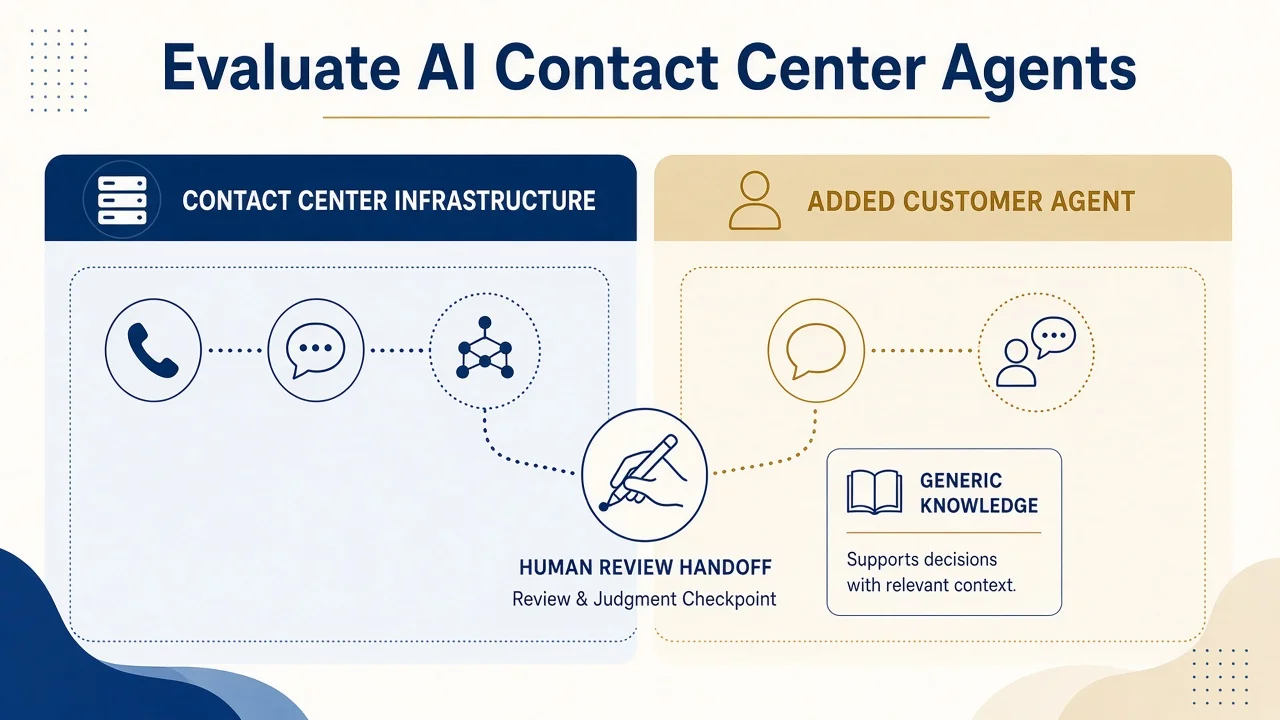
An AI contact center purchase should begin with the service architecture: the channels customers use, the system that routes work, and the humans responsible when automation cannot continue. Adding an agent to an existing helpdesk is different from choosing the contact center itself. Both decisions require clear action limits, inspectable knowledge, and an operational route back to people.
This article is for informational purposes only and does not constitute legal or compliance advice. Recording, QA, and cross-border data handling require qualified review under applicable law.
This is a documentation-based guide reviewed on November 10, 2026. We did not enter customer tenants, make calls, ingest tickets, connect production lines, or test agents. All scenarios below are synthetic evaluation plans. No automation rate, customer satisfaction improvement, language quality, service level, or replacement of human staff is promised.
First decide what you are buying
If an existing contact center already handles telephony, routing, queues, and workforce operations, investigate the missing AI function before considering a replacement. It might be customer self-service, assistance for employees, or quality review. Those functions can share a platform while having different permissions and licensing. If the organization lacks a suitable contact center, evaluate that foundation separately from the conversational agent demonstration.
If the helpdesk is satisfactory and the aim is an additional customer-facing agent, focus on integration, ownership of knowledge, and handoff. An agent's presence on a helpdesk marketplace does not prove that it preserves every routing rule or conversation field. Treat compatibility with the exact edition and channel configuration as an open acceptance question.
Contact center platforms and their AI surfaces
Talkdesk AI covers several functions that should be evaluated separately. Talkdesk's current platform overview distinguishes customer automation, employee assistance, routing, and supervision. Ask which named component the proposal actually includes. An Autopilot demonstration does not establish entitlement to every analytics or workforce feature.
Talkdesk also documents CXA for other contact centers. That matters for an organization retaining its existing infrastructure: stack-integrated AI does not always require replacing the stack. The integration and escalation route still need technical review; this guide did not configure them.
Dialpad AI should be evaluated through its contact center product surface, currently described as Dialpad Support on the official contact center page. The page distinguishes assistance, conversation intelligence, quality management, and automation. Keep those functions separate from general business communications and from a sales dialer. Their presence on the same website does not make the commercial packages identical.
Amazon Connect Customer is the current name shown on the official AWS product page. Its scope includes customer-facing AI and assistance for employees within a broader customer-interaction system. Evaluate the intended channel, routing design, AWS responsibilities, and human escalation path. Do not transfer a capability from another AWS service merely because both appear in the same architecture.
Customer agents layered onto an existing service operation
Intercom Fin is Intercom's customer agent, rather than an unrelated product sharing the short name. The official Intercom explanation of Fin establishes its identity and describes knowledge, connected actions, and human handoff. Intercom's Fin product URL now redirects to fin.ai. This identity check uses official sources, not the directory slug.
The current Fin site also presents deployment with other helpdesks. Keep this evaluation focused on service: broader sales or ecommerce roles do not automatically belong in a support purchase. Voice availability, helpdesk integration behavior, regional access, and the exact contracted functions require separate confirmation for the proposed configuration.
Sierra presents a customer-agent platform spanning multiple channels. Investigate how the proposed agent uses your approved knowledge and authorized tools within the existing service operation. A cross-channel product description does not prove that the same workflow, escalation information, or commercial terms apply to every channel. None of its channels or actions was tested here.
These groups overlap. Some platform vendors offer AI on other infrastructure, while customer-agent vendors support voice. The useful distinction is who owns routing, identity, actions, knowledge, and recovery in the proposed deployment, rather than a rigid assumption that one vendor is only a phone system or only a chat widget.
Record the service boundaries before a demo
Inventory voice, chat, email, social, and other required channels. List the languages and regions that need evaluation without assuming support from a headline language count. Identify hours when human staff are available, queues for escalation, knowledge owners, and scenarios that must always reach a person. Record who may approve policy changes and which system owns the authoritative version.
Use three fictional scripts: an address-change request for an invented order, a question about a supplied refund policy, and a complaint requiring human judgment. Use dummy order labels and invented policy text, with no real addresses, phone numbers, customer identities, tickets, or audio. These scripts are proposed inputs; we did not submit them to any product.
Require evidence for actions, knowledge, and handoff
Actions: distinguish explaining an address-change policy from actually updating an order. Define identity checks, required confirmation, permitted fields, and the point where a human must approve. Ask what happens if an action fails or the customer repeats a request. The acceptance condition should prevent an unsupported claim that a change succeeded. No account or order was changed for this article.
Knowledge: ask how sources are approved, refreshed, withdrawn, and separated by audience. Require an internal inspection path showing which source supports an answer; do not assume every channel exposes public citations. Include a proposed case where the synthetic knowledge has no answer. A useful response should preserve uncertainty and follow the escalation rule rather than invent a policy.
Handoff: specify the receiving queue, context that must travel, customer-visible explanation, and fallback when no employee is available. Ask separately about supervisor observation, intervention, and takeover, because monitoring a transcript does not establish control of the conversation. A future evaluation should verify the complete route in an authorized nonproduction environment. None of these functions has been exercised here.
Quality review: define critical failures such as fabricated refunds, unauthorized changes, missed escalation, or disclosure of restricted information. Ask whether reviewers can challenge an automated score and trace the evidence. Do not confuse a model-derived sentiment or quality label with direct customer feedback. Keep employee assessment subject to the organization's review process.
Data handling: request terms covering recordings, transcripts, prompts, knowledge sources, model providers, training use, retention, deletion, and processing locations. Examine the whole connected route, including telephony and external actions. A public security statement does not establish the lawfulness or suitability of a particular recording, monitoring, or cross-border arrangement.
Understand the helpdesk and neighboring-tool boundary
Zendesk AI illustrates the customer-service platform route. Its current official overview includes knowledge, agents, assistance, and quality functions. Compare the proposed native platform configuration with an additional agent using the same acceptance requirements. Do not assume either route avoids integration work, or that Zendesk AI is limited to a basic helpdesk chatbot.
This procurement problem extends beyond general meeting notes and sales conversation analysis. A record of a conversation does not demonstrate customer identity checks, live routing, service actions, or escalation. Likewise, a chatbot-building tutorial does not settle contact center operations—for the helpdesk chatbot evaluation frame, see How to Evaluate AI Customer Support Chatbots Before You Buy. Keep the evaluation focused on the customer service path instead of repeating a generic list of chatbot platforms.
Make billing definitions reviewable
Complete prices and entitlements are not verified for these proposed configurations as of November 10, 2026. No channel rate, outcome price, free allowance, or AI credit quantity is quoted. Public product pages cannot establish the full bill across telephony, service platforms, agents, integrations, implementation, and support.
Request a region-specific proposal with currency, billing period, product surface, seats, usage units, minimums, overages, and exclusions. Define an interaction, an outcome, a reopened case, and a transferred conversation wherever those terms affect billing. Ask how voice duration, retries, failed actions, and human handoff are counted. Compare complete scenarios rather than treating unlike billing units as interchangeable.
Frequently asked questions
What should a future pilot cover? One bounded service workflow using synthetic knowledge and cases, with named reviewers and a documented human fallback. Do not connect a production queue to make a demonstration more realistic.
When should we stop? Stop for unsupported commitments, unauthorized actions, missing handoff context, unexplained data handling, or billing that cannot be reconciled to the agreed scenario. Retain approved knowledge and document an exit path.
Can documentation prove readiness? It can support a shortlist and a test plan. Channel behavior, voice quality, permissions, billing reconciliation, and recovery still need separately authorized evaluation. No such tests were performed for this guide.