reviews
GitLab Duo agents and Amazon Q Developer: different jobs on the work you already have
GitLab Duo Agent Platform covers issue, merge request, and CI/CD flows on GitLab. Amazon Q Developer covers IDE and CLI agentic coding and application transformation. AWS is not treated as a GitLab-style repo host, and this is not a migration guide. Official names, the 18.8 GA and 18.10 Duo Enterprise add-on gate, credits, and the Q Developer IDE plugin end-of-support date of April 30, 2027 are taken from pages opened on 10 November 2026.
GitLab Duo agents and Amazon Q Developer: different jobs on the work you already have
GitLab Duo Agent Platform and Amazon Q Developer both put an assistant next to work you already do. They are not a like-for-like pair, and this article is not a plan to move a repository from one vendor to the other. GitLab is a DevSecOps platform where issues, merge requests, and CI/CD already live. AWS is not a GitLab-style code host; Amazon Q Developer helps with software development in the IDE and CLI, with application transformation, while conversational help in the AWS console is now documented under a different official name.
If the actual decision is which editor assistant to use day to day, use the already published Cursor vs GitHub Copilot vs Trae for Daily Coding and, for review-centric work, Qodo vs GitHub Copilot vs Cursor for AI Code Review. This article stays on the platform-native jobs: GitLab agents and flows versus Amazon Q Developer’s IDE, CLI, and transformation surfaces.
How this article was written
Official GitLab Docs and AWS documentation and pricing pages were opened first-hand on 10 November 2026 (Asia/Shanghai). No GitLab or AWS accounts were used, no Credits were purchased, and no agent was run against a repository. Names, version gates, plan limits, and data-use statements are quoted from those pages only. Where a number is not clearly published, it is marked as not verified rather than guessed. Examples below are illustrations, not run logs.
Current official names and availability
On GitLab, the current official name is GitLab Duo Agent Platform. Official docs say it is generally available in GitLab 18.8, and that GitLab Credits are supported on 18.8 and later. Agent Platform features consume GitLab Credits. In GitLab 18.9 and earlier, Agent Platform cannot be used with the Duo Enterprise add-on; the documented path is to upgrade to 18.10 or later. The platform is turned on by default and can be turned off at the top-level group on GitLab.com, or at the instance on GitLab Self-Managed. Free-tier Agent Platform features require purchased Credits.
Amazon Q Developer remains the official name for the IDE and CLI experience. AWS documentation for “What is Amazon Q Developer?” states that the conversational experience in the AWS console and the AWS Console Mobile Application is now the AWS assistant, and that those docs have moved. The same page posts an end-of-support notice: Amazon Q Developer IDE plugins end on April 30, 2027, and AWS points to Kiro for similar IDE capabilities. That date and pointer are recorded here as official notices. Kiro is not evaluated as a third product in this article.
Compare the jobs, not a migration path
The useful question is “what work is already in front of you?” rather than “which of these replaces the other?”
On GitLab, official docs describe foundational, custom, and external agents, plus foundational and custom flows. Documented foundational flows include a Developer Flow that starts from an issue and works toward a merge request, a Code Review Flow, a flow that fixes a CI/CD pipeline, a flow that converts a pipeline to GitLab CI/CD, and a Software Development Flow in the IDE. Those jobs sit next to GitLab issues, merge requests, and pipelines. Credit usage for a flow that runs as a service account is billed to the namespace; a user talking to Agentic Chat is billed to that user.
On Amazon Q Developer, the documented jobs are different. In the IDE or CLI, Q Developer provides Q&A and agentic coding. A separate official surface is application transformation, including Java upgrades, with published lines-of-code monthly caps. Conversational help while you are already in the AWS console is no longer documented as Amazon Q Developer; it is the AWS assistant. That is an operations and console-adjacent job, not “host the repo on AWS the way you host it on GitLab.”
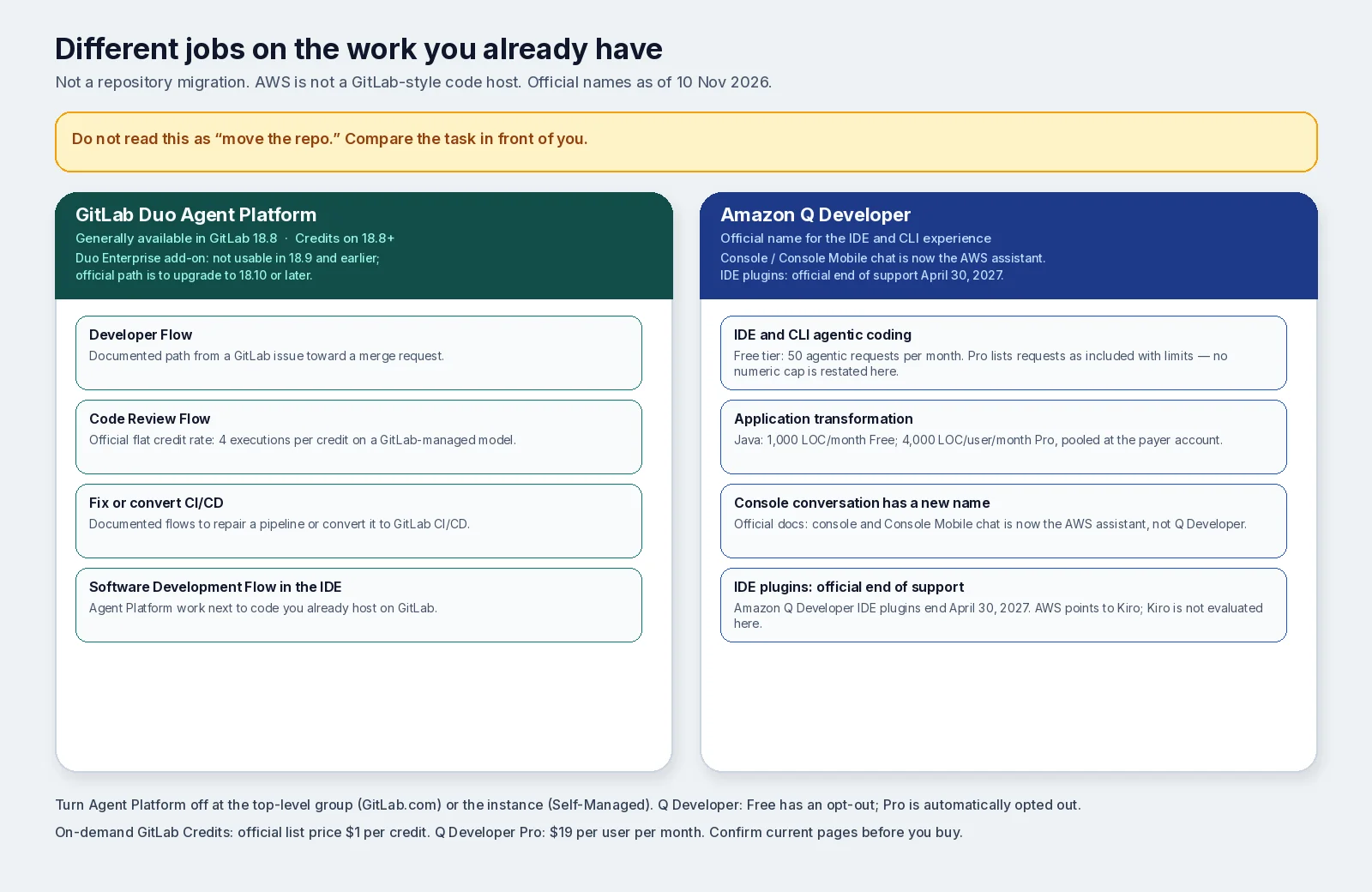
AINav original diagram based on official docs. Sources: GitLab Duo Agent Platform, GitLab Credits, GitLab Duo data usage, What is Amazon Q Developer?, Amazon Q Developer pricing. Not an official screenshot or a test result.
中文说明:按官方任务面区分 GitLab 上的 issue/MR/CI agent 与 Amazon Q Developer 的 IDE/CLI 及改造能力;不是迁移流程图,也不是产品截图或实测。
Task differences at a glance
| Job already in front of you | GitLab Duo Agent Platform (official) | Amazon Q Developer (official) |
|---|---|---|
| Turn an issue into a merge request inside GitLab | Documented Developer Flow (issue → merge request) | Not documented as a GitLab issue/MR flow. Q Developer works in the IDE and CLI on the code in front of you |
| Review a merge request or change set | Documented Code Review Flow. Official credit table lists a flat rate of 4 executions per GitLab Credit on a GitLab-managed model (5 on a self-hosted model) | Code review is not presented as a GitLab MR flow. Compare IDE/review assistants separately if that is the job |
| Repair or convert a CI/CD pipeline | Documented Fix CI/CD and Convert to GitLab CI/CD flows | Not documented as GitLab pipeline conversion. Console/operations chat is now the AWS assistant, not Q Developer |
| Agentic coding in an editor or terminal | Software Development Flow in the IDE is documented as part of Agent Platform | Official IDE and CLI Q&A and agentic coding. Free tier: 50 agentic requests per month |
| Language or framework upgrades | Not claimed here as an official GitLab equivalent to Q’s published transformation caps | Java transformation: 1,000 lines of code per month on Free; 4,000 lines of code per user per month on Pro, pooled at the payer account, with overage listed at $0.003 per line of code submitted (only successful suggested-upgrade submissions count, per the pricing page) |
| Host or migrate the repository itself | GitLab is the project host for the flows above | AWS is not treated in this article as a GitLab-like repository host. No official “move the repo here to replace GitLab agents” path is implied |
Credits, list prices, and what is not published clearly
GitLab Credits are the consumption currency for Agent Platform and some non-agentic features. Official docs state that GitLab Duo Pro and Enterprise, and their associated GitLab Duo features, are not billed on usage and do not consume GitLab Credits — a different billing model from Agent Platform. Credits can come as included credits (Premium or Ultimate users; individual, no sharing, monthly reset, no rollover), a monthly commitment pool, or on-demand credits. On-demand credits are billed at a list price of $1 per credit used, after included credits and any commitment pool are exhausted, and only if usage billing terms have been accepted. The exact number of included credits per user was not a clearly extracted figure on the Credits page opened for this article, so it is not invented here.
Free-tier namespaces can purchase a monthly commitment pool of Credits. Official docs also cap on-demand usage for Free namespaces at $25,000 each calendar month; at that cap, on-demand usage is turned off until the next month. Temporary evaluation credits can be requested from Sales and last 30 days. A functional verification check for a self-hosted model is documented as not consuming credits.
Amazon Q Developer’s official pricing page lists a Free tier and a Pro plan at $19 per user per month. Free includes 50 agentic requests per month in the IDE or CLI. Pro lists agentic requests as “Included (with limits)”; the pricing table opened on 10 November 2026 did not state a clear numeric monthly cap for Pro agentic requests, so no cap is invented here. The Java transformation caps and $0.003/LOC overage are as in the table above. Official pricing also notes that mid-month cancellation still bills the full month. Confirm tax, regional availability, and any bundle pricing in the AWS console; those were not independently verified here.
Data use, opt-out, and how to turn features off
GitLab’s Duo data-usage documentation states that GitLab does not train models on customer data. It describes zero data retention with Fireworks except for prompt caching, and an optional usage-data sharing setting used to improve the service and for debugging, not for training. Secret detection and redaction are documented, with an opt-in exception for secret false-positive detection. The operational off switch for Agent Platform is the top-level group (GitLab.com) or the instance (Self-Managed). Read the current data-usage page before you enable optional sharing.
Amazon Q Developer’s pricing and product docs distinguish Free and Pro data collection. Free-tier customers have an official opt-out path. Pro is automatically opted out. Intellectual-property indemnity is listed for Pro only. Use the official IDE and CLI opt-out pages when you need the click path; this article does not invent a UI walkthrough beyond what those docs state.
None of this is a recommendation to weaken repository permissions or to send secrets to a model. Official secret redaction and opt-out exist because that risk is real. Keep ordinary access control in place.
What this article does not claim
No agent was run, so there is no accuracy, time-to-merge, or “it handled our pipeline” result. GitLab included-credit counts and the Amazon Q Developer Pro agentic-request cap are not stated as exact numbers because they were not clearly published on the pages opened for this article. The April 2027 end of support for Q Developer IDE plugins is an official notice, not a review of Kiro. And nothing here is a repository-migration guide.