reviews
Qodo vs GitHub Copilot vs Cursor for AI Code Review
Same PR fixture for review/tests/secret nits—Qodo PR ritual, Copilot if GitHub-deep (verify review), Cursor local deep-read.
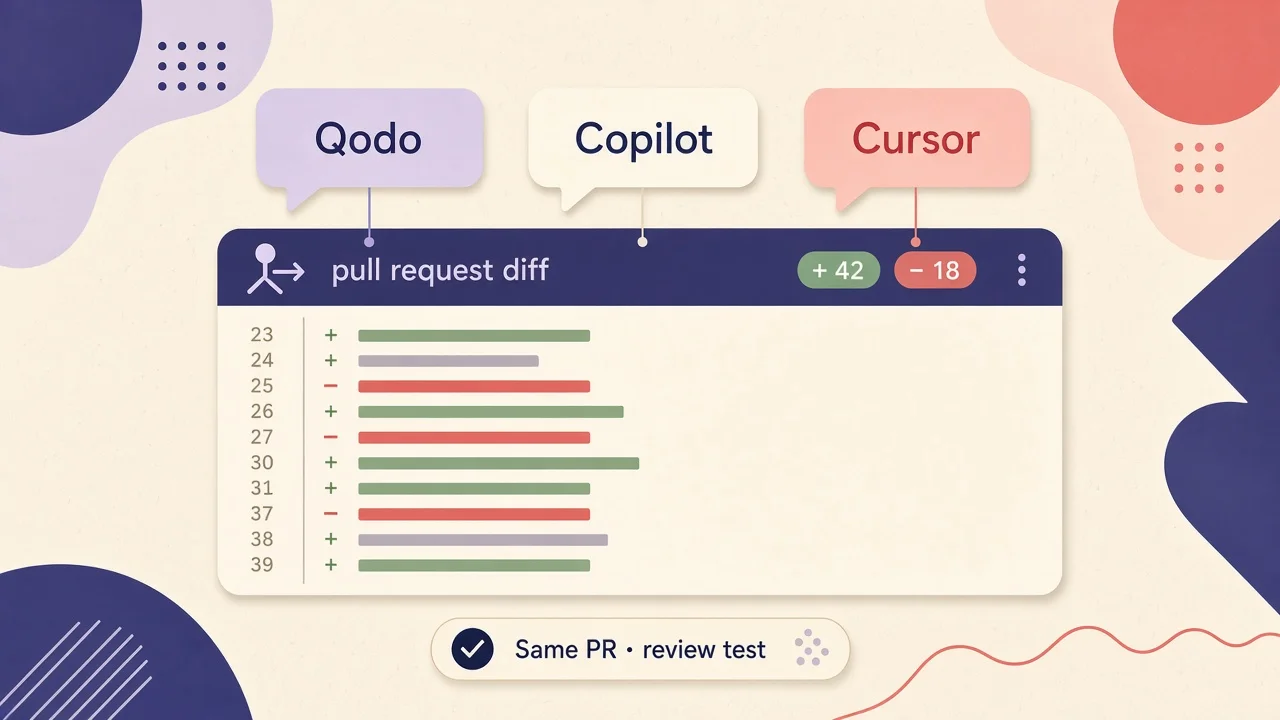
Autocomplete that never comments on the PR is a different product from an AI that leaves review notes on the same small change. Primary: Qodo, GitHub Copilot, Cursor. SonarQube is a traditional static-analysis baseline only—keep it light. Daily editor coding already has its own piece: Cursor vs GitHub Copilot vs Trae for Daily Coding. Trae stays out of this review-focused comparison.
Bottom line:
- Choose Qodo when the team already runs a GitHub PR ritual and wants an agentic review/test workflow on the pull request itself.
- Choose GitHub Copilot when you are deep in the GitHub ecosystem and want autocomplete plus growing PR/file-diff review—verify review quality on the same fixture, don’t assume completions quality equals review quality.
- Choose Cursor when the job is repo-level chat/edit—it can review a diff locally, but the role is closer to deep-read/rewrite than a dedicated PR review bot.
Do not rank by “smartest model.” Split by comment quality on one fixture, test-skeleton honesty, secret/injection hints, and workflow friction into GitHub Checks vs paste-the-diff.
Findings: public pricing/docs + limited hands-on framing (verification 2026-11-06, Asia/Shanghai). No invented vulnerability-detection rates or MAU. Prefer plan shapes; re-open vendor pages before seat buy.
What each product is optimized for
| Product | AINav | Public positioning (shape) | Best first fit for review |
|---|---|---|---|
| Qodo | /tool/qodo | Code-quality / agentic PR review platform; Git + IDE integrations; credit-metered Pro Team; trial without card; FAQ: no permanent free tier (OSS program exists) | Teams that want reviews to run on the PR with shared credit pools |
| GitHub Copilot | /tool/github-copilot | Editor agents + GitHub-native surfaces; public plans list pull request reviews and file-diff reviews on paid individual tiers; Business/Enterprise for org policy | Default if the org already standardizes on GitHub + Copilot seats |
| Cursor | /tool/cursor | AI-native IDE / agent; public X Subscription pricing includes limited Free usage; higher tiers list AI code reviews (Bugbot) among cloud features | Solo/power users who review by chatting the repo and rewriting locally |
How we tested (identical five tasks)
One shared small PR fixture: one real logic bug, one style nit, one suspicious secret-like pattern. Same five checks. Results are limited hands-on / public-doc grounded—not a security lab scorecard.
| # | Shared task | What “good” looks like |
|---|---|---|
| 1 | Same PR fixture → review comments | Names the logic bug; few noisy style false alarms |
| 2 | Unit-test skeleton | Runnable outline; no hallucinated APIs |
| 3 | Security nits | Warns on hardcoded-secret / injection smells without panic theater |
| 4 | Workflow friction | GitHub Check / extension / paste-diff; public install permission path |
| 5 | Pricing & seats | Personal vs team shapes; avoid double-pay advice without inventing promos |
Task 1 — Same PR fixture (bug + style + secret pattern)
| Product | Fit | Watch-out |
|---|---|---|
| Qodo | Built for agentic PR commentary—expect structured review on the change set when installed on the repo. | Limited hands-on: tune rules so style nits don’t drown the logic bug. Confirm which files the agent actually saw. |
| GitHub Copilot | PR reviews on GitHub + file-diff reviews in editors are on the public feature matrix for paid plans (not Free’s main story). | Completions ≠ review. Run the same PR through Copilot review; don’t extrapolate from Tab accept rates. Effort levels (where offered) change thoroughness and credit burn—read live docs. |
| Cursor | Strong at “open the branch, ask what’s wrong, patch it.” Comments may live in chat unless you wire a review bot tier. | More local deep-read than PR-bot theater. Exporting findings into GitHub review UI is a human step unless Bugbot/cloud review is on your plan. |
Takeaway: Score tools on whether they point at the logic bug first. Style-only essays are a miss even if they sound confident.
Task 2 — Test skeleton from the same change
| Product | Fit | Watch-out |
|---|---|---|
| Qodo | Review + test generation is part of the product story for PR workflows—ask for a skeleton next to the finding. | Reject tests that import modules your repo doesn’t have. Prefer failing-first stubs you can run. |
| GitHub Copilot | Agent/chat can draft tests in-IDE; cloud agent paths can open PRs—still verify imports and fixtures. | Hallucinated matchers and wrong testing library versions are common failure modes—run them. |
| Cursor | Excellent for iterative “write the test, run it, fix” inside the repo agent loop. | Great local loop ≠ automatic PR check. Decide who owns CI green. |
Takeaway: A skeleton that doesn’t run is documentation, not a test. Keep humans in the npm test / pytest loop.
Task 3 — Security nits (secret pattern / injection smell)
| Product | Fit | Watch-out |
|---|---|---|
| Qodo | Expect secret-like literals and risky patterns to show up when review rules cover them—validate against your policy pack. | Over-flagging test fixtures as “production secrets” wastes reviewer time—scope paths. |
| GitHub Copilot | Public responsible-AI materials discuss filters for insecure patterns in suggestions; PR review should still be asked explicitly about credentials and string-built queries. | Pair with org secret scanning / SonarQube (or GitHub Advanced Security where licensed)—AI review is not a substitute for SA/secret scanners. |
| Cursor | Chat will usually call out AKIA…-shaped strings or "SELECT * FROM " + user if you paste them—prompt for severity + fix. | Local chat warnings don’t create a durable audit trail on the PR unless you paste them back. |
Takeaway: Want durable security gates → traditional SA/secret scanning (SonarQube as baseline) plus AI review, not AI alone. Avoid horror-movie wording that blocks merges without a clear fix path.
Task 4 — Workflow friction (GitHub vs local)
| Product | Fit | Watch-out |
|---|---|---|
| Qodo | Install on repos (admin access called out in FAQ), reviews draw a shared credit pool, dashboard shows burn. Developers may not each need accounts—confirm live docs for your SCM. | Trial ends → reviews pause until a paid pack—plan the pilot calendar. |
| GitHub Copilot | Lowest friction if PRs already live on github.com: assign Copilot, optional auto-review policies for users/repos/orgs (plan-gated). Reviews consume AI credits (+ Actions minutes for agentic bits per public docs)—admins set budgets on Business/Enterprise. | Org enablement and license assignment are the real project plan; Free plan’s review story is limited vs paid. |
| Cursor | Clone, open, chat the diff—fast for a staff engineer. Cloud Bugbot / AI code reviews appear on higher public tiers—verify whether your seat includes them. | Team ritual “every PR gets a bot comment” may still need a GitHub-native reviewer (Qodo or Copilot) beside Cursor. |
Permission path (public docs only): Qodo—sign in, install on repos with admin; Copilot—org/enterprise policy + seat; Cursor—editor login / team admin privacy mode. Do not invent SSO screenshots.
Task 5 — Pricing & seats (public pages only)
Prefer shapes; verify-live before finance sign-off. Avoid “cancel Copilot because promo X” advice without a screenshot of today’s matrix.
- Qodo — qodo.ai/pricing: free trial (no card); FAQ states no permanent free tier (OSS program separate). Pro Team is credit-pack / pooled reviews (~reviews/mo guidance on page), monthly, overage at same per-credit rate up to a customer-set cap; Enterprise adds SSO/SAML, BYOK, single-tenant/on-prem shapes.
- GitHub Copilot — github.com/features/copilot/plans + docs plans page: Free (limited completions/chat); individual Pro / Pro+ / Max seat shapes; org Business / Enterprise seat + pooled AI-credit stories. Public matrix: PR reviews on paid individual plans (not the Free headline). Code review consumes AI credits (effort levels change burn)—treat dollar-per-review blog estimates as illustrative, re-check docs.
- Cursor — cursor.com/pricing / help pricing: Free limited usage; paid Plus → Premium → Super → Ultra (and Teams seats). Public feature table lists AI code reviews via Bugbot from Premium-shaped tiers upward; third-party models often prepaid/API-list on higher tiers. Legacy Pro/Hobby customers may still be on old matrices—verify which plan family your org is on.
Double-pay caution: If the team already bought Copilot for autocomplete and Cursor for agents, adding Qodo is a third meter—pilot on one high-traffic repo and compare comment usefulness before org-wide seats. Do not invent stacked discounts.
Scenario picks (not a leaderboard)
- GitHub PR ritual, want bot comments on every change → Qodo pilot
- Already standardized on GitHub + Copilot seats → enable Copilot review on the same fixture first
- Staff eng deep-reads and rewrites locally → Cursor (add a PR bot only if ritual demands it)
- Need deterministic SA/secret gates → keep SonarQube (or equivalent) in CI; AI review is additive
- Buying agents broadly → evaluate AI agent automation platforms; solo toolkit snapshot → best AI coding assistants for solo founders
FAQ
When is Qodo the wrong buy?
When you have no GitHub (or supported Git) review ritual, or when a trial-only team will disappear before credits convert—Qodo’s FAQ is explicit that reviews pause after trial without a paid plan.
When is GitHub Copilot the wrong buy for review?
When you only needed Tab completions and never open PR review features—or when org policy blocks cloud agents/Actions minutes that review may consume. Always test review on the fixture.
When is Cursor the wrong buy for review?
When the Definition of Done is “bot comment on github.com before merge” and nobody will paste chat findings or enable a cloud review add-on.
What did we not measure?
CVE recall, SAST false-positive rates under every language, SSO rollouts, or private-monorepo latency. Notes are limited hands-on.
How to re-check before annual commit?
Open Qodo, Copilot plans, and Cursor pricing the same morning; record credit vs seat meters, whether PR review is included on your tier, and whether you would pay twice for overlapping autocomplete + review bots.
Related on AINav
- Qodo · GitHub Copilot · Cursor · SonarQube
- Cursor vs GitHub Copilot vs Trae for Daily Coding · Best AI Coding Assistants for Solo Founders 2026 · Evaluate AI Agent Automation Platforms Before You Commit
List your AI tool → /submit