

Metaso
Ad-free AI search that returns direct results, with deep research, document Q&A, slides, and video generation.
AI Research & Data ToolsNot specified
AI Search & Research Tools
PRODUCT OVERVIEW
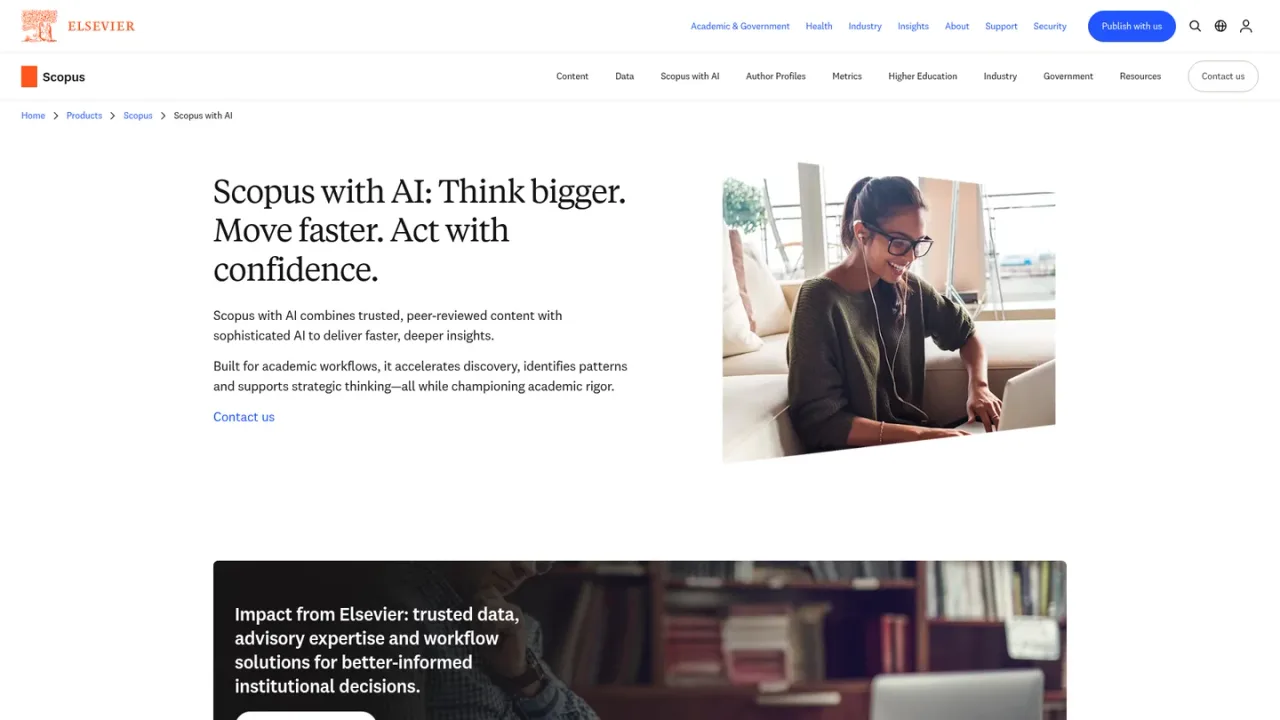
Scopus AI is Elsevier's generative AI layer inside Scopus, built for academic research workflows. Instead of crafting keywords or Boolean strings, researchers type a question in everyday language; the Copilot query tool blends vector and keyword search across Scopus metadata, abstracts and author profiles, then produces a referenced topic summary and expanded summary with a confidence indicator. Concept maps visualize the topic space, foundational documents surface high-impact prior work, emerging themes flag established, rising and novel areas, and Deep Research uses agentic AI to plan searches and deliver a downloadable in-depth report. Conversational history and follow-up questions support continued exploration. It is aimed at researchers, librarians and academic leaders, and institutions are invited to contact Elsevier about access.
Sign in to Scopus and select the Scopus AI tab, then type your question, statement or hypothesis in the words, format and language you prefer.
Scopus AI returns a topic summary and expanded summary with references to the sources used and an indication of confidence in relevance.
Use the concept map for a bird's-eye view of the topic space and foundational documents to identify high-impact papers cited by the summarized sources.
Use suggested Go deeper questions or conversational follow-up in everyday language, and revisit earlier topics through conversational history.
Ask a complex question and Deep Research develops a research plan, searches Scopus literature, refines its strategy and synthesizes findings in a downloadable report.
Exploring an unfamiliar research area with referenced summaries
Identifying influential prior work through foundational documents
Mapping a topic space and its links to adjacent fields with concept maps
Spotting established, rising and novel themes for publications, collaborations or funding
Producing an in-depth research report for a complex question with Deep Research
Resuming earlier exploration through conversational history
It draws exclusively on metadata, abstracts and author profiles in Scopus, covering articles, books, book chapters, conference papers, reports, reviews, short surveys and data papers; conference reviews and errata are excluded.
For summaries the start year is set to 2003, while foundational documents mine the entire Scopus corpus.
Strict prompt engineering requires responses to match the query intent, references are required for claims, and the tool tells you when it cannot find sufficient evidence and suggests alternative queries.
Deep Research uses agentic AI with a reasoning engine to develop a research plan, conduct extensive searches across Scopus literature, refine its strategy and share findings in a downloadable in-depth report.
Emerging themes categorizes established, rising and novel themes based on your query, and for each theme provides a mini-summary, references and suggested research hypotheses.
Yes. Conversational history provides an overview of topics you have previously explored so you can revisit key insights and resume queries.
Elsevier states that inputs are treated under its Privacy Policy and GDPR, that OpenAI's ChatGPT hosted on Microsoft Azure will not store or use queries for training, and that personal information and chat history are not stored unless done in a compliant way.
Elsevier invites institutions to contact its team to discuss Scopus AI use cases and the right subscription option.
The supplied pages do not list consumer prices for Scopus AI; institutions are invited to contact Elsevier to discuss access and subscription options.
See the official website for current pricing.
COMMUNITY REVIEWS
No reviews yet.
Ad-free AI search that returns direct results, with deep research, document Q&A, slides, and video generation.

Private search engine with AI answers, chat follow-ups, cited summaries and Deep Research mode.

AI built into Slack that summarizes conversations and files, answers questions from your workspace knowledge, and generates workflows.